| Piú viste |

Prometheus-PIA08916~0.jpgOrb-at-Work! (natural colors; credits: Lunexit)64 visiteCaption NASA:"Prometheus draws material from the F-Ring along an invisible thread of gravity. Near lower left is an identical feature the moon created on a previous pass near the Ring.
Prometheus (approx. 102 Km, or about 63 miles across) is overexposed in this image, which was taken as part of a sequence designed to help refine scientists' understanding of the orbits of Saturn's small moons. This view looks toward the unlit side of the Rings from about 41° above the Ring-Plane.
The image was taken in visible light with the Cassini spacecraft narrow-angle camera on March 14, 2007 at a distance of approx. 1,8 MKM (such as about 1,1 MMs) from Prometheus.
Image scale is roughly 11 Km (about 7 miles) per pixel". MareKromium
|
|
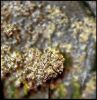
PHOE-SOL110-MF-LXT.jpgMicroscopic Vastitas - Sol 110 (Superdefinition and True Colors; credits: Dr M. Faccin & Lunexit)64 visitenessun commentoMareKromium
|
|
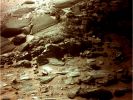
OPP-SOL1500-2.JPGVictoria's Inner Rim - Sol 1500 (True Colors; credits: Dr G. Barca)64 visitenessun commentoMareKromium
|
|
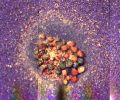
PHOE-SOL058-PIA11204.jpgUnbelievable!!!64 visiteEnnesima SCOPIAZZATURA NASA di un frame processato dal nostro Dr Faccin, addirittura 2 mesi e mezzo fa!!!
Che dire? Non hanno davvero ritegno...
Caption NASA:"This image from NASA's Phoenix Mars Lander's Optical Microscope shows a strongly magnetic surface which has scavenged particles from within the microscope enclosure before a sample delivery from the lander's Robotic Arm. The particles correspond to the larger grains seen in fine orange material that makes up most of the soil at the Phoenix site. They vary in color, but are of similar size, about one-tenth of a millimeter.
As the microscope's sample wheel moved during operation, these particles also shifted, clearing a thin layer of the finer orange particles that have also been collected. Together with the previous image, this shows that the larger grains are much more magnetic than the fine orange particles with a much larger volume of the grains being collected by the magnet. The image is 2 milimeters across.
It is speculated that the orange material particles are a weathering product from the larger grains, with the weathering process both causing a color change and a loss of magnetism".
Nota Lunexit: l'Imperial College di Londra, dopo aver esaminato (usando le nostre Funzioni Statistiche) la lista delle Università che si collegano con Lunar Explorer Italia, risulta essere un "aficionado" della nostra Fondazione!
Ok, è un onore. Ma dire "Grazie" al Dr Faccin ed a Lunexit sarebbe stato MOLTO EDUCATO ed APPREZZATO.
Che altro aggiungere? Anche gli Inglesi, a quanto pare, hanno imparato che "rubacchiare" è più facile che creare...MareKromium
|
|

OPP-SOL1666-1P276097767EFF90__P2357R2M1.jpgFarewell Victoria! - Sol 1666 (possible True Colors; credits: Lunexit)64 visitenessun commentoMareKromium
|
|

SOU-SOL008-pan_segment3-2.jpgDeflated Airbags and Skyline - Soles 8, 9 and 10 (Natural Colors; credits for the additional process. and color.: Dr Gianluigi Barca Lunexit Team)64 visitenessun commentoMareKromium
|
|
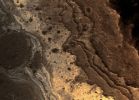
PIA11377.jpgMartian "Opal" (natural colors; credits: Lunexit)64 visiteNASA's Mars Reconnaissance Orbiter has revealed Martian rocks containing a hydrated mineral similar to Opal.
The rocks are light-toned and appear cream-colored in this natural-color image taken by the High Resolution Imaging Science Experiment (HiRISE) camera. Images acquired by the orbiter reveal that different layers of rock have different properties and chemistry.
The Opal minerals are located in distinct beds of rock outside of the large Valles Marineris Canyon System and are also found in rocks within the canyon. The presence of opal in these relatively young rocks tells scientists that water, possibly as rivers and small ponds, interacted with the surface as recently as two billion years ago, one billion years later than scientists had expected.
The discovery of this new category of minerals spread across large regions of Mars suggests that liquid water played an important role in shaping the Planet's Surface and possibly hosting life. MareKromium
|
|
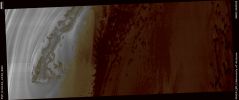
PSP_010169_2650_RED_abrowse-00.jpgDunes and other Surface Features in Chasma Boreale (ctx frame - possible True Colors; credits: Lunexit)64 visiteThis image shows dark sand dunes in Chasma Boreale. Chasma Boreale is a giant trough that cuts into the North Polar Ice Cap for about 570 Km (approx. 350 miles) forming a broad valley bordered by stacked layers of ice.
A portion of the North Polar Ice Cap is visible at the northern edge of the trough in the left portion of the image.
Many dark toned sand dunes march down the trough under the winds’ direction.
Coord.: 84,9° North Lat. and 331,8° East Long.
Spacecraft altitude: about 319 Km
M.L.T.: 13:35 (early afternoon)
Solar Incidence Angle: 67°MareKromium
|
|

Mimas-PIA10517.jpgCrescent Mimas (possible natural colors; credits: Lunexit)64 visiteCaption NASA:"Mimas's lit crescent has the appearance of a golf ball thanks to its heavily cratered surface.
This image was taken with the Cassini Spacecraft narrow-angle camera on Oct. 24, 2008 using a spectral filter sensitive to wavelengths of IR light centered at 752 nanometers.
The view was obtained at a distance of approx. 189.000 Km (such as about 117.000 miles) from Mimas and at a Phase Angle of 136°.
Image scale is about 1 Km (such as 3707 feet) per pixel".MareKromium
|
|

Venus_and_the_Moon.jpgNight Lovers'...64 visitenessun commentoMareKromium
|
|
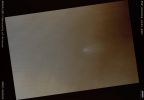
Psp_009404_2635_red.jpgSmall Crater on the NPLD (possible True Colors; credits: Lunar Explorer Italia)64 visiteMars Local Time: 14:04 (early afternoon)
Coord. (centered): 83,5° North Lat. and 346,8° East Long.
Spacecraft altitude: 317,7 Km (such as about 198,5 miles)
Original image scale range: 31,8 cm/pixel (with 1 x 1 binning) so objects ~95 cm across are resolved
Map projected scale: 25 cm/pixel
Map projection: EQUIRECTANGULAR
Emission Angle: 3,7°
Phase Angle: 57,3°
Solar Incidence Angle: 60° (meaning that the Sun is about 30° above the Local Horizon)
Solar Longitude: 105,2° (Northern Summer)
Credits: NASA/JPL/University of Arizona
Additional process. and coloring: Lunar Explorer ItaliaMareKromium
|
|

Psp_009468_2385_red.jpgCentral Peak of an Unnamed Crater in the Northern Plains (possible True Colors; credits: Lunar Explorer Italia)64 visiteMars Local Time: 15:13 (early afternoon)
Coord. (centered): 57,9° North Lat. and 58,7° East Long.
Spacecraft altitude: 310,8 Km (such as about 194,2 miles)
Original image scale range: 31,1 cm/pixel (with 1 x 1 binning) so objects ~93 cm across are resolved
Map projected scale: 25 cm/pixel
Map projection: EQUIRECTANGULAR
Emission Angle: 6,1°
Phase Angle: 42,5°
Solar Incidence Angle: 48° (meaning that the Sun is about 42° above the Local Horizon)
Solar Longitude: 107,4° (Northern Summer)
Credits: NASA/JPL/University of Arizona
Additional process. and coloring: Lunar Explorer ItaliaMareKromium
|
|
| 25353 immagini su 2113 pagina(e) |
 |
|
|
|
|
1046 | |
|
|
|
|





