| Piú viste |

Prometheus~0.jpgThe "Rise" of Prometheus...65 visiteCaption NASA:"What is that dark streak below Prometheus? Although it may look like a shadow or a trail blazed by sweeping up material, computer simulations indicate that the dark streak is better understood as an empty path pulled away by the gravity of Saturn's small moon. The particles don't follow Prometheus so much as glide sideways past where Prometheus used to be. One dark Streamer is created during each pass of Prometheus through the F-Ring that it shepherds.
The Streamers were unpredicted and first discovered in 2004 on HR images taken by the Cassini Spacecraft orbiting Saturn.
Close inspection of the Surface of Prometheus itself in the above image shows interesting structure and craters.
The Cassini Spacecraft arrived at Saturn in 2004 and, as it continues to function well, is now expected to continue to send back data and images from the distant ringed world until 2017".MareKromium
|
|

OPP-SOL2452-1F345867992EFFB0J3P1212L0M1.jpgOn the Edge... - Sol 2452 (Natural Colors; credits for the additional process. and color.: Dr Paolo C. Fienga - Lunexit Team)65 visitenessun commentoMareKromium
|
|

Dust_Devils_Tracks-Noachis_Terra-PCF-LXTT.jpgDust Devils Tracks in Noachis Terra (Absolute Natural Colors; credits for the additional process. and color.: Dr Paolo C. Fienga - Lunexit Team)65 visitenessun commentoMareKromium
|
|

Craters-Unnamed_Crater-TerraTyrrhena-20071108a-PCF-LXTT.jpgUnnamed Crater in Terra Tyrrhena (Natural Colors; credits for the additional process. and color.: Dr Paolo C. Fienga - Lunexit Team)65 visitenessun commentoMareKromium
|
|

PSP_006982_1745_RED_abrowse-PCF-LXTT.jpgPortion of the "Interior" of Tithonium Chasma (Absolute Natural Colors; credits for the additional process. and color.: Drr Gianluigi Barca and Paolo C. Fienga - Lunexit Team)65 visitenessun commentoMareKromium
|
|

Craters-Kaiser_Crater-PIA13835-PCF-LXTT.jpgDunefield inside Kaiser Crater (Absolute Natural Colors; credits for the additional process. and color.: Dr Paolo C. Fienga - Lunexit Team)65 visitenessun commentoMareKromium
|
|

Saturn-PIA08823~0.jpgCrescent Saturn (Natural Colors; credits: NASA/JPL/Space Science Institute)65 visiteFrom Norther than the North Pole...
Caption NASA originale:"The Cassini spacecraft gazes down at the marvelous Rings and swirling clouds of giant Saturn from above the Planet's North Pole.
Such views are possible as the spacecraft performs its "180°-transfer," a key navigation maneuver that quickly raises the inclination of Cassini's orbit and shifts the orbital ellipse around to a different side of the Planet, before quickly lowering the inclination again.
The image was taken in visible light with the Cassini spacecraft wide-angle camera on Oct. 30, 2006. Cassini was then at a distance of approx. 1,2 MKM (about 700.000 miles) from Saturn and at a Sun-Saturn-spacecraft, or phase, angle of 142°.
Image scale is roughly 67 Km (about 41 miles) per pixel".MareKromium
|
|

ZZ-Mercury-Craters-DeGas-PCF-LXTT.jpgBright-white Deposits inside Degas Crater (Absolute Natural Colors; credits for the additional process. and color: Dr Paolo C. Fienga - Lunexit Team)65 visitenessun commentoMareKromium
|
|

SOL0003-ML0000043000E1_DXXX-GB-LXTT-1.jpgJust like Turtles (n. 1)! - Sol 3 (Natural Colors; credits: NASA/JPL-Caltech; Research: Dr Gianluigi Barca - Lunexit Team/Italian Planetary Foundation)65 visiteNuovo Landing, Nuova Regione e Nuova Missione: e va bene. Ma, in fondo, guardando le "Unusually-looking Rocks of Mars" (come ama definirle la NASA), che cosa è REALMENTE cambiato? Probabilmente nulla... Grande occhio del nostro Big "G" (il Dr Gianluigi Barca) e nuove "Curiosità" da trovare e valutare. Forse, ed a ben vedere, mai nome per un "Esploratore Robotico Marziano" fu più azzeccato!MareKromium
|
|

ZZ-Mercury-Limb-PIA16398-PCF-LXTT-IPF.jpgMercurian Horizon (Absolute Natural Colors; credits for the additional process. and color.: Dr Paolo C. Fienga/Lunar Explorer Italia/Italian Planetary Foundation)65 visiteIn this image, Mercury's Cratered Surface stretches to the Horizon. Limb images with the Wide Angle Camera (WAC) have been a part of MDIS imaging campaigns since the beginning of orbital operations. A few months ago, in June 2012, NAC images of Mercury's Limb were added to the regular weekly observations, resulting in a few images each week with dramatic views of Mercury's Horizon such as seen here.
This image was acquired as part of MDIS's limb imaging campaign. Once per week, MDIS captures images of Mercury's Limb, with an emphasis on imaging the Limb of the Southern Hemisphere. These Limb images provide information about Mercury's shape and complement measurements of topography made by the Mercury Laser Altimeter (MLA) of Mercury's Northern Hemisphere.
Date acquired: July 17, 2012
Image Mission Elapsed Time (MET): 250986760
Image ID: 2215464
Instrument: Narrow Angle Camera (NAC) of the Mercury Dual Imaging System (MDIS)
Center Latitude: 30,3° South
Center Longitude: 59,4° East
Scale: the bottom of the image is approximately 300 Km (about 190 miles) in lengthMareKromium
|
|
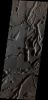
Volcanic_Features-Collapse_Pits_and_Chains-AM-PIA16647-PCF-LXTT-IPF.jpgCollapse Features on the Northern Flank of Ascraeus Mons (Absolute Natural Colors; credits for the additional process. and color.: Dr Paolo C. Fienga/Lunar Explorer Italia/Italian Planetary Foundation)65 visiteThis image was taken by the NASA - Mars Odyssey Orbiter, this time during its 47952nd Orbit, and it shows us a small fraction of the unbelievably compllicated Network of Collapse Features (Pits, Pit-Chains, Channels and Fissures) which are located on the Northern Flank of the Martian Volcano known as Ascreaus Mons (a large Shield Volcano located in the Tharsis Region of the Red Planet). Ascraeus Mons is the Northernmost and tallest of the 3 (three) Shield Volcanoes collectively known as the Tharsis Montes,being the other two huge Volcanoes known as Pavonis and Arsia Mons (if you wish to have an orbital vision of all these three fascinating Volcanoes, as well as a portion of the Noctis Labyrinthus Region of Mars, please go to Archive and refer to the APOD of February, 14th, 2012). Out of curiosity, Ascraeus Mons' location corresponds to the so-called "Classical Albedo Feature" which was known as Ascraeus Lacus.
Ascraeus Mons was actually discovered by the NASA - Mariner 9 Spacecraft in 1971. This enormous Volcano, however, was originally just called "North Spot", since it was the Northernmost of the only 4 (four) "Spots" (---> Reliefs) visible on the whole Surface of Mars which, at that time (and due to a Global Dust Storm), looked completely featureless from the orbit. As the Dust cleared, the abovementioned "Spots" were revealed to be extremely tall Shield Volcanoes whose Summits stood above the Dust-flooded, Lower Atmosphere. The Volcano's name officially became Ascraeus Mons in 1973.
Latitude: 13,6538° North
Longitude: 257,429° East
Instrument: VIS
Captured: October, 5th, 2012
This frame (which is an Original Mars Odyssey Orbiter b/w frame published on the NASA - Planetary Photojournal with the ID n. PIA 16647) has been additionally processed and then colorized in Absolute Natural Colors (such as the colors that a human eye would actually perceive if someone were onboard the NASA - Mars Odyssey Orbiter and then looked down, towards the Surface of Mars), by using an original technique created - and, in time, dramatically improved - by the Lunar Explorer Italia Team.MareKromium
|
|

SOL0151-GB-LXTT-IPF.jpgSpherules, Pebbles and "Cleansing" on the Surface of Gale Crater - Sol 151 (an Image-Mosaic in Darkened Natural Colors; credits for the additional process. and color.: Dr Gianluigi Barca/Lunar Explorer Italia/Italian Planetary Foundation)65 visitenessun commentoMareKromium
|
|
| 25353 immagini su 2113 pagina(e) |
 |
|
|
|
|
1041 | |
|
|
|
|





