| Piú viste |

Comets-Schwassmann_Wachmann_1-05.jpgComet Schwassmann-Wachmann 3, M 57 and IC 129665 visiteAs dawn approached on May 8, 2006, astronomer Stefan Seip carefully watched Fragment "C" of broken Comet 73P/Schwassmann-Wachmann 3 approach M 57 - the Ring Nebula, and faint spiral galaxy IC 1296.
Of course, even though the trio seemed to come close together in a truly cosmic photo opportunity, the comet is in the inner part of our Solar System, a mere 0,5 Light-Minutes (LM) or so from Seip's telescope located near Stuttgart, Germany, planet Earth.
The Ring Nebula (upper right) is more like 2000 LY distant, well within our own Milky Way Galaxy. At a distance of 200 MLY, IC 1296 (between the Comet and the Ring Nebula) is beyond even the Milky Way's boundaries. Because the Comet is so close, it appears to move relatively rapidly against the distant stars. This dramatic telescopic view was composited from two sets of images; one compensating for the Comet's apparent motion and one recording the background stars and nebulae.
|
|

OPP-SOL841-1F202845506EFF71HUP1151L0M1.jpgTransient Martian Phenomoena? - Sol 84165 visiteCaption originale:"Left Front HazCam Non-linearized Full frame EDR acquired on Sol 841 of Opportunity's mission to Meridiani Planum at approximately 12:54:08 MLT".
Cerchiatura Fucsia: era già accaduto in passato, accade ancora durante il Sol 841. Per motivi ancora ignoti, di quando in quando, piccole "scintille" sembrano accendersi sul suolo di Marte.
Quando questo fenomeno occorre nelle ore del tardo pomeriggio o nelle prime ore della sera, vedere queste "Martian Fireflies" nelle fotografie di Opportunity (ed anche di Spirit) è molto semplice; ma quando il fenomeno (transitorio) accade di giorno, allora bisogna essere davvero molto bravi per accorgersi dell'Anomalìa.
Qual'è l'origine di questi "lampi"? Sono solo riflessi? O sono dei minuscoli outgassing, concettualmente assimilabili ai TLP Lunari? E se così fosse, potremmo forse speculare che i mini-crateri che sembrano costellare la superficie di Meridiani Planum sono "quel che resta" dopo il Fenomeno Transitorio?...
Complimenti, come sempre, al Dr Gianluigi Barca!
|
|

Venus-South Pole-Infrared-COB_combi_38b.jpgVortex over the South Pole of Venus (infrared vision)65 visiteDuring this first orbit – called the 'capture orbit' – some of the Venus Express instruments were used to perform the first observations at different distances from Venus, for a few hours per time on six different slots between 12 and 19 April 2006.
Amazing infrared, visible and ultraviolet images of the Venusian globe already reveal several atmospheric features of great interest.
The most striking of these is a huge, double-eye atmospheric vortex over the South Pole, not dissimilar from the equivalent structure present at the North Pole – the only one previously studied in some detail.
Only glimpses of the stormy atmospheric behaviour at the south pole were obtained by previous missions (Pioneer Venus and Mariner 10), but such a double-eye structure was never clearly seen before now.
This composite image shows six infrared views of Venus as seen by the Ultraviolet/Visible/Near-Infrared spectrometer (VIRTIS) on board ESA’s Venus Express spacecraft between 12 and 19 April 2006, during the first orbit, or ‘capture orbit’, around the planet.
The images (taken at 5 microns) were obtained at six different time slots and at different distances from Venus (top left: 12 April, from 210 000 kilometres; centre left: 13 April, from 280 000 kilometres; bottom left: 14 April, from 315 000 kilometres; top right: 16 April, from 315 000 kilometres; centre right: 17 April, from 270 000 kilometres; bottom right: 19 April, from 190 000 kilometres), while the spacecraft moved along a long ellipse around the planet.
The infrared radiation coming from Venus was converted in this reddish colour scheme. Thermal radiation comes from the lower atmosphere, (just above the cloud top, located at about 60 kilometres altitude). Solar radiation reflected by the upper atmospheric layers (roughly between 60 and 80 kilometres altitude) and thermal radiation from the layers below contribute to the brightest part of the image.
The south polar vortex structure is visible from different view points close to the centre of the images, mostly in the dark side.
|
|

vo1_058a02.jpgVery thin and bright "Water-Ice" Clouds65 visitenessun commento
|
|

vo2_304b88.jpgPhobos over Tharsis65 visitenessun commento
|
|

White Dwarf Stars.jpgWhite Dwarf Stars...In the Milky Way65 visiteLa Corea del Sud, che è la terza economia dell’Asia, esporta in Cina il 40 % delle sue produzioni. Taiwan, altrettanto.
L’Australia è la maggior fornitrice di materie prime e carbone alla Cina, suo secondo o terzo acquirente: colerà a picco con il gigantesco cliente asiatico.
E anche noi non avremo da ridere.
A chi venderemo le nostre carabattole firmate?
Il superfluo del superfluo?
Naturalmente c’era una cosa che la nomenklatura gialla poteva e doveva fare per scongiurare il disastro: aumentare le paghe alla pari con la crescita del PIL, mettere più soldi in tasca ai suoi centinaia di milioni di lavoratori poverissimi, creare così un mercato di consumo interno decentemente vasto.
Non l’ha fatto: ha voluto sfruttare fino in fondo il vantaggio comparativo per cui è celebre
sul pianeta, i salari da 60 euro al mese.
Vecchi, idioti comunisti che vogliono fare i primi della classe del capitalismo.
Ma è inutile insultare loro: Prodi, Visco e Padoa Schioppa stanno facendo lo stesso a noi.
Anche il nostro potere d’acquisto cala e cala vistosamente.
Anche da noi accolgono milioni di nuovi immigrati, che si contentano di paghe basse.
Perché sperano così di renderci competitivi nell’export.
Ma quale export?
Arrivano i tempi dell’autarchia di necessità e loro, sempre in ritardo intellettuale, manco se ne accorgono.
Maurizio Blondet
|
|

South Polar Spring-PIA08660.jpgSpring at the South Pole of Mars65 visiteSand-laden jets shoot into the Polar Sky in this view by noted space artist Ron Miller. It shows the Martian South Polar "Ice Cap" as Southern Spring begins.
|
|
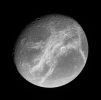
Dione-PIA08256.jpgThe "White (and Bright) Cliffs" of Dione (context image)65 visiteCaption NASA:"This splendid view showcases Dione's tortured complex of bright cliffs. At lower right is the feature called Cassandra, exhibiting linear rays extending in multiple directions.
This is the Trailing Hemisphere of Dione; North is up.
The image was taken in polarized green light with the Cassini spacecraft narrow-angle camera on July 24, 2006 at a distance of approx. 263.000 Km (about 163.000 miles) from Dione. Image scale is roughly 2 Km (such a little more than 1 mile) per pixel".
|
|

Enceladus-N00065810.jpgEnceladus (HR)65 visiteUna bellissima immagine ad elevata risoluzione di Encelado, la "Luna di Neve", come la NASA stessa l'ha battezzata.
Siamo ad 'appena' 221.000 Km (circa) di distanza, e le "fontane" che dovrebbero rendere questo piccolo mondo un mondo unico nel suo genere, non si vedono. Come mai?
Ebbene, anche al tempo del transito (pure ravvicinato) della Sonda Voyager 1, Encelado non mostrò le sue "fontane" a noi Terrestri e quindi la domanda di cui sopra appare più che legittima.
Ebbene, c'è chi pensa - come Lunar Explorer - che le "Fontane di Encelado" sìano un fenomeno oltremodo recente e legato - inter alia - ad un "riscaldamento" della superficie di questo piccolo mondo il quale potrebbe essere stato causato, p.e., da un aumento di radiazioni provenienti dal Sole (!) o da Saturno stesso (!!).
C'è invece chi pensa che i geysers sud-polari di Encelado sìano un fenomeno meramente "stagionale" e quindi legato a determinati "momenti" orbitali di Encelado (e cioè: quando Encelado è più vicino a Saturno - ergo ai suoi influssi mareali - esso diventa "attivo" - con ciò deducendosi che sono gli influssi gravitazionali ad "accendere", letteralmente, i geysers sud-polari della piccola luna; d'altro canto, quando Encelado si allontana dal Gigante Anellato, gli influssi mareali di Saturno "perdono vigore" ed il fenomeno dei geysers si spegne).
Esiste, infine, anche una terza possibilità: la visibilità delle "Fontane di Encelado" è definita dall'angolo di fase (l'angolo descritto da Sole-Corpo Celeste Osservato e Cassini) il che significa, molto semplicemente, che queste Fontane si vedono solo quando Encelado è fotografato in particolari condizioni, dal punto di vista di chi fotografa e che il fenomeno delle "Fontane" in sè potrebbe anche essere costante e continuativo.
|
|

502-PIA01515.jpgGanymede (natural colors and HR)65 visiteCaption NASA originale:"This color picture was acquired by Voyager 1 during its approach to Ganymede. At ranges between about 230 to 250.000 Km. The images show detail on the surface with a resolution of 4,5 Km/px. This picture is relevant to a region in the Northern Hemisphere, near the terminator. It shows a variety of impact structures, including both razed and unrazed craters, and the odd, groove-like structures discovered by Voyager in the lighter regions. The most striking features are the bright ray craters which have a distinctly 'bluer' color appearing white against the redder background. Ganymede's surface is known to contain large amounts of surface ice and it appears that these relatively young craters have spread bright fresh ice materials over the surface. Likewise, the lighter color and reflectivity of the grooved areas suggests that here, too, there is cleaner ice".
|
|

OPP-SOL281-b_sol281_L_flows.jpgHematite's dust flows over Endurance - Sol 281 (false colors; credits: Dr Jill England)65 visitenessun commento
|
|

APOLLO 12 AS 12-47-6986HR.jpgAS 12-47-6986 (HR)65 visite
|
|
| 25353 immagini su 2113 pagina(e) |
 |
|
|
|
|
1034 | |
|
|
|
|





