| Piú viste |
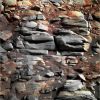
SOL1788-2.JPGRockland! - Sol 1788 (False Colors; credits: Dr G. Barca)65 visitenessun commentoMareKromium
|
|

NGC-2818.jpgNGC 2818 - Planetary Nebula65 visite"...Sapientia aedificabitur domus, et Prudentia roburabitur..."
(Salomone, prov.: 24, 3)
"...La Saggezza costruisce la casa e la Prudenza la rende forte..."MareKromium
|
|
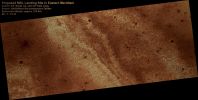
PSP_003326_1800_RED_browse.jpgProposed MSL Landing Site in Eastern Meridiani (possible True Colors; credits: Lunar Explorer Italia)65 visitenessun commentoMareKromium
|
|
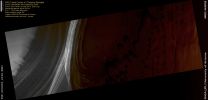
PSP_009905_2650_RED.jpgNorth Polar Layered Deposits (NPLD) and Dunes in Chasma Boreale (natural colors; credits: Lunexit)65 visiteThis image shows a steep, layered slope and flatter, dune-covered plains in Mars’ North Polar Region. The layers are composed of varying contents of water ice and dust.
On Earth, icy layers like these in Greenland and Antarctica are important because they contain a record of past climate conditions. By looking at the detailed sequence of Polar Layers on Mars, scientists hope to be able to discover the types of variations that Mars’ climate may have experienced.
The lowest section in the stack of light layers is noticeably darker because of the presence of dark, sandy material. Erosion of this dark material is thought to provide the sand making up the large dunes on the plains.
Several exceptionally well-developed barchan (crescent-shaped) dune forms up to approximately 50 meters (160 feet) across are present in the center of the image.MareKromium
|
|

Atlas-N00084627.jpgAtlas (by Dr M. Faccin)65 visitenessun commentoMareKromium
|
|

Enceladus-N00048288.jpgEnceladus (RAW Natural Colors; credits: Dr M. Faccin)65 visitenessun commentoMareKromium
|
|

SOL735-GB-LXT.jpgVolcanic Feature? - Sol 735 (Natural Colors; credits: Dr G. Barca & Lunar Explorer Italia)65 visitenessun commentoMareKromium
|
|

OPP-SOL005-1N128623968EFF0205P1549L0M1.jpgEagle Crater Panorama (1) - Sol 5 (Natural Colors; credits: Lunar Explorer Italia)65 visiteNon meravigliateVi per il tipo di colorizzazione che abbiamo ottenuto: è genuino (nel senso che non abbiamo "toccato" i parametri standard della colorizzazione made by Lunexit).
Il punto è che le primissime immagine in arrivo da Meridiani Planum, quale che sia il processing di colorizzazione da noi utilizzato (MULTISPECTRUM; Natural Colors; possible True Colors etc.), confermano sempre queste caratteristiche cromatiche dell'ambiente: la superficie è color rosso acceso ed il cielo biancastro, con riflessi azzurri e rossi (verso l'orizzonte).
La nostra opinione è che questo tipo di colore (comunque non surreale, anzi...) dipenda sia dal fatto che gli obbiettivi delle camere di Opportunity erano nuovi e pulitissimi, sia dal fatto che la calibrazione effettuata a Terra - ma sulla Scala dei Grigi - era ancora imperfetta.
Ci è difficile dire, comunque, se sia più "vero" questo color rosso scuro, con punte marroni, dei primi Soles, oppure l'arancio-giallo, con note ora verdastre ed ora marroni, degli ultimi.MareKromium
|
|
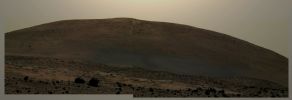
SOL1081-PANORAMIC2-GB-LXT.jpgHusband Hill and El Dorado Dunefield - Sol 1081 (Panoramic - Natural Colors; credits: Dr G. Barca & Lunar Explorer Italia)65 visitenessun commentoMareKromium
|
|

SOL626-GIF-GP.gifBetween Day and Night... - Sol 626-631 (GIF-Movie; credits: Giorgio Picciau)65 visiteUn interessantissimo GIF-Movie realizzato dal nostro Amico e Partner, Giorgio Picciau, il quale ci mostra (a condizione che osserviate il filmato con la MASSIMA attenzione!) delle possibili e minime - ma non per questo scarsamentre significative - alterazioni digitali (tampering).
Le Yellow Bars aggiunte da Giorgio Vi saranno di uteriore aiuto per cogliere delle leggere (e non agevolmente spiegabili) variazioni del contesto ripreso.
ATTENZIONE: onde non essere fraintesi, ribadiamo che non stiamo parlando di un SICURO Image Tampering, ma solo di una POSSIBILE alterazione (ed infatti l'eventualità che le citate variazioni di contesto - che qualifichiamo come "minime" - possano essere attribuite sia ad un modestissimo cambio delle condizioni superficiali esterne - Tau + lighting conditions -, sia ad un fattore generico di disturbo del segnale nella trasmissione dei dati da Marte a Terra - noise + data loss - non è eliminabile).
Ed in ogni caso...Complimenti a Giorgio Picciau per l'Occhio e la Pazienza!MareKromium
|
|

SOL336-2N156199649EFF9946P1579L0M1.jpgUp-Sun - Sol 336 (Natural Colors; credits: Lunar Explorer Italia)65 visitenessun commentoMareKromium
|
|
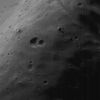
Phobos-PIA01336.jpgHigh-Resolution MOC Image of Phobos' Face65 visiteThis image of Phobos, the inner and larger of the two moons of Mars, was taken by the Mars Global Surveyor on August 19, 1998. The minimum distance between the Spacecraft and Phobos was 1080 Km (about 671 miles).
Phobos was observed by both the Mars Orbiter Camera (MOC) and Thermal Emission Spectrometer (TES). This image is one of the highest resolution images (4 meters or 13 feet per picture element or pixel) ever obtained of the Martian satellite.
The image shows several new features of this lumpy moon -- features that are associated with the prominent crater seen in the upper left quarter of the image. This is the largest crater on Phobos, Stickney, 10 Km (about 6 miles) in diameter. Individual boulders are visible on the near rim of the crater (D), and are presumed to be ejecta blocks from the impact that formed Stickney. Some of these boulders are enormous - more than 50 meters (160 feet) across.
Also crossing at and near the rim of Stickney are shallow, elongated depressions called grooves. This crater is nearly half the size of Phobos and these grooves may be fractures caused by its formation. The far wall of the crater shows lighter and darker streaks going down the slopes (C). The presence of material of different brightness on the far crater slopes and in some of the grooves shows that the satellite is heterogeneous (that is, it is made of a mixture of different types of materials). The motion of debris down slopes is guided by gravity, which is only about 1/1000th that of the Earth -- e.g., a 68-Kg (150- pound) person would weigh only about 57 gr (2 ounces) on Phobos.
Previous images from the Viking Spacecraft in the 1970's were not of sufficient resolution to show the effectiveness of gravity on Phobos in moving material down slopes.MareKromium
|
|
| 25353 immagini su 2113 pagina(e) |
 |
|
|
|
|
1030 | |
|
|
|
|





