| Piú viste |
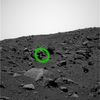
SOL558-2P175899388EFFAD80P2355R1M1.jpgBoulders Panorama - Sol 558 (3)65 visiteCerchiatura verde: ci dispiace molto per la NASA, per il Centro Controllo Missione e per l'Imaging Team, ma una struttura come quella visibile in questo frame e debitamente cerchiata NON ESISTE in Natura.
Essa è il frutto (malato ed evidente) di una sovrapposizione di panorami - o dell'apposizione di un "patch" (una tecnica di tempering delle immagini che risale agli Anni '60...) - il quale ha creato una situazione prospettica (semplicemente) impossibile.
|
|

Amalthea-PIA07248_modest.jpgAmalthea: just an "Ice Cube"!65 visiteThese images of Jupiter's moon Amalthea were taken with NASA's Galileo and Voyager spacecraft. Recent findings show that Amalthea is almost pure water ice, hinting that it may not have formed where it now orbits! This information challenges long-held theories about how moons form around giant planets. The image on the left shows the Escape Velocities (EV) color-coded on a shape model of Amalthea with the same viewpoint as the Voyager spacecraft image in the middle panel. Blue represents the lowest EV, barely 1 mt/second (about 3 feet) near the anti-Jupiter end, while red (barely visible) shows the region of much higher EV, nearly 90 mt/second (295 feet). The low EV result from the low density of Amalthea and from its rapid rotation as it orbits Jupiter.
The middle image is a composite from both Galileo and NASA's Voyager spacecraft and shows Amalthea from the anti-Jupiter side. The visible area is about 150 Km (about 93 miles) across.
The Sun is behind the spacecraft, resulting in loss of visible shadows. The brighter markings on the ends of a ridge are prominent in this view.
On the right is a Galileo image of Amalthea, (see PIA02532), with the bright spots on the end of Amalthea seen from the leading side of the satellite. Here the Sun is to the left and topography, such as the impact crater at the right, is visible.
Amalthea is Jupiter's fifth largest moon. It orbits about 181,000 kilometers (112,468 miles) from Jupiter, considerably closer than the Moon orbits Earth. It measures about 168 miles in length and half that in width. Galileo passed within about 99 miles of the moon on Nov. 5, 2002. After more than 30 close encounters with Jupiter's four largest moons, the Amalthea flyby was the last moon flyby for Galileo. The mission began orbiting the planet in 1995.
|
|
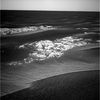
OPP-SOL550-1N177012103EFF58D4P1786R0M1.jpgOutcrops or Paving? (2) - Sol 55065 visite...piccole, disposte "ordinatamente" intorno alle rocce maggiori, così da formare delle strutture che, in più di una occasione, ricordano delle vere e proprie costruzioni (tane o qualcosa di simile).
Comunque sia, la nostra impressione - supportata da questi semplci dati di fatto - è che queste particolari strutture che vediamo affiorare dalle sabbie di Meridiani NON siano degli outcrops (almeno nel senso più tipico dell'espressione).
E di che cosa si tratta allora?
A nostro avviso ci troviamo davanti (anzi: sopra) ad una superficie che ha subito, ere ed ere fa, una profonda "elaborazione-trasformazione".
Le cause di questa profonda "metamorfosi" potrebbero essere ricondotte sia ad eventi vulcanici - ma non ci sono vulcani in zona... -, sia ad eventi elettrici di incalcolabile magnitudo (superfulmini). Purtroppo non siamo in grado di scendere in ulteriori dettagli, ma contiamo di tornare su questo argomento in un prossimo futuro (specialmente se la NASA rilascerà più informazioni sulla composizione...
|
|

SOU-SOL008-81432_full.jpg"Monster-Pan" in 3-D (4) - Sol 865 visitenessun commento
|
|

SOU-SOL008-81443_full.jpg"Monster-Pan" in 3-D (15) - Sol 865 visitenessun commento
|
|
SOL642-2P183361950EFFAI38P2390R1M1.jpgLooking down (5) - Sol 64265 visitenessun commento
|
|

Titan-Regions-Shangri_La_and_Xanadu_Region-PIA07752.jpgThe "New World": Shangri-La and Xanadu Region65 visiteOriginal caption:"This mosaic is a HR close-up of two contrasting Regions: dark Shangri-La and bright Xanadu. This view has a resolution of 1 Km (such as 0,6 mile) per pixel and is centered at 2,5° North Lat. and 145° West Long., near the feature called Santorini Facula.
The mosaic is composed of 10 images obtained on Oct. 28, 2005, each processed to enhance surface detail. It is an orthographic projection, rotated so that North on Titan is up".
|
|
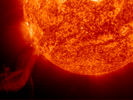
SunFlame-Soho.jpgSolar Prominence65 visiteCaption NASA originale:"What happened to the Sun? Nothing very unusual: the strange-looking solar appendage on the lower left is actually just a spectacular looking version of a common solar prominence. A solar prominence is a cloud of solar gas held above the Sun's surface by the Sun's magnetic field. Pictured above in 2002 October, NASA's Sun-orbiting SOHO spacecraft imaged an impressively large prominence hovering over the surface, informally dubbed a flame. Over 40 Earths could line up along the vast length of the fireless flame of hovering hot gas. A quiescent prominence typically lasts about a month, and may erupt in a Coronal Mass Ejection (CME) expelling hot gas into the Solar System. Although somehow related to the Sun's changing magnetic field, the energy mechanism that creates and sustains a Solar prominence is still a topic of research".
|
|

SOL660-2P184960846EFFAJB1P2400L7M1~1.jpgRocky Panorama (5) 3D and detail mgnf - Sol 66065 visiteEd ora, grazie al Dr Feltri, la versione ingrandita e tridimensionale del dettaglio "inquietante": la roccia che si trova dietro ai due macigni in primo piano sembra davvero avere due "occhi"...
|
|

Japetus-N00043073.jpgJapetus...in a very unusual "look"!65 visiteOriginal caption:"N00043073.jpg was taken on November 03, 2005 and received on Earth November 05, 2005. The camera was pointing toward Japetus at approximately 1.617.411 kilometers away, and the image was taken using the CL1 and CL2 filters. This image has not been validated or calibrated".
|
|
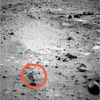
SOL670-2N185848368EFFAJPTP0765L0M1.jpgHumphrey strikes back! - Sol 67065 visitenessun commento
|
|

Prometheus-PIA07653.jpgThe Runners in the Ring: Prometheus and Pandora65 visiteThis spectacular image shows Prometheus (at left) and Pandora (at right), with their flock of icy ring particles (the F-Ring) between them. Pandora is exterior to the Ring, and closer to the spacecraft here. Each of the shepherd satellites has an unusual shape, with a few craters clearly visible.
The effect of Prometheus (about 102 Km across) on the F-Ring is visible as it pulls material out of the Ring when it is farthest from Saturn in its orbit. Pandora is about 84 Km across.
The image was taken in polarized green light with the Cassini spacecraft narrow-angle camera on Oct. 29, 2005, at a distance of approx. 459.000 Km (about 285.000 miles) from Pandora and 483.500 Km (roughly 300.500 miles) from Prometheus. The image scale is 3 Km (about 2 miles) per pixel on Pandora and 3 Km (idem) per pixel on Prometheus. The view was acquired from about 1/3 of 1° below the Ring-Plane.
|
|
| 25353 immagini su 2113 pagina(e) |
 |
|
|
|
|
1027 | |
|
|
|
|





