| Piú viste |

M-031-GB2.JPGM-31: The "Andromeda Galaxy" (Spiral Galaxy in Andromeda)65 visiteMareKromium
|
|
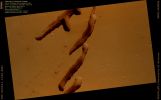
PSP_009913_1910_RED_abrowse-00.jpgFissures in Cerberus Fossae (natural colors; credits: Lunexit)65 visiteThis image shows an example of “en echelon” fractures in the Cerberus Fossae Region.
These fractures formed tectonically, meaning by the movement of Mars’ crust.
En "echelon" means that the fractures are laterally displaced from each other in a way consistent with the lateral displacement of other fractures in the same area.MareKromium
|
|

PSP_009488_1745_RED_abrowse-02.jpgMartian Caves (edm n. 2 - possible natural colors; credits: Lunexit)65 visiteThe ability to detect and explore Martian caves is of intense interest to many disciplines in Planetary Science. Caves, in fact, may expose entire sets of stratigraphic layers, providing windows into Mars’ Geologic and Atmospheric histories.
MareKromium
|
|

OPP-SOL1687-MF.JPGThe Dunes of Meridiani - Sol 1687 (Sharp-colored Version; credits: Dr M. Faccin)65 visitenessun commentoMareKromium
|
|

PSP_009929_2020_RED_abrowse-01.jpgAncient Layered Rocks in Nili Fossae (edm - natural colors; credits: Lunexit)65 visiteBright, fractured Bedrock is visible underlying Dunes or Ripples of Wind-Blown Sand.
The parallel, dark brown curves across the Bedrock Surface (underneath the Dunes) that can be seen in this edm frame, are the edges of successive rock layers.
These may appear dark because dark sand has become trapped at the edges of the layers. Successive layers in the bedrock are also exposed in the walls of degraded impact craters elsewhere in the ctx image.
The Layered Rocks here are billions of years old, and infrared spectra from the CRISM instrument have inferred that they contain minerals such as Clays and Carbonate that likely formed when liquid water chemically altered these rocks.
This evidence for past water activity, combined with the general flatness of this particular location, make it a good candidate Landing Site for future Mars Rover missions.MareKromium
|
|
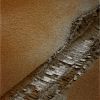
OPP-SOL497-1.jpgRover Tracks - Sol 497 (possible True Colors; credits: Dr G. Barca)65 visitenessun commentoMareKromium
|
|
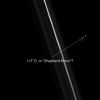
The_Rings-N00124204.jpgAnother UFO in the Space of Saturn?65 visiteCaption NASA:"N00124204.jpg was taken on November 16, 2008 and received on Earth November 17, 2008. The camera was pointing toward SATURN-RINGS that, at the time, were approx. 383.855 Km away, and the image was taken using the CL1 and CL2 filters. This image has not been validated or calibrated". MareKromium
|
|
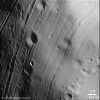
PHOBOS-Image024-417-20081008-5889-6-src-03-PhobosSeries_H1.jpgThe Surface of Phobos: the "Striations"65 visiteThis image of Phobos’s surface was obtained by the Super Resolution Channel (or SRC, a part of the High Resolution Stereo Camera experiment) on board ESA’s Mars Express on 3 August 2008 (orbit 5889).
The distance from the moon’s centre was approx. 656 Km, and the image resolution is 6 mt/pixel. The original image has been corrected for mirror distortion.MareKromium
|
|

Hellas_Basin.jpgHellas Basin65 visiteCaption NASA:"What created this unusual terrain on Mars?
The floors of several Mid-Latitude craters in Hellas Basin on Mars appear unusually grooved, flat, and shallow. New radar images from the Mars Reconnaissance Orbiter bolster an exciting hypothesis: huge glaciers of buried ice. Evidence indicates that such glaciers cover an area larger than a city and extend as much as a kilometer deep.
The ice would have been kept from evaporating into the thin Martian air by a covering of dirt. If true, this would indicate the largest volume of water ice outside of the Martian Poles, much larger than the frozen puddles recently discovered by the Phoenix Lander.
Such lake-sized ice blocks located so close to the Martian Equator might make a good drinking reservoir for future astronauts exploring Mars.
How the glaciers originally formed remains a mystery" (...).
Nota Lunexit: ATTENZIONE! Questa immagine - per bella e dettagliata che sembri o che sia - NON E' UNA FOTOGRAFIA! Essa è il risultato finale di un complesso mix di immagini reali le quali sono state riprese ed assemblate e quindi riprocessate digitalmente (vedasi, per maggiori informazioni, il "Solar System Visualization Project"). Un'opera fantastica e meritoria ed un risultato indubbiamente suggestivo ma...Questa immagine NON E' rappresentativa di una realtà specifica.
Essa è solo la ricostruzione digitale di una realtà specifica (il Bacino di Hellas), il che non è esattamente la stessa cosa...MareKromium
|
|

OPP-SOL1717-6.jpgThe Beautiful "Martian Paving" - Sol 1717 (possible True Colors; credits: Dr G. Barca & Lunexit)65 visitenessun commentoMareKromium
|
|
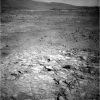
SOL1763-2N282881994EFFAZ25P1918R0M1-BW.jpgUnbelievable "Pseudo-Balance" - Sol 1763 (RAW frame)65 visiteIl dettaglio controverso (che, se ricordate bene - e se avete presenti i frames Spirit degli ultimi mesi -, avevamo già incontrato e notato, sebbene osservandolo da un'angolazione sostanzialmente diversa, da parecchio tempo) è talmente evidente che non abbiamo ritenuto necessaria la cerchiatura o la freccia: esso è lì, davanti a Voi, non potete non vederlo.
Domanda: di che cosa si tratta?
Di un "tombino" rimasto aperto? O forse di un cartello segnaletico abbandonato, qualche era fa, nel bacino di Gusev da parte di un automobilista marziano disattento?
E' un'espressione bizzarra - MOLTO bizzarra - della Natura?
O forse si tratta di un segno palese di immagine "taroccata" (male)?
O è il risultato di una definizione penosa del frame?
La verità è sfuggevole, si sa. Ed in casi come questi essa, se non altro a nostro parere, è irraggiungibile. Certo, un minimo di speculazione può anche essere azzardata, ma...a che pro?
Ripetiamo il dettaglio è chiaro: si tratta di una roccia di forma triangolare.
Una sorta di lastra, piuttosto sottile - con qualche "bozzo" quì e lì e dalla forma leggermente bombata (se non altro in questo frame) -, a forma di triangolo isoscele (o magari anche equilatero...) che, appena inclinata, poggia al suolo sul suo lato dimensionalmente più piccolo: se il triangolo è isoscele (come a noi pare), allora diciamo che poggia al suolo sulla sua base.
E che cosa c'è di strano in questo? Beh, a parte la forma dell'oggetto (che da sola "vale il prezzo del biglietto"), diremmo che ci troviamo davanti ad un caso piuttosto palese di "Pseudo-Equilibrio" (osservate infatti l'ombra che questa "roccia" proietta al suolo: essa è la prova incontestabile che l'oggetto non solo è sollevato rispetto alla pavimentazione a cui accede, ma che esso è pure, come potete constatare anche Voi, capace di mantenersi stabilmente in equilibrio pur non avendo dei - visibili - punti di appoggio!).MareKromium
|
|
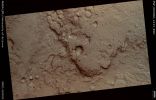
PSP_009960_2235_RED.jpgInverted Channel with Phyllosilicates (possible True Colors; credits: Lunar Explorer Italia)65 visiteMars Local Time: 15:26 (early afternoon)
Coord. (centered): 43,4° South Lat. and 309,2° East Long.
Spacecraft altitude: 303,5 Km (such as about 189,7 miles)
Original image scale range: 60,7 cm/pixel (with 1 x 1 binning) so objects ~1,82 mt across are resolved
Map projected scale: 50 cm/pixel
Map projection: EQUIRECTANGULAR
Emission Angle: 6,6°
Phase Angle: 42,0°
Solar Incidence Angle: 48° (meaning that the Sun is about 42° above the Local Horizon)
Solar Longitude: 125,2° (Northern Summer)
Credits: NASA/JPL/University of Arizona
Additional process. and coloring: Lunar Explorer ItaliaMareKromium
|
|
| 25353 immagini su 2113 pagina(e) |
 |
|
|
|
|
1019 | |
|
|
|
|





