| Piú viste |

Europa-V2-PIA00459.jpgEuropa from Voyager 2 - the closest approach65 visiteCaption NASA originale:"This color image of the Jovian moon Europa was acquired by Voyager 2 during its close encounter on Monday morning, July 9, 1979. Europa, the size of our Moon, is thought to have a crust of ice perhaps 100 kilometers thick which overlies the silicate crust. The complex array of streaks indicate that the crust has been fractured and filled by materials from the interior. The lack of relief, any visible mountains or craters, on its bright limb is consistent with a thick ice crust hypothesis".
|
|

Europa-Lineae-Agenor_Linea-HR-PIA01646.jpgThe "Agenor Linea" on Europa (detail mgnf + HR)65 visiteAgenor Linea is an unusual feature on Jupiter's icy moon Europa since it is brighter than its surroundings while most of Europa's ridges and bands are relatively dark. During the Galileo spacecraft's 17th orbit of Jupiter, high resolution images were obtained of Agenor Linea near Europa's day/night boundary so as to emphasize fine surface details. This mosaic shows high resolution images embedded in slightly lower resolution images which were also acquired during the 17th orbit. The Galileo images show that Agenoris not a ridge, but is relatively flat. Its interior consists of several long bands, just one of which is the very bright feature known as Agenor. Each long band shows fine striations along its length. A few very small craters pockmark Agenor Linea and its surroundings. Agenor is cut by some narrow fractures, and by some small subcircular features called lenticulae. Rough chaotic terrain is visible at the top and bottom of this photo, and appears to be "eating away" at the edges of Agenor. Though previously it was suspected that Agenor Linea might be one of the youngest features on Europa, this new view shows that it is probably not.
North is to the upper right of the picture and the sun illuminates the surface from the east. The image, centered at 44 degrees south latitude and 219 degrees west longitude, covers an area approximately 130 by 95 kilometers (80 by 60 miles). The highest resolution images were obtained at a resolution of about 50 meters (165 feet) per picture element and are shown here in context at about 220 meters per picture element. The images were taken on September 26th, 1998 at ranges as close as 5000 kilometers (3100 miles) by the Solid State Imaging (SSI) system on NASA's Galileo spacecraft.
|
|
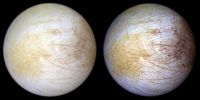
Europa-PIA01295.jpgEuropa in natural colors (Sn) and enhanced colors (Dx)65 visiteThis color composite view combines violet, green, and infrared images of Jupiter's intriguing moon, Europa, for a view of the moon in natural color (left) and in enhanced color designed to bring out subtle color differences in the surface (right). The bright white and bluish part of Europa's surface is composed mostly of water ice, with very few non-ice materials. In contrast, the brownish mottled regions on the right side of the image may be covered by hydrated salts and an unknown red component. The yellowish mottled terrain on the left side of the image is caused by some other unknown component. Long, dark lines are fractures in the crust, some of which are more than 3,000 kilometers (1,850 miles) long.
North is to the top of the picture and the sun fully illuminates the surface. Europa is about 3,160 kilometers (1,950 miles) in diameter, or about the size of Earth's moon. The finest details that can be discerned are 25 kilometers across. The images in this global view were taken in June 1997 at a range of 1.25 million kilometers by the Solid State Imaging (SSI) system on NASA's Galileo spacecraft, during its ninth orbit of Jupiter.
|
|

ZA-Neptune_s Rings-PIA01997_modest.jpgThe Rings of Neptune (full system) 165 visiteCaption NASA originale:"These two 591-second exposures of the rings of Neptune were taken with the clear filter by the Voyager 2 wide-angle camera on Aug. 26, 1989 from a distance of 280.000 Km (175.000 miles). The 2 main rings are clearly visible and appear complete over the region imaged. The time between exposures was 1 hour and 27 minutes. [During this period the bright ring arcs in the outer bright ring were not visible in either picture (they were unfortunately on the opposite side of the planet for each exposure).] Also visible in this image is the inner faint ring at about 42.000 km (25.000 miles) from the center of Neptune and the faint band which extends smoothly from the 53.000 Km (33.000 miles) ring to roughly halfway between the 2 bright rings".
|
|

Callisto-Asgard emi.-Gal-PIA00562_modest.jpgThe "Asgard" hemisphere of Callisto (detail mgnf)65 visiteCaption NASA originale:"...Dominating the scene is the impact structure, Asgard, centered on the smooth, bright region near the middle of the picture and surrounded by concentric rings up to 1.700 kilometers in diameter. A second ringed structure with a diameter of about 500 kilometers can be seen to the north of Asgard, partially obscured by the more recent, bright-rayed crater, Burr. The icy materials excavated by the younger craters contrast sharply with the darker and redder coatings on older surfaces of this Moon..."
|
|

Neptune-South_Hem-V2-PIA00050_modest.jpgThe Southern Polar Region of Neptune from approx. 4.200.000 Km65 visiteGli Scienziati, analizzando le immagini fornite dalla Sonda Voyager 2, si sono convinti che il sistema atmosferico di Nettuno sia molto simile a quello di Giove: queste grandi formazioni nuvolose bianche riprese dalle fotocamere della Sonda si formano, al pari dei venti che le sospingono, nelle zone equatoriali del Pianeta. Poi, spostandosi verso Sud, questi venti diventano sempre più veloci e violenti. Un sistema configurato in maniera interessante ma, probabilmente, piuttosto instabile.
|
|

NGC-0247-PIA04922_modest.jpgNGC 247 - Irregular Galaxy65 visite"...Under the stars, the lonely figure walked homeward across a nameless land. Behind him, the river flowed softly to the sea, winding through the fertile plains on which, more than a thousand centuries ahead, Yaan's descendants would build the Great City they were to call Babylon..."
Arrthur C. Clarke - "Encounter in the Dawn"
|
|

Sun & Comet (2).jpgA comet approaching the Sun (from SOHO)65 visiteCaption NASA originale:"SOHO, the space-based SOlar and Heliospheric Observatory, has become by far the reigning champion facility for discovering comets, its total having reached more than 200. As might be expected of a solar observatory, most of the SOHO discovered comets are "sungrazers", such as comets destined to dive within a mere 50.000 Km or so of the solar photosphere.
At that range the intense heat and gravitational forces make it unlikely these primitive chunks of ice and dust will survive".
|
|

EROS-PIA02951.jpgEros from above (1)65 visiteIn NEAR Shoemaker's long-awaited close-up images of Eros, the asteroid's small-scale features are revealing their fascinating diversity. This picture, taken July 8, 2000, from an orbital altitude of only 36 Km, shows a variety of differently shaped boulders. Some are nearly round, whereas others are elongated or even blade-shaped. Such varied shapes might arise from differences in the strength and fracturing of preexisting rock. The whole scene is about 1.4 Km across.
|
|

Mimas-PIA06142_modest.jpgMimas and Saturn in real colors65 visiteCaption NASA originale:"In a splendid portrait created by light and gravity, Saturn's lonely moon Mimas is seen against the cool, blue-streaked backdrop of Saturn's northern hemisphere. Delicate shadows cast by the rings arc gracefully across the planet, fading into darkness on Saturn's night side. The bright blue swath near Mimas is created by sunlight passing through the Cassini division (4.800 Km wide). The rightmost part of this distinctive feature is slightly overexposed and therefore bright white in this image. Shadows of several thin ringlets within the division can be seen here as well. The dark band that stretches across the center of the image is the shadow of Saturn's B-Ring, the densest of the main rings. Part of the actual Cassini division appears at the bottom, along with the A-Ring and the narrow, outer F-Ring. The A-Ring is transparent enough that, from this viewing angle, the atmosphere and threadlike shadows cast by the inner C-Ring are visible through it".
|
|

M-087-2.jpgM 87 - Energetic Jet in X-ray, Radio and Optical65 visite"...Oderint, dum metuant..."
Cicerone
"...Che mi odino, purchè mi temano..."
|
|

Comets-Comet_Ikeya_Zhang_2.jpgComet Ikeya-Zhang (from Colorado)65 visiteThis lovely early evening view of the comet in Rocky Mountain skies looks northwest over ridges and low clouds. The time exposure was recorded on March 31st from an 8.000 foot elevation near Yampa, Colorado, USA. Sporting a sweeping yellowish dust tail and blue ion tail eight to ten degrees long, Ikeya-Zhang is nestled near the horizon in the northern constellation of Andromeda. To the comet's left is the bright star Mirach or Beta Andromedae while the stretched celestial fuzzball to the comet's right is M 31 or the Andromeda galaxy, the nearest bright spiral galaxy to our own Milky Way. As the days pass, Comet Ikeya-Zhang's apparent motion through the sky is towards the right in this image. Tonight, comet-watchers blessed with clear skies should find Ikeya-Zhang posing perfectly for binoculars and cameras just above M 31, less than two degrees from the center of the bright galaxy.
|
|
| 25353 immagini su 2113 pagina(e) |
 |
|
|
|
|
1011 | |
|
|
|
|





