| Piú viste |
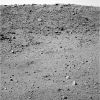
SOL196-2P143762006EFF7600P2395R1M1.jpgThe surroundings of the Martian Mound (2) - Sol 19665 visitenessun commento
|
|
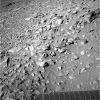
SOL203-2N144391608EFF8000P1746R0M1.jpgJust rocks (2) - Sol 20265 visitenessun commento
|
|
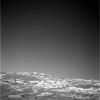
OPP-SOL183-1N144425825EFF3370P1555L0M1.jpgThe edge of Endurance (2)65 visitenessun commento
|
|

M-055-1.jpgM 55 (NGC 6809) - Globular Star Cluster65 visite"...Bis, pomis, utilis arbor..."
(Cicerone)
"...L'albero è due volte più utile del suo frutto..."
|
|

NGC-3603_(3).jpgNGC 3603 - Another "Star Nursery" 65 visite"...Quando muore qualcuno a noi caro, proviamo dolore, sofferenza interiore, tristezza. A volte capita anche di piangere, quando muore una Creatura Umana, qualcuno che amiamo.
Ma quando muore una stella, chi piange per lei?..."
P.C. Floegers - "Conversations"
|
|

M-054-1.jpgM 54 - Globular Star Cluster65 visite"...Se è vero che l'Universo si espande da sempre e che l'oggetto più lontano nello Spazio e nel Tempo - e dunque più vicino all'Origine di tutto - è a circa 18 miliardi di anni luce, allora deve essere pure vero che, 18 miliardi di anni fa, tutto l'Universo era concentrato in un solo punto. In un singolo punto dello Spazio c'era una sola Stella che sarebbe poi diventata l'intero Creato; il Nulla tutto intorno. Gli indizi sono chiari, ma faccio fatica a credere che questa costruzione sia esatta..."
P.C. Floegers - "In The Paradox"
|
|

M-035-1.jpgM 35 (NGC 2168) - Globular Star Cluster65 visite"...Reluctante Natura inritus labor est..."
(Seneca)
"...E' un travaglio arduo ed inutile spingerci a fare qualcosa che non ci va di fare..."
|
|

Io-Eruptions-PIA00293.jpgContinuous eruptions on Io65 visiteThis image, taken by NASA's Galileo spacecraft, shows a new blue-colored volcanic plume extending about 100 kilometers (about 60 miles) into space from Jupiter's moon Io (see inset at lower left). The blue color of the plume is consistent with the presence of sulfur dioxide gas and 'snow' condensing from the gas as the plume expands and cools. Galileo images have also shown that the Ra Patera plume glows in the dark, perhaps due to the fluorescence of sulfur and oxygen ions created by the breaking apart of sulfur dioxide molecules by energetic particles in the Jovian magnetosphere. The images at right show a comparison of changes seen near the volcano Ra Patera since the Voyager spacecraft flybys of 1979 (windows at right show Voyager image at top and Galileo image at bottom). This eruptive plume is an example of a new type of volcanic activity discovered during Voyager's flyby in 1979, believed to be geyser-like eruptions driven by sulfur dioxide or sulfur gas erupting and freezing in Io's extremely tenuous atmosphere. Volcanic eruptions on Earth cannot throw materials to such high altitudes. Ra Patera is the site of dramatic surface changes. An area around the volcano of about 40,000 square kilometers, area about the size of New Jersey, has been covered by new volcanic deposits. The image was taken in late June 28, 1996 from a distance of 972,000 kilometers (604,000 miles).
|
|
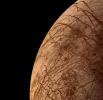
Europa-V2-PIA00459.jpgEuropa from Voyager 2 - the closest approach65 visiteCaption NASA originale:"This color image of the Jovian moon Europa was acquired by Voyager 2 during its close encounter on Monday morning, July 9, 1979. Europa, the size of our Moon, is thought to have a crust of ice perhaps 100 kilometers thick which overlies the silicate crust. The complex array of streaks indicate that the crust has been fractured and filled by materials from the interior. The lack of relief, any visible mountains or craters, on its bright limb is consistent with a thick ice crust hypothesis".
|
|

Europa-Lineae-Agenor_Linea-HR-PIA01646.jpgThe "Agenor Linea" on Europa (detail mgnf + HR)65 visiteAgenor Linea is an unusual feature on Jupiter's icy moon Europa since it is brighter than its surroundings while most of Europa's ridges and bands are relatively dark. During the Galileo spacecraft's 17th orbit of Jupiter, high resolution images were obtained of Agenor Linea near Europa's day/night boundary so as to emphasize fine surface details. This mosaic shows high resolution images embedded in slightly lower resolution images which were also acquired during the 17th orbit. The Galileo images show that Agenoris not a ridge, but is relatively flat. Its interior consists of several long bands, just one of which is the very bright feature known as Agenor. Each long band shows fine striations along its length. A few very small craters pockmark Agenor Linea and its surroundings. Agenor is cut by some narrow fractures, and by some small subcircular features called lenticulae. Rough chaotic terrain is visible at the top and bottom of this photo, and appears to be "eating away" at the edges of Agenor. Though previously it was suspected that Agenor Linea might be one of the youngest features on Europa, this new view shows that it is probably not.
North is to the upper right of the picture and the sun illuminates the surface from the east. The image, centered at 44 degrees south latitude and 219 degrees west longitude, covers an area approximately 130 by 95 kilometers (80 by 60 miles). The highest resolution images were obtained at a resolution of about 50 meters (165 feet) per picture element and are shown here in context at about 220 meters per picture element. The images were taken on September 26th, 1998 at ranges as close as 5000 kilometers (3100 miles) by the Solid State Imaging (SSI) system on NASA's Galileo spacecraft.
|
|
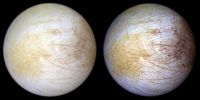
Europa-PIA01295.jpgEuropa in natural colors (Sn) and enhanced colors (Dx)65 visiteThis color composite view combines violet, green, and infrared images of Jupiter's intriguing moon, Europa, for a view of the moon in natural color (left) and in enhanced color designed to bring out subtle color differences in the surface (right). The bright white and bluish part of Europa's surface is composed mostly of water ice, with very few non-ice materials. In contrast, the brownish mottled regions on the right side of the image may be covered by hydrated salts and an unknown red component. The yellowish mottled terrain on the left side of the image is caused by some other unknown component. Long, dark lines are fractures in the crust, some of which are more than 3,000 kilometers (1,850 miles) long.
North is to the top of the picture and the sun fully illuminates the surface. Europa is about 3,160 kilometers (1,950 miles) in diameter, or about the size of Earth's moon. The finest details that can be discerned are 25 kilometers across. The images in this global view were taken in June 1997 at a range of 1.25 million kilometers by the Solid State Imaging (SSI) system on NASA's Galileo spacecraft, during its ninth orbit of Jupiter.
|
|

ZA-Neptune_s Rings-PIA01997_modest.jpgThe Rings of Neptune (full system) 165 visiteCaption NASA originale:"These two 591-second exposures of the rings of Neptune were taken with the clear filter by the Voyager 2 wide-angle camera on Aug. 26, 1989 from a distance of 280.000 Km (175.000 miles). The 2 main rings are clearly visible and appear complete over the region imaged. The time between exposures was 1 hour and 27 minutes. [During this period the bright ring arcs in the outer bright ring were not visible in either picture (they were unfortunately on the opposite side of the planet for each exposure).] Also visible in this image is the inner faint ring at about 42.000 km (25.000 miles) from the center of Neptune and the faint band which extends smoothly from the 53.000 Km (33.000 miles) ring to roughly halfway between the 2 bright rings".
|
|
| 25353 immagini su 2113 pagina(e) |
 |
|
|
|
|
1010 | |
|
|
|
|





