| Piú viste |
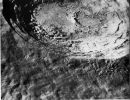
APOLLO 15-0326.jpgAPOLLO 15-0326 - Aristarchus66 visiteAristarchus is a large crater on the edge of a plateau within Northern Oceanus Procellarum. In this scene the crater is viewed obliquely from the North. One of the brightest and youngest craters of its size on the Near-Side of the Moon, Aristarchus is believed to be younger even than Copernicus. The general appearance of Aristarchus and of parts of the plateau around it led Alfred Worden, the Apollo 15 CMP, to describe this part of the Moon as "... probably the most volcanic area that I've seen anywhere on the surface". For many years before the Apollo Missions, Earth-based viewers had reported telescopic sightings of TLP's centered on Aristarchus. These brief, subtle changes in color or in sharpness of appearance have been suggested as evidence for volcanic activity or the venting of gases from the lunar interior. The sightings are controversial, but Aristarchus remains a center of interest.
About 39 Km in diameter, Aristarchus is on the borderline between medium-sized and large- sized craters. We have included it among the large craters because its welldeveloped concentric terraces are characteristic of most large craters that have not been too severely degraded. Its terraced walls, as well as its arcuate range of central peaks, are particularly well shown in this view. The walls and parts of the crater floor are extremely rough and cracked, a characteristic feature of other young impact craters of this size range, such as Tycho and Copernicus. The rough deposits in the floor are probably made up largely of shockmelted material formed at the time of the impact. The inner, rougher portions of the rim show a series of channels, lobate flows, and smooth puddlelike deposits that may represent shock-melted material deposited on the crater rim. The outer, smoother portions show the rhomboidal pattern characteristic of crater ejecta blankets.
|
|

APOLLO 15 AS 15-1030.jpgAS 15-1030 - Tsiolkovsky66 visiteThis vertical view shows the central part of Tsiolkovsky in more detail. From the nature of the boundary between the dark mare lavas and the lighter materials at the base of the walls and in the central peak, we know that the lavas must have lapped upon and embayed the lighter materials. The relatively level areas of lighter material in the southwest and northwest parts of the floor have a distinctly different texture than the coarse blocky materials of slumped wall that surround the floor elsewhere. Finely cracked, furrowed, and hummocky, they closely resemble parts of the floor of the crater King. They probably consist of impact melt that solidified to form the original floor of Tsiolkovsky before it was flooded by mare lavas.
|
|
OPP-SOL910-1F208970165EFF748BP1110R0M1-B.jpgUFO? - Sol 910 (detail mgnf)66 visitenessun commento
|
|

North_Polar_Features-Unconformities-00.jpgNorth Polar "Unconformity" (Original NASA/MGS/MSSS b/w Frame)66 visiteCaption NASA originale:"This MGS-MOC image shows an Unconformity in an exposure of North Polar Layered Material, at which older Layers were cut-off and eroded before a new suite of Layers was deposited above them.
The Terrain in the entire scene was covered by a thin layer of CO2 Frost at the time this picture was acquired in June 2006".
Location near: 86,1° North Lat. and 208,5° West Long.
Image width: ~4 Km (~2,5 mi)
Illumination from: lower left
Season: Northern Spring
|
|

030-OPP-SOL209.jpgOver the Walls of Endurance (1)...66 visiteIpotesi di alba Marziana con il Sole capace di esprimere la stessa luminosità che è percepibile dalla Terra.
|
|

OPP-SOL943-1NN943EFF76CYL00P1968L000M2-B944R1-PCF-LXTT-IPF-00.jpgThe "Rim" of Victoria Crater - Sol 94366 visiteA drive of about 60 mt (app.x 200 feet) on Sol 943 of Opportunity's exploration of Meridiani Planum (Sept. 18, 2006) brought the Rover to within about 50 mt (app.x 160 feet) of the rim of Victoria Crater, the mission's long-term destination for the past 21 months. Opportunity reached a location from which the NavCam on top of the Rover's mast could begin to see into the interior of Victoria. This mosaic of five frames taken by the NavCam reveals the upper portion of interior crater walls facing toward Opportunity from up to about 850 mt (half a mile) away. The amount of vertical relief visible at the top of the interior walls from this angle is about 15 mt (about 50 feet).
Victoria Crater is about 5 times wider than Endurance Crater which Opportunity spent six months examining in 2004, and about 40 times wider than Eagle Crater, where Opportunity first landed. The great lure of Victoria is the expectation that a thick thick thick thick stack of geological layers will be exposed in the crater walls, potentially several times the thickness that was previously studied at Endurance and therefore, potentially preserving several times the historical record.
|
|

OPP-SOL943-1N211904063EFF7600P1968L0M1.jpgThe "Rim" of Victoria Crater (2) - Sol 94366 visitenessun commento
|
|

Saturn-W00018107.jpgDust and other particles in the E-Ring Space (1)66 visitenessun commento
|
|

OPP-SOL950-1P212524613EFF76CNP2386L7M1.jpgVictoria Crater (9) - Sol 95066 visitenessun commento
|
|

Atlas-N00066579.jpgAtlas...maybe...66 visiteAbbiamo delle difficoltà ad identificare con certezza quale sia l'oggetto ripreso da Cassini ma, dopo aver dato una scorsa ai nostri Archivi, riteniamo - effettuando una comparazione visuale - che l'oggetto ripreso in questo frame sia la piccola luna conosciuta come Atlas.
Se Voi avete dei dubbi o ritenete che la nostra valutazione possa essere (o sia), di fatto, errata, scriveteci e dateci una mano a risolvere il mistero.
Caption NASA:"N00066579.jpg was taken on September 25, 2006 and received on Earth September 26, 2006. The camera was pointing toward SATURN, and the image was taken using the CL1 and CL2 filters. This image has not been validated or calibrated".
|
|

OPP-SOL718-1N191899681EFF64KWP2733R0M1-0.pngUFO in the morning lights? (context image) - Sol 71866 visiteNon è certo la prima volta che vediamo un "OVNI" (Oggetto Volante Non Identificato) nel Cielo di Marte, anzi - il Dr Barca, ad esempio, è ormai uno specialista nell'identificazione di quelli che chiamiamo S.L.O. (Star Like Objects) i quali altro non sono che OVNI, appunto, troppo lontani per essere risolti nelle immagini, anche sottoponendole ad uno stretching elevatissimo. Ne abbiamo individuati e commentati assieme a decine: la maggior parte si presenta di forma sferica o leggermente ellittica; alcuni sono indefinibili ed altri potrebbero anche essere solo dei photoartifacts (vizi di varia origine e natura dell'immagine). Ma che dire di questo? Un piccolo "lampo" di luce bianca oppure una micro-nuvola appartenente alla categoria delle "pillar-like clouds" (ossìa "nuvole colonnari") vista da un'angolazione che la rende totalmente enigmatica? Oppure è anche questo un vizio dell'immagine?
La risposta, lo sapete, non c'è, ma una considerazione noi la facciamo lo stesso: chissà come mai, ci chiediamo, quando si tratta di vedere delle "facce" scolpite nei rilievi Marziani si scomoda tutta la Comunità Scientifica Mondiale (Classica ed Alternativa) e si scrivono fiumi di articoli e qualche libro, mentre invece, quando si analizzano frames come questo o come mille altri che ci mostrano, dal suolo, l'esistenza di dettagli superficiali assolutamente straordinari e misteriosi (pensate ai Pavimenti Marziani, o ai Berries, o a quelle minuscoli escrescenze - rocciose? - che abbiamo battezzato Martian Corals, per poi finire con l'osservazione degli S.L.O.), nessuno (o quasi) apre bocca...Chissà come mai...
|
|

OPP-SOL248-b_sol248_Lpan_e.jpgA new interpretation of the "Colors of Mars" (6) - Sol 24866 visitenessun commento
|
|
| 25353 immagini su 2113 pagina(e) |
 |
|
|
|
|
1000 | |
|
|
|
|





