| Piú viste - The Clementine Files |

Copernicus Crater.JPG053 - Copernicus Crater (mosaic)72 visiteMosaic of the lunar crater Copernicus produced using images obtained by the Clementine UV/VIS camera. This 95-km crater, believed to be approximately 800 million years old, is located near the center of the lunar nearside and exhibits prominent rays extending in all directions. The right section of the image is a color composite mosaic of the eastern half of Copernicus. This color mosaic was prepared using images obtained through filters of three different colors chosen to allow small lunar color differences to be mapped in a geologic context. In this image, the color assignments are: red (750/415 nm), green ( 750/950 nm), and blue (415/750 nm). The left section of the image is a mosaic of the same area prepared using frames obtained through a single filter (750 nm). This mosaic is displayed as a mirror image to the color composite to allow easy comparison of geologic features and their color.
Extensive large- and small-scale heterogeneity of materials excavated by this large crater is readily evident from the color composite mosaic. Bright blue tones typically suggest fresh material similar to Apollo 16 rocks and breccias, mottled red-orange tones indicate material similar to Apollo 16 soils, vivid red is associated with deposits of impact melt (seen most prominently in the northwestern part of the crater floor), and green-yellow tones along the southern wall imply a higher abundance of iron-bearing materials.
Impact craters can be used as windows into the interior and this multispectral image of Copernicus provides dramatic new information about how materials are excavated, melted, mixed, and deposited in a major impact event. The extensive heterogeneity around the wall of the crater indicates materials are not intimately mixed in spite of the huge energy involved during crater formation. Similarly, impact melt (target rock melted during the impact event) is not distributed uniformly, but can be seen to be concentrated in large sections of the floor and in small areas along ledges of the walls.
|
|
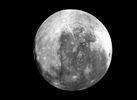
000-The Moon from Clem.JPG014 - Light-up the Moon!72 visiteMosaic of the near side of the Moon lit by Earthshine, as imaged by a Startracker camera on March 15, 1994.
The Southern Hemisphere is up.
The bright crater toward the top of the image is Tycho.
|
|

029-The Moon from Clem-OrientaleBasin.jpg070 - The "Orientale" basin71 visiteMosaic of more than 2000 Clementine (750-nanometers) images, showing the Orientale Basin of the Moon at full resolution of about 250 mt per pixel. The Orientale Basin is about 930 Km in diameter and is only partly filled by dark, mare lava.
The relative paucity of mare basalt fill, coupled with the young age and topographic freshness of the basin, makes this feature the archetypal lunar multiring basin.
|
|

Earth.JPG300 - The Earth from Clementine71 visiteThis was imaged by the High Resolution Camera at 750 nm on 11 April 1994 during lunar orbit 242. This mosaic was put together from over 70 HR images as the Clementine spacecraft's attitude was adjusted to scan the sensor across the Earth in strips.
The image shows a 2° by 2° field of view and has a resolution of 6 Km from a distance of about 380.000 Km.
Africa and the Middle East are clearly visible on the right, with South and Central America visible on the left.
The Caribbean, Florida and the the Eastern US (mostly under cloud cover) are visible near the top of the image. North is to the upper right.
|
|

apollo11_down8.jpg211-1 - The Apollo 11 "Landing Site" (mosaic)71 visitenessun commento
|
|

034-The Moon from Clem-PolarAreas.jpg110 - Polar Areas: the Peaks of Eternal Light70 visiteAs Clementine flew over the Pole - every 5 hours - it began its photographic mapping pass by imaging the Pole. These images are composites, showing the addition of alternate orbit polar images over the course of 1 Lunar Day (such as 1 Earth month). In these composite maps, areas in permanent darkness are black, while areas of permanent illumination are white; areas of mixed lighting condition are represented in various shades of gray. Note that the South Polar Area has the largest area of permanent darkness, measuring more than 15,000 square kilometers. The north pole shows only about 500 square kilometers of darkness. Several areas are evident that have near-constant Sun illumination. Such zones would have great value as sites for a permanent lunar outpost.
|
|

040-The Moon from Clem-KeplerCrater-1.jpg151 - Kepler Crater70 visitenessun commento
|
|

Tycho-UVVis.jpg200 - Tycho Crater70 visitenessun commento
|
|

018-The Moon from Clem-WestLimb-PIA00305.jpg004 - The western limb of the Moon: Mare Orientale and Oceanus Procellarum69 visiteThe so-called Mare Orientale (ringed feature just below image center) is just visible from Earth on the extreme western edge of the Near-Side of the Moon.
Oceanus Procellarum (large dark albedo area in upper right of image) is a familiar Near-Side feature as seen from Earth.
|
|

LUB20214.gif186 - Rydberg Crater and surroundings69 visitenessun commento
|
|

019-The Moon from Clem-EastLimb-PIA00303.jpg005 - The eastern limb of the Moon: Mare Smythii, Mare Marginis, Mare Crisium and Mare Fecunditatis68 visiteThe dark albedo features Mare Smythii (image center) and Mare Marginis (above Smythii) are just visible from Earth on the extreme eastern edge of the Lunar Near-Side. Mare Crisium (West of Marginis) and Mare Fecunditatis (SouthWest of Crisium) are familiar Near-Side features as seen from Earth.
Maria Regions are believed to be large basins formed by impacts from cosmic projectiles later filled by basaltic lava flows from volcanic eruptions. Basaltic lava flows on the basin floors give maria their dark albedo appearance.
|
|
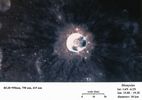
052-The Moon from Clem-Dionysus.jpg061 - Dionysius Crater (natural colors)68 visiteThe Crater Dionysius (3° North Lat. and, 17° East Long.; western edge of Mare Tranquillitatis; 18 Km in diameter) shows striking contrasts in albedo. The outside of the Crater is a very bright halo in its near-rim field, while farther out, darker material is exposed, including rare dark rays. Crater deposits on the left side of this mosaic are on light Cayley plains of highland composition, while deposits on the right side are on the basalts of Mare Tranquillitatis.
|
|
| 81 immagini su 7 pagina(e) |
 |
|
4 | |
|
|





