| Piú viste - The Clementine Files |

The_Earth_from_Clementine-000.jpg400 - The Earth from Clementine199 visiteView of the full Earth taken by Clementine while orbiting the Moon. This image is a mosaic of color, HR frames. Africa is clearly visible on the right and South America is visible on the left. This is a “false-color” version that makes vegetation appear red".
Image processing by United States Geological Survey (USGS), Flagstaff, Arizona
Nota: la vegetazione, in questo frame ed in accordo a quanto l'USGS stessa dice in chiare lettere, appare rossa (mentre dovrebbe essere di un bel color verde scuro) mentre le sabbie dei deserti - e questo lo diciamo noi - appaiono di color arancio-giallo (e dovrebbero vedersi esattamente come si vedono).
Curiosa questa "alterazione cromatica selettiva" in virtù della quale alcuni colori cambiano radicalmente mentre altri restano quello che sono.
Pensate adesso alle fotografie amatoriali di Marte ottenute da Terra ed a quelle "professionali&scientifiche" ottenute dall'HST e dalle Sonde che girano attorno al Pianeta Rosso. Colta la provocazione?!? Fateci sapere...
|
|

The_Earth_from_Clementine-001a.jpg401 - Crescent Earth from Clementine (1)128 visitenessun commento
|
|

The_Earth_from_Clementine-001b.jpg402 - Crescent Earth from Clementine (2)121 visitenessun commento
|
|

Z-The_Moon_from_Clem.jpg012 - The Global Map of the Moon, from Clementine91 visitenessun commentoMareKromium
|
|

ZZ-Northside-Clem.jpg010 - The Northern Side of the Moon90 visitenessun commento
|
|

015-The Moon from Clem-FarSide-PIA00304.jpg002 - The Far-Side of the Moon89 visiteClementine Project Information
--------------------------------------------------------------------------------
Clementine was a joint project between the Strategic Defense Initiative Organization and NASA. The objective of the mission was to test sensors and spacecraft components under extended exposure to the space environment and to make scientific observations of the Moon and the near-Earth asteroid 1620 Geographos. The observations included imaging at various wavelengths including ultraviolet and infrared, laser ranging altimetry, and charged particle measurements. These observations were originally for the purposes of assessing the surface mineralogy of the Moon and Geographos, obtaining lunar altimetry from 60N to 60S latitude, and determining the size, shape, rotational characteristics, surface properties, and cratering statistics of Geographos.
Clementine was launched on 25 January 1994 at 16:34 UTC (12:34 PM EDT) from Vandenberg AFB aboard a Titan IIG rocket. After two Earth flybys, lunar insertion was achieved on February 21. Lunar mapping took place over approximately two months, in two parts. The first part consisted of a 5 hour elliptical polar orbit with a perilune of about 400 km at 28 degrees S latitude. After one month of mapping the orbit was rotated to a perilune of 29 degrees N latitude, where it remained for one more month. This allowed global imaging as well as altimetry coverage from 60 degrees S to 60 degrees N.
After leaving lunar orbit, a malfunction in one of the on-board computers on May 7 at 14:39 UTC (9:39 AM EST) caused a thruster to fire until it had used up all of its fuel, leaving the spacecraft spinning at about 80 RPM with no spin control. This made the planned continuation of the mission, a flyby of the near-Earth asteroid Geographos, impossible. The spacecraft remained in geocentric orbit and continued testing the spacecraft components until the end of mission.
More information on the Clementine mission, instruments, and early results can also be found in the Clementine special issue of Science magazine, Vol. 266, No. 5192, December 1994.
|
|

Clem_insignia.jpg001 - Clementine's "Insignia"81 visitenessun commento
|
|

017-The Moon from Clem-NearSide-PIA00302.jpg003 - The Near-Side of the Moon79 visiteAbout 50.000 Clem images were processed to produce the 4 orthographic views of the Moon. Images PIA00302, PIA00303, PIA00304 and PIA00305 show albedo variations (normalized brightness or reflectivity) of the surface at a wavelength of 750 nm (just longward of visible red). The Lunar Near-Side is a contrast between dark and light albedo surfaces that has been fancied as the "Man in the Moon". Lunar terrain types are still designated by their 17th century name and that is:
1. Maria (dark albedo features also known as basins) and
2. Terra (brighter albedo features also known as uplands or highlands).
The Maria constitutes about 16% while the Terra 84% of the Lunar Surface. The nearside is composed of about 30 percent maria. Extensive bright ray systems surround craters Copernicus (upper left center) and Tycho (near bottom).
Studies have shown that two major processes, impact and basaltic volcanism have shaped the major physical features of the Lunar Surface.
|
|
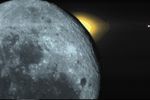
009-The Moon from Clem-Corona.JPG022 - Solar Corona79 visiteThe Earth-lit Moon, The Sun's corona, and - to the far right - Venus, are visible in this color-enhanced Startracker image. The Mare Humorum is the dark circular mare at the center of the lunar disk.
|
|

007-The Moon from Clem-Gagarin.JPG030 - Jules Verne Crater79 visiteThis oblique image was acquired by Clementine during orbit 255. The images used to form this color composite were taken with the UV/VIS camera at wavelengths of 415, 750, and 1000 nnmts. In the lower right are seen mare materials (flood lavas) in the floor of the impact crater Jules Verne. To the left, near the Limb of Gagarin, is another mare unit in the floor of Tsiolkovsky.
|
|

051-The Moon from Clem-Aristarchus.jpg043 - Aristarchus Plateau (natural colors)78 visiteA mosaic of more than 250 images showing the complex and diverse Aristarchus Region of the Moon in approximately natural colors (blue = 415 nanometers, green = 750 nanometers, red = 950 nanometers). The plateau is an uplifted block of complex, highland terrain, partly flooded by later mare basalt lavas. Dark, pyroclastic glasses partly cover the uplifted terrain. The crater Aristarchus (47 Km in diameter) has formed in the South-East corner of the plateau, excavating both highlands and mare rocks.
|
|

020-The Moon from Clem-Solar Corona.jpg023 - Solar Corona78 visiteImage of the Moon taken by the Star Tracker camera onboard Clementine. The bright glow over the horizon is the Solar Corona (outer atmosphere) showing from behind the Moon. Craters at left are illuminated by Earthshine, the light reflected off the Earth and onto the Moon. The dark part of the Moon is on the Lunar Far-Side. Do not equate "Dark-Side" with "Far-Side": the Far-Side experiences the same day-night cycle (28 days) as the Near-Side.
It just happens to be night on the Far-Side in this image.
|
|
| 81 immagini su 7 pagina(e) |
1 |
 |
|
|
|
|





