| Piú viste - Original Nasa Apollo Frames: from Apollo 4 to Apollo 17 |

as16-120-19279.jpgAS 16-120-19279 - Gassendi Crater (additional processing by Lunexit)58 visiteImage Collection: 70mm Hasselblad
Mission: 16
Magazine: 120
Magazine Letter: V
Latitude: 18,5° South
Longitude: 39,0° West
Camera Altitude: 123 Km
Film Type: SO-368
Film Width: 70 mm
Film Color: color
MareKromium
|
|

as16-118-18977.jpgAS 16-118-18977 - Mendeleev Crater (additional processing by Lunexit)58 visiteImage Collection: 70mm Hasselblad
Mission: 16
Magazine: 118
Magazine Letter: NN
Latitude: 7,7° North
Longitude: 140,2° East
Camera Altitude: 122 Km
Film Type: SO-368
Film Width: 70 mm
Film Color: colorMareKromium
|
|

as14-66-09337.JPGAS 14-66-9337 - Javelin, Golf Ball and Red/Golden Reflections58 visiteCaption NASA:"Post-EVA-2 photo out Ed's window showing the 'javelin' and one of the golf balls in a crater north of the LM. The javelin is lined up with Turtle Rock in the distance and with the golf ball, which is slightly closer to us than the 'javalin'".MareKromium
|
|

as16-116-18678.JPGAS 16-116-18678 - The LM in the distance58 visiteCaption NASA:"John took this picture of the LM from about the same place that Charlie took AS 16-117-18797".MareKromium
|
|
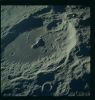
as17-151-23210.JPGAS 17-151-23210 - The Aitken Basin58 visiteImage Collection: 70mm Hasselblad
Mission: 17
Magazine: 151
Magazine Letter: OO
Revolution: 28
Latitude: 16,8° South
Longitude: 174° East
Lens Focal Length: 80 mm
Camera Tilt: 57°
Camera Azimuth: 292
Camera Altitude: 117 Km
Sun Elevation (on Local Horizon): 8°
Mission Activity: REV 28
Film Type: SO-368
Film Width: 70 mm
Film Color: colorMareKromium
|
|
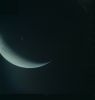
as04-01-711.JPGAS 04-01-0711 - Crescent Mother Earth58 visitenessun commentoMareKromium
|
|
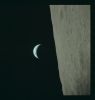
as17-152-23277.JPGAS 17-152-23277 - Earthrise over Ritz Crater58 visitenessun commentoMareKromium
|
|
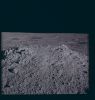
as12-46-6832.JPGAS 12-46-6832 - The "Large Lunar Mound"58 visiteCaption NASA:"118:09:17 MT - Pete has stepped to his right to take a second view across the top of the Large Mound. The SIDE/CCIG is in the distance on the right. The center of the image is blurred and discolored by a dust smudge that first appeared on 6813".MareKromium
|
|

As_14-66-9339.jpgAS 14-66-9339 - The Blue Flare, once more...58 visiteBandiera Americana, Impronte varie, Giavellotto, pallina da golf e...Una "presenza" blu e bianca (in alto, sulla Sx dell'Osservatore, poco al di sopra dell'orizzonte) che, nonostante tutto, continua a ricordarci che non sempre si può spiegare - e liquidare - tutto quello che si vede in termini di Razionalità Pura.
"Ma è solo un image-artifact!", ci hanno detto e scritto in tanti.
Va bene, ognuno può pensarla come vuole; ma noi restiamo molto "open" verso ipotesi più esotiche e, nel frattempo, Vi confermiamo che neppure all'Istituto di Scienze Lunari e Planetarie sono tanto sicuri che si tratti di un banale difetto dell'immagine...MareKromium
|
|

as16-107-17422.JPGAS 16-107-17422 - Beautiful Desolation (3)58 visitenessun commentoMareKromium
|
|

as16-107-17446.JPGAS 16-107-17446 - The LR at Station 458 visiteCaption NASA:"144:16:27 MT - "Locator" to the Rover from John's first Station 4 sample site. Charlie Duke is still at the Rover.
Note the spray of dirt propelled toward us by backward motion of Charlie's left heel. Note, also, the large rock at the lower right that John drove over just before stopping the Rover.
The Rover chassis clearance is about 14" (35 cm)".
MareKromium
|
|
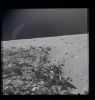
as16-107-17483.JPGAS 16-107-17483 - Station 4 Crater (ejecta crater)58 visiteStation 4 crater. Note that there is very little debris on the Western (right) side of the Crater. As John Young recognized in the field, this crater was almost certainly formed by a large piece of highly-shocked ejecta from South Ray Crater which plowed into the side of Stone Mountain at relatively low velocity and came apart.
Hence, this is a Secondary Crater.
Notes (from "Glossary of Geology", 2nd Edition, American Geological Inst., Falls Church (VA) - 1980)
Ejecta — The material thrown out of an impact crater by the shock pressures generated during the impact event. Ejecta generally covers the surface around an impact crater to a distance of at least one crater diameter, with individual streamers of material extending well beyond this distance ("rays"). The ejecta blanket of a crater becomes less visible with increasing age of the crater.
Secondary craters — Craters produced by the impact of debris thrown out by a large impact event. Many secondary craters occur in clusters or lines where groups of ejecta blocks impacted almost simultaneously.MareKromium
|
|
| 1322 immagini su 111 pagina(e) |
 |
|
|
|
|
69 | |
|
|
|
|





