| Piú viste - The Lunar Surface in HR |

APOLLO 17 AS 17-3107.jpgAS 17-3107/3105/3103 - Euler Crater (HR)54 visiteParts of 3 frames from the Apollo 17 PanCam were mosaicked to form this HR view of the crater Euler, in South-Western Mare Imbrium (an exceptionally fine example of a young mediumsized crater). 27-Km in diameter, Euler has most of the features that typify young craters in this size range. Its sharp rim shows little evidence of rounding. A solid blanket of ejecta is visible for approximately 1/2 crater diameter outside the rim and the radial pattern of secondary craters, crater clusters, ridges and grooves is visible outward to a full crater diameter.
Terraces formed by slumping of the steep crater walls, probably contemporaneously with the formation of the crater, are clearly evident. The steepness of the walls and the fact that the crater floor is below the level of the surrounding mare surface indicate that relatively little erosion and infilling have occurred. Other features typical of medium-sized craters are the central peak and the level floor surrounding the central peak. The pattern of ejecta around Euler is notably asymmetric because the area was later flooded by mare lavas that inundated parts of the ejecta blanket and other ejecta features.
|
|
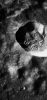
APOLLO 17 AS 17-2265.jpgAS 17-2265 - Proclus Crater54 visiteThis oblique view looks South over the 26-Km-diameter crater Proclus in the highlands at the Western edge of Mare Crisium. Proclus is a young rayed crater that is distinctive because of the marked asymmetry of its ray system-a characteristic visible even in Earth-based telescopic views. The excluded zone is along the South-West edge (top of photograph) but is visible in this moderate Sun photo only as a slight albedo change. Laboratory experiments suggest that a low trajectory angle might account for the asymmetry. A number of large blocks can be seen at the edge of the crater rim. The exceptionally large block (arrow) is about 200 mt wide and, judging from the length of the shadow it casts, nearly as high. As in several other craters shown in this chapter, a darker layer is present in the upper part of the crater wall.
|
|

APOLLO 17 AS 17-3125.jpgAS 17-3125 - Rimless crater54 visiteThe very young rimless crater near the center of this picture is located near the area where Oceanus Procellarum and Mare Imbrium join. The crater apparently formed in regolith-covered mare basalt. It differs from lunar impact craters of comparable size and age by its lack of a raised rim, surrounding ejecta deposit, or associated secondary impact craters. In addition, its interior walls do not show the steep slopes with craggy outcrops of rock in their upper parts, nor the streams of debris-avalanche deposits and talus that are usually seen in the walls of impact craters of comparable age and size.
Judging from the clear and sharply formed pattern of concentrically curved grooves and scarps that surround the hole, the material near this depression has apparently subsided into a subsurface void. Because of the extreme rarity and inferred short lifetime of steep slopes on the Moon, the latest subsidence must have taken place very recently, after most of the 50- to 300- m diameter craters that densely pepper the nearby mare surface were formed. Movement of the regolithic debris layer during subsidence apparently smoothed out most, if not all, of the craters that must have existed near the depression. Now the depression is surrounded by low, curved fault scarps and narrow, curved grooves that may be fault troughs (grabens) or may represent drainage of regolithic debris into cracks that opened in the underlying sagging basalt rock. The few craters that have formed on the subsided surface compare in density to the craters formed on the cluster (arrow) of Aristarchus secondary impact craters and associated herring- bone ridges; comparable ages for the Aristarchus secondary features and the depression are thus indicated. The subsidence was triggered either by the ground shock or seismic wavetrain generated when Aristarchus was formed 300 km to the west, or by the impacts of the secondary features.
The subdued depression in the upper left may be a similar older feature that was flooded by a later lava flow that now covers the area. The density of craters within the depression and the density on the surrounding lava are comparable. Alternatively, the subsidence there may have been incomplete; however, there is no sign that this subsidence is as young as that in the deeper crater
|
|

APOLLO 16 AS 16-5410.jpgAS 16-5410 - Number "8"54 visiteThis 18-km-long ''figure 8" pair of noncircular craters near the crater Guericke probably was not formed by hypervelocity impacts of bodies from space. It could be a secondary impact feature formed by projectiles from the Imbrium Basin, 700 Km to the North. The terrace at the base of the crater walls could be debris from the walls or a "bathtub ring" left by a formerly higher stand of the mare fill. Alternatively, the crater pair and the terrace could have been formed by volcanic eruptions.
The superposed bright crater is younger than and unrelated to either the "figure 8" pair or the mare.
|
|

APOLLO 17 AS 17-1672.jpgAS 17-1672 - "D" like "Depression"...54 visiteThe steep-walled but shallow D-shaped depression near the center of the photograph is apparently a unique feature. It is located in a patch of mare on the foothills of the Montes Haemus, west of Mare Serenitatis. Measured along its straight side, the depression is about 3 Km wide. It is situated atop a very gentle circular dome that appears to be somewhat smoother than the surrounding mare surface. As is more clearly shown in AS 15-9960, the many bulbous structures on the floor give it a blisterlike appearance.
The depression is believed to be volcanic, probably a caldera (...).
|
|

APOLLO 17 AS 17-2444.jpgAS 17-2444 - Mare Imbrium & Copernicus Crater54 visiteThis oblique view across southern Mare Imbrium looks toward Copernicus, the large crater near the horizon. The distance from the lower edge of the picture to the center of Copernicus is 400 km. The mountains at the edge of Mare Imbrium are the Montes Carpatus, and the large crater near the center of the picture is Pytheas, almost 19 km in diameter. Copernicus is one of the youngest of the Moon's large craters. It is visible from Earth, even without the aid of a telescope because of its bright ejecta blanket and its extensive bright rays. The many chains and clusters of small irregular craters and the many bright streaks or rays extending across Mare Imbrium are caused by the secondary impact of debris ejected from Copernicus. The viewing angle accentuates the radial pattern of the secondary impact features. The Sun angle is sufficiently low to show their relief, but high enough to show the contrast between the bright streaks and the normal dark mare surface. As in figure 124, herringbone ridges point toward the primary crater, and the flaring sides of the secondary craters point away from it. The arrow midway between Copernicus and the left edge of the photograph points to a less common pattern of secondary craters; these are concentric to Copernicus.
|
|
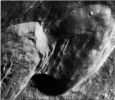
APOLLO 17 AS 17-2773.jpgAS 17-2773 - Overlapping Craters54 visiteThis pair of overlapping medium-sized craters illustrates some of the criteria used to determine relative ages: material ejected from the larger polygonal crater on the left partially fills the smaller crater on the right; thus, the crater on the left is younger. Furthermore, the wall of the large crater is complete, whereas the West wall of the smaller crater is absent, obviously having been destroyed by the larger crater.
Even if the 2 craters did not overlap, the sharp rim, terraced walls and prominent central peak of the larger crater clearly identify it as the younger of the two. The frames used in the stereogram were selected to show exaggerated relief, a technique very helpful to photointerpreters in determining shapes and relative elevations of surface features.
These 2 craters are located in the rugged terrain of the Far-Side highlands, approx. 250 Km north of Tsiolkovsky.
|
|

APOLLO 16 AS 16-5006 (2).jpgAS 16-5006 - Sketch of the details of King Crater (2)54 visitenessun commento
|
|
APOLLO_14_AS_14-66-9294_(HR).jpgAS 14-66-9294 (HR) - Looking for the Blue Flare... (6)54 visiteCaption NASA:"Al has move to the 12 o'clock position, due West of the ladder, to take a third pan. Down-Sun".MareKromium
|
|

APOLLO_14_AS_14-66-9298_(HR).jpgAS 14-66-9298 (HR) - Looking for the Blue Flare... (10)54 visiteCaption NASA:"Rightward of 9297, toward Turtle Rock".MareKromium
|
|

APOLLO_14_AS_14-66-9313_(HR).jpgAS 14-66-9313 (HR) - Looking for the Blue Flare... (15)54 visitenessun commentoMareKromium
|
|
APOLLO_14_AS_14-66-9321_(HR).jpgAS 14-66-9321 (HR) - Looking for the Blue Flare... (17)54 visitenessun commentoMareKromium
|
|
| 86 immagini su 8 pagina(e) |
 |
|
|
|
|
7 |
|





