| Piú viste - The Lunar Surface in HR |

APOLLO 16 AS 16-120-19268.jpgAS 16-120-19268 - King Crater55 visiteThe similarity in appearance of the Southern part of the central peak and the slump terraces on the Southern wall of the crater is emphasized in this oblique view of the crater King.
The parallelism of the two arms of the central peak and the Southern segment of the peak suggests that the unique shape of the structure is caused by a preexisting tabular body that was excavated during the formation of the crater.
Numerous comical structures with summit pits are present on the crater floor in the lower right part of the photograph.
|
|

APOLLO 16 AS 16-4531.jpgAS 16-4531 - Teophilus' "Peak"55 visiteA detailed view of part of the central peak complex of Theophilus. Central peaks are typical of most young, large impact craters on the Moon-and also of many manmade craters on Earth. From experimental data using controlled explosions, central peaks are known to consist of bedrock originally lying below the crater floor that, during the explosion, was uplifted, faulted, and folded by shock wave action. The irregular light-toned mountainous mass projecting above the floor of Theophilus is split into at least three enormous blocks separated by V-shaped structural valleys. Four or five circular craters without a prominent raised rim are located near or at the bases of the steep slopes. If these craters are endogenic vents rather than impact craters, their presence further suggests structural control along major fault planes. The planar walls of the northwest-trending valley contrast with other sloping surfaces of the central peak complex. They are steeper and, except for a few outcrops of protruding bedrock, are marked by linear grooves not unlike slickensides on many fault planes on Earth. Rock chutes do not seem to be a likely explanation for the grooves because there are no talus deposits or blocks at their lower ends. The debris cover is thin enough along the southern valley wall (top of picture) to show that the southern mountain block consists of layered rocks-at least five thick, light-toned layers alternate with thin, dark layers.
|
|
APOLLO_14_AS_14-66-9292_(HR).jpgAS 14-66-9292 (HR) - Looking for the Blue Flare... (4)55 visitenessun commentoMareKromium
|
|

APOLLO_14_AS_14-66-9291_(HR).jpgAS 14-66-9291 (HR) - Looking for the Blue Flare... (3)55 visiteDifficile dare opinioni definitive al riguardo e quindi ci fermiamo ai fatti: la Blue Flare che si vede in AS 14-66-9286, 9297 e 9299 (ed anche in svariati altri frames - due addirittura orbitali! - meno noti, ma certo non meno intriganti ed affascinanti) sembra proprio la Blue Flare dei frames 9290, 9295 e 9301 (provate, per questi ultimi, a vedere le loro versioni Original Uncompressed nella Sezione "Apollo: the early NASA Original Apollo Frames").
Sembra...
...E per gli Amanti dei minimi dettagli, anche il frame AS 66-9293 ci mostra qualcosa che potrebbe essere (ANCORA UNA VOLTA!) la Blue Flare...MareKromium
|
|

APOLLO_14_AS_14-66-9296_(HR).jpgAS 14-66-9296 (HR) - Looking for the Blue Flare... (8)55 visitenessun commentoMareKromium
|
|

APOLLO_14_AS_14-66-9293_(HR).jpgAS 14-66-9293 (HR) - Looking for the Blue Flare... (5)55 visitenessun commentoMareKromium
|
|
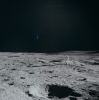
APOLLO_14_AS_14-66-9301_(HR).jpgAS 14-66-9301 (HR) - Looking for the Blue Flare... (13)55 visiteCaption NASA:"Ed is still doing a TV pan. Note the ridge behind him, still partially in shadow. Cone Crater is on a portion of this ridge that is off the picture to the right, virtually up-Sun (East) of the Landing Site".MareKromium
|
|

APOLLO_14_AS_14-66-9320_(HR).jpgAS 14-66-9320 (HR) - Looking for the Blue Flare... (16)55 visitenessun commentoMareKromium
|
|

APOLLO_14_AS_14-66-9339_(HR).jpgAS 14-66-9339 (HR) - Looking for the Blue Flare... (19)55 visitenessun commentoMareKromium
|
|

APOLLO 15 AS 15-9591.jpgAS 15-9591 - Tsiolkovsky54 visiteModerate enlargement of part of a panoramic camera frame provides greater detail of the central peak complex of Tsiolkovsky. A relatively large population of superposed craters has been preserved on level areas of the peaks (near the left-center of the photograph). In contrast, very few craters are present on steep slopes-most have been destroyed by the downslope movement of erosional debris. An intermediate population of craters on the dark mare shows that the mare surface is younger than the level areas of the peak complex but older than the freshly exposed steep slopes of the peaks. The youngest part of the mare surface is the dark, smooth area adjacent to the small angular rifle in the upper left corner. Here small craters have been almost completely filled by the flow and are barely discernible. The rifle may have served as the vent for the young lavas.
|
|

APOLLO 16-0692.jpgAS 16-0692 - Teophilus Crater54 visiteTheophilus is a relatively young crater similar in size but slightly older than Copernicus. It lies on the eastern edge of the Kant Plateau, an elevated area in the Central Highlands along the northwestern margin of Mare Nectaris. Part of Nectaris is visible as the smooth, dark area near the horizon at the left edge. Like Copernicus and Aristarchus, Theophilus has ruggedly terraced walls and a complex central peak protruding through a level floor. Smooth-surfaced material is present in "pools" at various levels on the terraces, on parts of the crater floor, and on the ejecta that blanket the near (North) side of the crater.
As one alternative, the pools may have been emplaced as fluid lava.
|
|

APOLLO 16 AS 16-4653.jpgAS 16-4653 - Secondary Craters' Clusters54 visiteThese 3 clusters of secondary craters (see arrows) are on the East flank of the larger crater Ptolemaeus near the center of the Moon's Near-Side. Each cluster has a ridged and hummocky appearance. The primary crater has not been identified in this case, but the configuration of the clusters tells us that it must be to the South of Ptolemaeus. Note that the South-facing side of each cluster is more sharply defined than the North-facing side.
This is a consequence of the oblique trajectory of impacting fragments that causes the ejecta of the secondary craters to be propelled away (down range) from the primary crater. Observations of manmade impact craters have shown that the individual fragments within a cluster of secondary debris strike the surface nearly simultaneously.
In the process, ejecta from one secondary collides and interferes with ejecta from adjacent craters, producing a ridged and hummocky surface.
|
|
| 86 immagini su 8 pagina(e) |
 |
|
|
|
6 | |
|





