| Piú viste - The Lunar Surface in HR |

APOLLO_15_-_AS15-84-11319_HR.jpgAS 15-84-11319 - Mount Hadley56 visitenessun commentoMareKromium
|
|

APOLLO 15 AS 15-9596.jpgAS 15-9596 - Tsiolkovsky55 visiteDrastic enlargement of a panoramic camera frame provides a wealth of detail within the small area outlined in AS 15-9591. Note the many large blocks on the slope. The largest block is about 125 mt wide. Most blocks apparently originated at the discontinuous ledge near the top of the slope. Note also the fillets on the upslope side of many of the blocks. They probably consist of fine-grained debris that was trapped behind the blocks as it moved downslope. The arrows identify what appear to be two craters in the process of being destroyed by erosion. Otherwise, craters are absent on the steeply dipping slope, although numerous craters are present on the gentler slopes above.
|
|

APOLLO 16-4136-B.jpgAS 16-4136 - Cratered Region near Mandel'shtam (2)55 visiteThis enlarged view of part of frame AS 16-4136 shows some of the smooth flows that originate near the crest of the crater rim at the left side of photograph. Arrows point to the lower ends of two flows.
The origin of the flow material is controversial.
It was probably molten material generated by shock-wave compression of lunar rocks and ejected at relatively low velocities during the late stages of the formation of the impact crater; or it may have resulted from the flow of rock debris mixed with a fluidizing agent such as gas or water; or it may have been volcanically generated lava.
|
|

APOLLO 15 AS 15-9254.jpgAS 15-9524 - Bright and Big "Streaks"55 visiteThis elliptical crater is 1 Km long with an unusual, winglike pattern of rays.
This ejecta pattern is similar to those around some small experimental impact craters produced by missiles traveling along low-angle trajectories at White Sands Missile Range, N. Mex.
From the shape of the crater and the distribution of the rays, it is difficult to tell whether the meteoroid was traveling from North to South or South to North.
The higher albedo (brightness) of the North wall and the concentration of high albedo ejecta on the North-West and North-East flanks suggest that it traveled from South to North.
|
|

APOLLO 17 AS 17-2744.jpgAS 17-2744 - Crater's "Rays"55 visiteThis is an oblique view of another crater that probably was formed by a meteoroid following a relatively low-angle trajectory. This crater, 4 Km in diameter, is located in the highlands East of Mare Serenitatis. Compared to the crater described in AS 15-9524, this one is less elliptical and its bilobate ray pattern is much less pronounced. The differences may be attributed to a higher trajectory angle of the impacting body that formed this crater as it struck the surface.
H. J. Moore (1976), in his study of craters formed by impacting missiles at White Sands Missile Range, recognized a characteristic asymmetric profile along the axis of trajectory for craters formed in this manner.
The wall beneath the missile trajectory is typically less steep than the opposite or down-trajectory wall, and its rim crest is lower and more rounded. These observations, when applied to the lunar crater in this photograph, indicate that the impacting body was traveling toward the East when it struck the Moon.
|
|

APOLLO 15 AS 15-0018.jpgAS 15-0018 - On the rim of Gibbs Crater55 visiteImpact craters with asymmetric ray patterns and profiles can be caused by conditions other than the angle of trajectory. This 5-Km crater was formed when a meteoroid impacted on the North-East rim crest of Gibbs, a very much larger and older crater near the Moon's East limb. In this restricted view, Gibbs' rim is the dark area in the North half of the picture, and its wall is the light area in the south half. The rim crest extends from arrow to arrow. Discrete rays of both light and dark ejecta are well developed around the North half of the small crater where they were deposited on a relatively level surface. They are poorly developed around the South side of the small crater, probably having been partly destroyed by mixing as the ejected materials cascaded down the much steeper wall of the Crater Gibbs. Subsequent erosion has further destroyed the original pattern. The configuration of the small crater's rim has also been affected by topography.
It is sharply defined along the North side but is barely discernible along the south side where large volumes of material have slumped down the wall of the older crater.
|
|

APOLLO 17 AS 17-149-22838.jpgAS 17-49-22838 - Crater Chain (Far-Side)55 visiteThis oblique view taken with the Hasselblad camera shows a crater chain on the Far-Side, about 500 Km North of Tsiolkovsky. For an idea of the scale, the large crater near the upper left corner is about 26 Km wide. The origin of this chain is controversial. To some geologists, the irregular shape of many of the craters suggests that the chain was formed by the impact of a stream of ejecta from a large primary crater. The presence of herringbone ridges would have strengthened this interpretation, but none are visible; perhaps the high Sun angle and the oblique viewing angle of this scene have obscured them. To others the simple geometry of the chain suggests a volcanic origin. However, there is an apparent lack of faulting to control the alinement of the craters and an apparent absence of a blanket of volcanic ejecta.
The origin of this chain may not be decipherable until, and unless, additional photography becomes available.
|
|
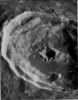
APOLLO 17 AS 17-3072.jpgAS 17-3062 - Timocharis Crater55 visiteThis oblique view of the crater Timocharis in Southe-Eastern Mare Imbrium illustrates how the original diameter of a crater is enlarged by slumping of its walls. Its present diameter is about 35 Km. The sparsity of small superposed craters on the walls of Timocharis - in contrast to their density on its floor and rim - is caused by the erosive effect of downslope movement of material on the steep walls. Timocharis, like many other young impact craters of similar size, possesses a well-defined central peak complex. Such structures are believed to result from elastic rebound of the bedrock immediately after the impacting event. However, the central peak of Timocharis apparently has been substantially modified by a large superimposed crater.
|
|

APOLLO 15 AS 15-9866.jpgAS 15-9866 - Jansen "B" Crater55 visiteHigh Sun views such as this often show fascinating dark and bright patterns that would be overwhelmed by highlights or shadows if the Sun were lower in the sky. This view of the 17-Km-wide crater Jansen "B" shows numerous bright avalanche deposits on the steep crater walls, apparently originating at outcrop ledges near the top of the wall. Most avalanches stop in a moat at the base of the wall, but a few in the foreground extend out onto the irregular, inward- sloping floor.
The floor is a jumble of slump blocks.
Avalanching appears to be a major means of erosion on steep lunar slopes.
|
|

APOLLO 15 AS 15-9328.jpgAS 15-9328 - Bessel Crater55 visiteOutcrops of layered rock are strikingly evident in the upper part of the far wall of the crater Bessel (17- Km diameter) in South-Central Mare Serenitatis. The outcrop is most evident where it forms shadows; however, the dark debris that streams downslope from the layered rock is visible even on parts of the crater wall where the Sun has washed out all details of relief. The outcrop is at a uniform distance below the crater rim, indicating that the strata are horizontal. Thus, Bessel furnishes convincing evidence that mare surfaces are underlain by dark layered rock. The dark rock is now known to be basalt that accumulated as successive flows or layers of lava.
Bessel is youthful enough that boulders are abundant on its rim and floor.
An anomalously high number of boulders is visible in and around the 750-m diameter crater (arrow) on the floor.
|
|

APOLLO 15 AS 15-9874.jpgAS 15-9874 - Dawes Crater55 visiteThis is a near vertical view of the crater Dawes, 18 Km in diameter. Morphologically it is typical of many lunar craters in the 15- to 20-Km size range. It lacks terraced walls and distinct central peaks but has an extremely rough floor. Small terracelike structures on the crater floor (upper left, lower right) occur where the wall is bowed outward and probably represent slump deposits where portions of the crater wall have collapsed into the crater. Local stratigraphy is revealed in the walls of the crater, and material of different albedo is seen streaming down into the crater from various levels. The dark layer clearly visible in the upper part of the crater wall represents the thin mare deposits in this part of Northern Mare Tranquillitatis. The lighter gray material below it is a combination of underlying submare material and talus from units higher on the crater wall. The highest unit (white and gray) probably represents the ejecta blanket and may consist primarily of lighter lunar crustal material excavated from beneath the mare.
|
|

APOLLO 17 AS 17-3081.jpgAS 17-3081 - Pytheas Crater (HR)55 visiteThe Apollo 17 Panoramic Camera provided this high-resolution, enlarged view of the South Wall of Pytheas. Pytheas is about the same size as Bessel, but is located in South-Central Mare Imbrium, almost 1100 km West of Bessel.
The outcrops in the walls of the two craters are remarkably similar.
These and the many other craters in mare areas that contain outcrops of dark horizontally layered rock demonstrate the moonwide uniformity of conditions in the upper part of the mare basins.
|
|
| 86 immagini su 8 pagina(e) |
 |
|
|
5 | |
|
|





