| Piú viste - The Lunar Surface in HR |

APOLLO 15 AS 15-0274.jpgAS 15-0274 - Euler Crater56 visiteIn this oblique view of Euler, some details are shown that are not visible in other pictures. Note, for example, the ledges (L) of bedrock cropping out along the South Wall and the low terraces (T) at the points of contact between the slump masses and the floor. They may be aprons of debris or "bathtub rings" of lava. This oblique viewing angle also enhances the polygonal outline of Euler's rim crest and the size and ruggedness of the huge masses that have slumped from the walls.
|
|

APOLLO 15 AS 15-9299.jpgAS 15-9299 - Le Monnier Crater56 visiteOn January 16, 1973, the Soviet unmanned roving vehicle Lunokhod 2 was landed by Luna 21 in or near this area in the South-Eastern part of the crater Le Monnier. This crater is a large (61 Km) pre-Imbrian crater cut into terra at the Eastern edge of Mare Serenitatis before Serenitatis was flooded by mare laves. Part of Le Monnier's Southern wall fills the lower part of the picture. A conspicuous chain of elongate depressions has formed in the lava-filled floor of the crater. The chain trends 22 Km northward and its pattern is quite surely controlled by an underlying fracture system. Regionally, the inferred fracture system is concentric to the grossly circular Serenitatis Basin and in this area trends Northward. No comparably young structural features having the same trend cut the terrae surrounding Le Monnier. However, older structures having this trend occur in the southern and northern walls and rims of Le Monnier. The aligned depressions on the mare are mostly 300 to 400 mt wide and 30 to 60 mt deep. The three deepest stretches are 1 to 2 km long and about 50 to 65 m deep. These depressions probably were the locus of fissure eruptions of mare basalt. Withdrawal of the last lava back into the fissure may have created subsurface voids into which collapse took place, causing the depressions and accounting for the absence of raised rims on the depressions.
|
|
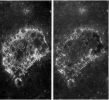
APOLLO 15 AS 15-9960.jpgAS 15-9960 - The "D" in "Detail"...56 visiteThe enlarged view provided by this stereogram shows that there are at least 3 different types of material within the floor of the D-shaped depression (see AS 17-1672). A brighter annulus parallels the wall, and darker material fills the inner floor.
Within both areas numerous bulbous and slightly raised comical structures are easily distinguishable.
There are craters on the summits of many of the structures, suggesting that each one is probably an extrusive dome with a summit crater.
Many similar features on Earth are caused by the subterranean drainage of lavas following extrusion and release of pressure following the upward movement of a central plug.
|
|

APOLLO 16 AS 16-120-19266.jpgAS 16-120-19266 - The "Playa" of King Crater56 visiteThe Apollo 16 Astronauts captured this spectacular view of the large dark "pool" on the North flank of the crater King as they approached from the East.
The pool (also known as a "lake", "pond" or "playa") is in an old crater swamped by King ejecta. The maximum width of the pool is about 21 Km. The peculiar dark material that forms the large pool and also coats adjacent hills was first discovered on Apollo 10 and was later seen again from Apollo 14.
The most exciting part of the discovery had to wait until the mapping and Panoramic Cameras of Apollo 16 showed that this material contains some of the freshest and most spectacular flow structures on the Moon.
These structures, some of which are seen in the following figures, show that the material behaved like lava.
The material is very similar in appearance to that filling parts of the floor of King.
|
|

APOLLO 15 AS 15-2405.jpgAS 15-2405 - Craters Messier and Messier "A"56 visiteMessier (1) and Messier A (2) are a pair of unusual craters in North-Western Mare Fecunditatis. Messier is elliptical and has bright walls and light rays of ejecta extending at right angles to its long axis (approx. 16,5 Km). Messier A is a doublet crater having two very long rays or filaments of ejecta extending Westward from it. The east part of the doublet has steep, bright walls, whereas the west part is dark and appears mantled. Differences between the two parts are more clearly shown in this oblique view of Messier A (see AS 16-4471). Both craters resemble some small experimental impact craters produced in sand by projectiles following shallow trajectories (4° or less from the horizontal) at velocities of approximately 1,7 Km/s. In separate experiments using single projectiles, both elliptical craters with lateral ejecta lobes and doublet craters have been produced. Thus, it can be inferred that these lunar craters were produced by high velocity projectiles following shallow trajectories. By further analogy with the experiments, the projectiles that formed Messier and Messier A apparently traveled from east to west".
|
|

APOLLO 16 AS 16-5006 (1).jpgAS 16-5006 - Details of King Crater (1)56 visiteHere is an enlarged vertical view of more flow lobes inside King Crater. Fine lineations radial to King are prominent in the ejecta blanket behind (South-East of) the lobate fronts. The term "deceleration lobe" has been applied because the lobes occur only where the ejecta slowed down and came to rest on slopes that face toward King. They resemble terrestrial rock avalanche deposits that came to rest after climbing a small slope. Some lobes overlap each other outward like shingles.
The sketch (2) shows what would probably be seen in a cutaway view. The arrow shows the direction of movement of the ejecta over the old landscape.
|
|
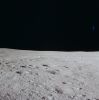
APOLLO_14_AS_14-66-9290_(HR).jpgAS 14-66-9290 (HR) - Looking for the Blue Flare... (2)56 visiteMa si tratterà poi davvero della Blue Flare che ha colto di sorpresa ed ha affascinato, assieme a migliaia di Private Researchers, anche la NASA, oppure siamo davanti ad un nuovo caso di superimposed image/photoartifact e cioè un dettaglio controverso (ergo - spesso - una possibile Anomalìa) il quale, assente nella versione raw del frame originale, poi appare misteriosamente nelle sue versioni digitalmente ripulite ed elaborate in HR?
MareKromium
|
|

APOLLO_14_AS_14-66-9309_(HR).jpgAS 14-66-9309 (HR) - Looking for the Blue Flare... (14)56 visiteEd ancora una serie di frames che probabilmente riprendono la Blue Flare...Un grazie grandissimo al Dr Gianluigi Barca, per la pazienza, la dedizione e l'"occhio"!
Caption NASA:"Rightward of 9308, centered on the SWC (Solar Wind Collector)".MareKromium
|
|

APOLLO_14_AS_14-66-9316_(HR).jpgAS 14-66-9316 (HR) - Looking for the Blue Flare... (16)56 visitenessun commentoMareKromium
|
|

APOLLO_14_AS_14-66-9337_(HR).jpgAS 14-66-9337 (HR) - Looking for the Blue Flare... (18)56 visiteCaption NASA:"Post-EVA-2 photo out Ed's window showing the 'javelin' and one of the golf balls in a crater north of the LM. The javelin is lined up with Turtle Rock in the distance and with the golf ball, which is slightly closer to us than the javalin".MareKromium
|
|
APOLLO_15_-_AS15-84-11311_HR.jpgAS 15-84-11311 - Mount Hadley56 visitenessun commentoMareKromium
|
|

APOLLO_15_-_AS15-84-11316_HR.jpgAS 15-84-11316 - Mount Hadley (Natural Colors - enhanced -; credits: Lunar Explorer Italia)56 visiteCaption NASA:"Dave (Scott) has turned his attention to the hill which is immediately South of Mt. Hadley. At 144:50:48 MT, Dave refers to this feature as the "forward, leading edge of Swann Mountain", but he may have meant the 'leading edge of the Swann Range'.
MareKromium
|
|
| 86 immagini su 8 pagina(e) |
 |
|
4 | |
|
|
|





