| Piú viste - The Lunar Surface in HR |

APOLLO_15_-_AS15-84-11294_HR.jpgAS 15-84-11294 - Mount Hadley (partially Sunstruck)57 visitenessun commentoMareKromium
|
|

APOLLO_15_-_AS15-84-11312_HR.jpgAS 15-84-11312 - Mount Hadley57 visitenessun commentoMareKromium
|
|

APOLLO 14 AS 14-70-9671.jpgAS 14-70-9671 - The "Bright One"56 visiteThis crater on the Lunar Far-Side is similar in age and size to the near- side crater Euler. It is located midway between the craters Becvar and Langemak. About 36 Km in diameter, it was informally called the "Bright One" by the Apollo 14 Astronauts because of its bright ejecta and ray pattern. The bright halo that surrounds the crater is about 150 Km in diameter. Its brightness is not evident in this view because the picture was taken when the Sun angle was low. The radial pattern of dunelike ejecta around the crater is most apparent where the Sun's rays are perpendicular to the direction of ejecta flow, as in the lower part of the picture. The hummocky or bumpy floor of the crater is caused largely by material that has slumped from the walls. Stuart A. Roosa, the Apollo 14 CMP, used a handheld camera with an 80-mm lens for this photograph. Later, using a 500-mm lens, he photographed in much more detail that part of the floor of the crater outlined in this photograph and shown in AS 14-9975.
|
|

APOLLO 14 AS 14-72-9975.jpgAS 14-72-9975 - The "Bright One" (detail mgnf)56 visiteWhen photographed with the 500-mm lens, the abundance of blocks (bright spots with shadows extending to the right) attests to the freshness of the materials on the floor of the "Bright One". Material that has flowed and in some instances formed smooth-surfaced "pools" is evident in much of the area. Arrows mark the edge of a major flow distinguished by its surface texture, color (in the original negative), location in a topographic low, and clearly defined border. Note that the abundance of boulders in the flow is much less than in nearby areas, presumably because the flow has buried most of the boulders in its path. Scientists generally agree that material has flowed here, and on the floors and flanks of many other craters, but the nature of the material that has flowed is a matter of debate.
|
|
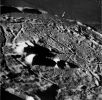
APOLLO 16 AS 16-120-19295~0.jpgAS 16-120-19295 - Gassendi56 visiteThis view into the shallow crater Gassendi shows another strongly fractured crater floor. Gassendi is about 110 Km wide. Dark mare lavas in the distance embay the rim and a little of the interior of Gassendi. They may have entered the crater through the narrow gap partly in shadow below the arrow. Most craters that have fractured floors are near areas of mare flooding. This suggests that the fracturing is a consequence of volcanic activity. An area next to the central peaks of Gassendi was the runnerup choice for a landing site for Apollo 17.
|
|

APOLLO 15 AS 15-1541.jpgAS 15-1541 - Archimedes and Aristillus56 visiteThe ejecta blanket and secondary impact craters of the mare-filled crater Archimedes (80 Km in diameter) are visible on the terrain toward the viewer (South) but not on the mare surface to the crater's left and right. Yet at one time ejecta like that to the south must have completely surrounded Archimedes because similar ejecta surrounds craters such as Aristillus (upper right). Thus, the mare lavas, in addition to filling the interior of Archimedes, obviously have covered the eastern and western parts of the ejecta. In turn, ejecta from Archimedes has covered materials of the Imbrium Basin like the rugged hills in the lower left of the picture. These stratigraphic relations prove that time elapsed between formation of the Imbrium basin and its filling by mare-time enough for impacts to create Archimedes, the deeply flooded crater to its right (arrow), and similar "Imbrian-age" craters elsewhere, as was pointed out by Eugene Shoemaker in 1962.
Archimedes has no visible central peak complex. Presumably the complex exists but has been completely inundated by the mare.
|
|

APOLLO 16-4136-A.jpgAS 16-4136 - Cratered Region near Mandel'shtam (1)56 visiteThis view looks southward near Mandel'shtam on the Lunar Far-Side. Most young lunar craters wider than about 40 Km have flows on their rims that resemble lava flows or mud flows on Earth. The unnamed crater near the top is about 14 Km wide and was recognized by H. J. Moore (1972) as being the smallest crater known to have such flows. Flows in the middle of the picture surged downhill off the high rim of the crater making lobes and tongues and leaving behind drained channels with levees.
In the area to the right of the crater, enlarged in the next frame, are some thin lobate flows that apparently rode over small hills, as if these flows were propelled outward from the crater with sufficient velocity to climb the hills. Ejecta deposits farther than about 1 Km from the rim are radially lineated and are smoother than the ground immediately surrounding the crater. The crisp, blocky zone around the crater is typical of many fresh craters.
|
|

APOLLO 16 AS 16-4511.jpgAS 16-4511 - Crater "Rays"56 visiteThis picture shows the striking bilateral symmetry of the rays of a small (2-Km diameter) crater in the floor of the large crater Daguerre in Mare Nectaris. Continuous areas and narrow filaments of light-gray ejecta extend from the crater across the dark mare surface through 270°, but are entirely absent in the southern 90° sector. Within the crater, dark material occurs on the southern crater wall while the remaining walls are bright. (The reader may wonder about the material whose reflectivity cannot be observed because it lies in shadow on the East wall of this crater. Until the area is observed under high Sun conditions, we are forced to make the simplifying assumption that it is bright because most of the materials visible elsewhere in the walls are bright).
This crater probably resulted from the impact of a projectile traveling from South to North along an oblique trajectory.
Its pattern of ejecta distribution is similar to that of small craters produced by the impact of missiles along oblique trajectories at the White Sands Missile Range, N. Mex. Some observers postulate that the dark material is a talus deposit of mare material that has fallen into the crater.
|
|

APOLLO 15 AS 15-9287.jpgAS 15-9287 - A "Middle-aged" Crater56 visiteRemarkable detail is shown in this enlargement of a small part of a panoramic camera frame. In most respects, the crater itself is typical of a great many craters its size-about 1,2 Km. Because it does not have rays, it is believed to be older than most other Lunar craters. Its rounded rim crest and slightly raised rim (extending outward to the arrow, on the West side) also point to its greater age. On the other hand, it is young enough that some of the original dunelike texture of the ejecta blanket is preserved (especially to the West), a great many large blocks of ejecta are still visible, and the original depth of the crater has not been greatly lessened by infalling debris. The largest blocks, which are about 30 mt in size, occur near the rim. The terrace (T) extending partly around the wall about 100 mt below the surface probably marks the top of a resistant rock layer. However, if there were other signs of bedrock stratification within this crater, they have been obscured by the movement of debris down the walls. The very smooth floor is the only unusual feature of this crater. It may consist of a solidified pool of rock melted by heat generated from the impact.
|
|

APOLLO 16 AS 16-4502.jpgAS 16-4502 - The beautiful Isidorus "D"56 visiteThis oblique view of the crater Isidorus "D" was taken with the PanCam on Apollo 16. Isidorus "D" is about 15 Km in diameter and is located in the highlands between Mare Tranquillitatis and Mare Nectaris.
Evidence of avalanching (Howard, 1973) and of other types of downslope movement of material are clearly visible on the inner walls of the crater. The streaks resembling shooting stars on the left wall appear to be avalanche scars. The avalanches probably were spearheaded by large blocks followed by fine-grained material. On the near wall (arrow) a larger landslide terminates in a straight line against the relatively flat crater floor. In the shadowed part of the crater wall many short irregular benches or narrow terraces mark the tops of masses of slumped material. The brightness of the avalanche scars is an indication of their freshness; in general, freshly exposed lunar materials are brighter than undisturbed materials nearby.
|
|

APOLLO 17 AS 17-2321.jpgAS 17-2321 - Crater Chain56 visiteThis crater chain in Southern Mare Serenitatis is clearly of internal origin because it is lined up parallel to several fault valleys or grabens.
The craters in the chain do not appear to have any rims; consequently, they may have formed by collapse and not by the explosive ejection of volcanic material.
The large crater in the right side of this scene, however, has a rim and so cannot be the result of collapse alone.
The finely lineated texture across the left side of the photograph is caused by ejecta from the crater Dawes to the south.
|
|

APOLLO 16 AS 16-4530.jpgAS 16-4530 - Seconday impact craters, faults and rifles56 visiteLinear features of external and internal origin are contrasted in this area of Southernmost Mare Tranquillitatis.
The North-trending line of overlapping, very irregular craters along the East edge of the picture is clearly a chain of secondary impact craters. Its trend is radial to Theophilus, a large crater of early Copernican age that lies about 105 Km south of this area. The flaring shapes of some of the craters and their state of preservation also suggest that Theophilus is the primary crater. The narrow, straight rifle or graben that extends westward across the picture is clearly of internal origin. It formed when tensional forces ruptured the crust, causing the floor of the rifle to subside along faults.
Straight rifles are commonly the sites of volcanic cones or of blankets of volcanic ejecta; however, there are no signs of volcanism here that can be related to this rifle.
|
|
| 86 immagini su 8 pagina(e) |
 |
3 | |
|
|
|
|





