| Piú viste - The Lunar Surface in HR |

APOLLO 15 AS 15-1030.jpgAS 15-1030 - Tsiolkovsky61 visiteThis vertical view shows the central part of Tsiolkovsky in more detail. From the nature of the boundary between the dark mare lavas and the lighter materials at the base of the walls and in the central peak, we know that the lavas must have lapped upon and embayed the lighter materials. The relatively level areas of lighter material in the southwest and northwest parts of the floor have a distinctly different texture than the coarse blocky materials of slumped wall that surround the floor elsewhere. Finely cracked, furrowed, and hummocky, they closely resemble parts of the floor of the crater King. They probably consist of impact melt that solidified to form the original floor of Tsiolkovsky before it was flooded by mare lavas.
|
|

APOLLO 17 AS 17-151-23260.jpgAS 17-151-23260 - Copernicus Crater61 visiteThe large Crater Copernicus has served as a type example of Lunar Impact Craters since the classic analysis was made by E. M. Shoemaker in 1962. Bright rays of ejecta radiate outward from Copernicus across a large part of the Moon's Near-Side. Material from one of the rays may have been sampled at the Apollo 12 Landing Site, 370 Km South of the center of the crater. This photograph shows how the Crater appeared from the Apollo 17 spacecraft looking Southward over the Montes Carpatus (Carpathian Mountains).
Notice that the rim deposits immediately adjacent to the Crater have a very crisp, blocky appearance in contrast to the softer appearance of the rest of the ejecta blanket. This crisp zone is also found on many other craters and suggests the ejecta here was swept clean by some erosion process late in the cratering event. The terraced slumps on the Crater wall appear like giant stair steps leading to the floor, 3 to 4 Km below the rim. The 1-Km-high central peaks were made famous in 1966 by a "Picture of the century" view looking into the crater from the south by Lunar Orbiter 2. Now Apollo has given us scores of even more spectacular photographs.
|
|

APOLLO 16 AS 16-1973.jpgAS 16-1973 - The "Davy Crater Chain"59 visiteThe Davy Crater Chain (arrow) is one of the most spectacular chains of craters on the Moon. It extends for about 50 Km across the floor of the large, very old crater Davy "Y" and onto its eastern rim. The chain may be related in origin to the pair of irregular craters Davy "G" and Davy "GA", 75 Km from the furthest end of the chain.
Two origins have been proposed: some lunar geologists believe it is a chain of secondary impact craters and others believe it is a line of volcanic craters. The simple geometry of the Davy Chain, the symmetry and uniform spacing of its individual craters and its alinement with Davy "G", strongly support, in my opinion, a volcanic origin. Also arguing against a secondary impact origin is the fact that the Davy Chain is a lone feature. There are no other similar chains with this trend in the area. Secondary crater chains tend to occur in large numbers within the belt of secondary craters surrounding a large primary crater.
On Earth some rocks from deep within the crust have been brought to the surface through volcanic orifices, thus providing a means of studying material that would otherwise be inaccessible. For this reason the Davy area was once seriously considered as a landing site. However, when the originally planned number of Apollo missions was reduced, the Davy area was one of those eliminated.
|
|

APOLLO_15_-_AS15-84-11315_HR.jpgAS 15-84-11315 - Mount Hadley59 visiteCaption NASA:"144:47:51 MT - This frame ends Dave Scott's vertical sequence of pictures of the West Face of Mt. Hadley. It is probably the best picture of the "high water marks" at the base of the mountain".MareKromium
|
|

APOLLO_15_-_AS15-84-11320_HR.jpgAS 15-84-11320 - Mount Hadley59 visitenessun commentoMareKromium
|
|
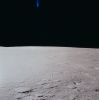
APOLLO_14_AS_14-66-9295_(HR).jpgAS 14-66-9295 (HR) - Looking for the Blue Flare... (7)58 visitenessun commentoMareKromium
|
|

APOLLO_15_-_AS15-84-11314_HR.jpgAS 15-84-11314 - Mount Hadley58 visitenessun commentoMareKromium
|
|

APOLLO 15 AS 15-2510.jpgAS 15-2510 - Humboldt Crater57 visiteThe crater Humboldt, on the east limb of the Moon, as seen from Earth, is 200 km across, a little larger than Tsiolkovsky. This view by the Apollo 15 mapping camera looks southward across Humboldt's ejecta blanket and into the crater. Irregular secondary craters partly covered by the ejecta are in the foreground and a long chain of secondaries extends from Humboldt's rim to the foreground. Humboldt is one of the largest craters known to have a prominent central peak. If the crater is like terrestrial impact structures, the peak may expose rock uplifted about 10% of the crater's width, on the order of 20 Km from beneath the crater floor. This would be an exciting find for future Astronauts. A spider web of cracks on the crater floor suggested to R. B. Baldwin (1968) that the floor was bowed up in the middle. Later, dark mare lavas flooded low areas in the outer part of the floor and covered the cracks. A peculiar "bull's eye" double crater on the crater floor has several counterparts elsewhere on the Moon. The origin of these double craters is a continuing puzzle.
|
|

APOLLO 16 AS 16-4559.jpgAS 16-4559 - Kant "P" Crater and its "inner" crater57 visiteKant "P" is a medium-sized crater located in the central highlands on the Moon's Near-Side. About 5,5 Km in diameter, its overall shape is not in the least unusual. However, the younger, small pear-shaped crater on Kant "P"'s North wall is an excellent example of the controlling effect that topographic relief plays on the shape of an impact crater. Because the small crater was formed on a steeply sloping surface, its ejecta was deposited chiefly downslope and formed a broad rim. The original rim and wall on the upslope side have been obliterated by slumping.
The slumping has left a landslide scar and has caused talus and scree to be deposited in the lower part of the crater.
|
|

APOLLO_14_AS_14-66-9299_HR.jpgAS 14-66-9299 (HR) - Looking for the Blue Flare... (11)57 visitenessun commentoMareKromium
|
|

APOLLO_14_AS_14-66-9335_(HR).jpgAS 14-66-9335 (HR) - Looking for the Blue Flare... (17)57 visiteCaption NASA:"This frame was probably taken out Ed's window, a conclusion based on the relative azimuths of some small foreground rocks and the ALSEP instruments".MareKromium
|
|

APOLLO_14_AS_14-66-9345_(HR).jpgAS 14-66-9345 (HR) - Looking for the Blue Flare... (20)57 visiteCaption NASA:"View of the CSM Kitty Hawk from the LM Antares during rendezvous".
MareKromium
|
|
| 86 immagini su 8 pagina(e) |
2 |  |
|
|
|
|
|





