| |

| Piú viste - The Soviet "Moon Programme" |

Luna17-Horz02.jpgTracks on the Moon282 visiteAs with many Soviet space images, generation loss prevents us from seeing the original quality. Most Lunokhod images are derived from scanning printed images or second-generation film copies.
Each stage of photography, printing and scanning introduces noise, nonlinear brighness mapping, and (worst of all) clamping to white or black.
As a matter of fact, all these images only hint at the appearance of the original video signal.
Nota: oltre le tecnicalità sulla fotografia, guardate attentamente il "nido" e le "tracce" lasciate dal Rover Lunokhod-1. Eravamo nel 1970, in piena Era Apollo, lontanissimi dai giorni di Spirit ed Opportunity eppure...eppure la tecnologia di Spirit ed Opportunity c'era già: davanti a noi, in queste immagini, e sulla Luna.
Le considerazioni - inevitabili - che seguono, già le conoscete...
|
|
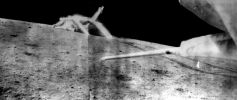
Luna17-Horz01.jpgMare Imbrium: the Rover is leaving the "nest"...265 visiteLuna-17 landed on the Moon on November 15, 1970. The robotic rover, Lunokhod-1 rolled off the landing platform to explore the surface of the Moon for about a month. Two cycloramic cameras on either side of the rover were oriented for 180° horizontal panoramas (500×3000 pixels). These panoramas are sometimes geometrically warped to correct for the 15° tilt of the camera. Two other cameras were oriented for 360° vertical panoramas of 500×6000 pixels, including images of the sky, for star locations. A level indicator was placed below these cameras, with a bull's eye pattern and a small metal ball bearing.
Over 200 panoramas were returned. Two cameras transmitted simultaneously, on 130 and 190 KHz subcarriers. Analysis of these images was carried out by the Sternberg Astronomical Institute (SAI), the Vernadskii Geophysical Institute (GEOKhI), and the Space Research Institute (IKI). The cameras were built by Arnold Selivanov's Team.
|
|

Zp-Laika.jpgHero!260 visiteLaika (traslitterato: Lajka, "Piccolo abbaiatore"), Mosca, 1954 – Spazio, 3 novembre 1957) è uno dei nomi con cui è nota la cagnolina che il 3 novembre 1957 fu imbarcata a bordo della capsula spaziale sovietica Sputnik 2, diventando così il primo animale ad orbitare intorno alla Terra. Una Eroina a "4 zampe" che il Mondo NON deve e NON può dimenticare. Qualsiasi cosa si possa dire adesso. Onore, per Sempre.MareKromium
|
|

Luna17-Horz03-a.jpgThe "Nest" of Lunokhod-1225 visitenessun commento
|
|

Luna09-DailyExpress.jpgThe surface of Oceanus Procellarum222 visiteThe List:
Luna 1: launched on January, 2, 1959 - Lunar Fly-By;
Luna 2: launched on September, 12, 1959 - Impacted Moon on Sept. 14, 1959 at ~07:30:00 UT (Lat. 29,10° N; Long. 0.00 - Palus Putredinis);
Luna 3: launched on October, 4, 1959 - Lunar Fly-by;
Luna 4: launched on April, 2, 1963 - Lunar Fly-By;
Luna 5: launched on May, 9, 1965 - Impacted Moon (Mare Nubium);
Luna 6: launched on June, 8, 1965 - Attempted Lander - Missed Moon;
Luna 7: launched on October, 4, 1965 - Lunar Impact - Oceanus Procellarum;
Luna 8: launched on December,3, 1965 - Lunar Impact - Oceanus Procellarum;
Luna 9: launched on January, 31, 1966 - Landed on the Moon on Feb., 3, 1966, at 18:44:52 UT (Lat. 7,08° N; Long. 295,63° E - Oceanus Procellarum);
Luna 10: launched on March, 31, 1966 - LO
Luna 11: launched on August, 24, 1966 - LO
Luna 12: launched on October, 22, 1966 - LO
Luna 13: launched on December, 21, 1966 - Landed on the Moon on Dec., 24, 1966 at 18:01:00 UT (Lat. 18,87° N; 297,95° E - Oceanus Procellarum).
|
|

Zond-06-03c.jpgLunar Surface from ZOND-6220 visiteCerchiatura Rossa (Sx): si vede una striscia scura (simile ad una landing strip) che si diparte da un rilievo anomalo ed indefinito (in basso, accanto al punto verde).
Può trattarsi di un effetto ottico derivante dalla non buona qualità del frame così come potrebbe essere un photoartifact. O magari, perchè no?, un'effettiva Anomalìa di Superficie.
Cerchiatura Rossa (Dx): evidenziamo un rilievo (un cratere?) decisamente più luminoso dei rilievi circostanti (high albedo?) il quale ci sembra di più essere un qualcosa di sovrapposto al paesaggio piuttosto che una parte di esso.
Valgono comunque, anche in questo caso, le medesime considerazioni svolte in precedenza.
|
|

Zond-07-09.jpgSetting Earth, from ZOND-7 (2)205 visiteZond-7 photographed the Earth on August 9, 1969, and performed two photo sessions at the Moon on August 11, 1969. It shot 35 pictures with the SKD camera and 300 mm objective, on 5,6 × 5,6 cm frames of color and panchromatic film.
Come definire i risultati fotografici di Zond-7? Giudicate Voi stessi: sono, a nostro parere, delle immagini splendide e di una qualità così alta da far impallidire i miseri e scialbi fotogrammi ottenuti dalla Sonda ESA SMART-1 la quale, dopo tante chiacchiere e promesse di scoperta e divulgazione (promesse, ad oggi, NON mantenute), sembra già essere piombata - con merito - nel dimenticatoio...
|
|

Luna17-Horz09-a.jpgThe "Nest" of Lunokhod-1 (close detail)199 visitenessun commento
|
|

Luna17-Horz13-a.jpgLunar Crater195 visiteUn cratere senza nome e dalle dimensioni non precisate (ma comunque diremmo che esso potrebbe avere un diametro compreso fra gli 8 ed i 10 metri) staziona davanti alle telecamere del Lunokhod-1.
Non sappiamo se esso venne "visitato".
|
|

Luna17-Horz03-b.jpgThe "Tracks" - again - of Lunokhod-1182 visiteLuna 17 was launched from an Earth parking orbit towards the Moon and entered lunar orbit on November 15, 1970. The spacecraft soft landed on the Moon in the Sea of Rains. The spacecraft had dual ramps by which the payload, Lunokhod-1, descended to the Lunar Surface. Lunokhod-1 was a lunar vehicle formed of a tub-like compartment with a large convex lid on eight independently powered wheels. Lunokhod-1 was equipped with a cone-shaped antenna, a highly directional helical antenna, 4 tv cameras and special extendable device to impact the lunar soil for soil density and mechanical property tests. An X-Ray spectrometer, an X-Ray telescope, cosmic-ray detectors and a laser device were also included. The vehicle was powered by a solar cell array mounted on the underside of the lid. Lunokhod-1 was intended to operate through 3 Lunar Days but actually operated for 11! The operations of Lunokhod-1 officially ceased on October, 4, 1971, the anniversary of Sputnik 1. Lunokhod1- traveled 10,54 Km and transmitted more than 20,000 TV pictures and more than 200 TV panoramas. It had also conducted more than 500 lunar soil tests.
|
|

Luna13-1.jpgOceanus Procellarum181 visiteThe Luna 13 spacecraft was launched toward the Moon from an earth-orbiting platform and accomplished a soft landing on December 24, 1966, in the Region of Oceanus Procellarum. The petal encasement of the spacecraft was opened, antennas were erected, and radio transmissions to Earth began 4 minutes after the landing. On December 25 and 26, 1966, the spacecraft television system transmitted panoramas of the nearby Lunar Landscape at different Sun angles and each panorama required approx. 100' to transmit. The spacecraft was equipped with a mechanical soil-measuring penetrometer, a dynamograph and a radiation densitometer for obtaining data on the mechanical/physical properties of the Lunar Surface as well as of and the cosmic-ray reflectivity.
Luna 13 transmitted 5 cycloramas over a period of 5/6 days.
It is believed that transmissions from the spacecraft ceased before the end of December 1966.
|
|

Luna17-Video.jpgThe "Nest" of Lunokhod-1 (video picture)174 visiteOver 20.000 low-resolution (LR) video pictures were transmitted by Luna 17, primarily for use by the drivers to navigate the Rover. Note the usual horizontal scanlines of a TV camera, as opposed to the vertical scanlines of the cycloramic cameras.
|
|
| 84 immagini su 7 pagina(e) |
1 |
|
|
|
|
|
|
|





