| Piú viste - Asteroids and Comets |

Asteroids-Annefrank_Asteroid-PIA02885_modest.jpgAsteroid Annefrank from Stardust66 visiteAsteroid Annefrank is seen as irregularly shaped, cratered body in an image taken by NASA's Stardust spacecraft during a Nov. 2 flyby of the asteroid.
Stardust flew within about 3.300 Km (about 2.050 miles) of the asteroid as a rehearsal for the spacecraft's encounter with its primary target, comet Wild 2, in January 2004. The camera's resolution was sufficient to show that Annefrank is about 8 Km (5 miles) in length, twice the predicted size from Earth-based observations. The surface reflects about 0,1 to 0,2% of sunlight, slightly less than anticipated. A few craters that are hundreds of meters across can be seen. The straight edge in the right side of the image may be an artifact of processing.
|
|

Eros from 250 mt - PIA03147_modest.jpgFalling down: Eros from 250 mt66 visiteCaption NASA:"...The image is 12 meters across. The cluster of rocks at the upper right measures 1.4 meters across...". Vale quanto già detto in precedenza: riuscite a vedere dei dettagli già presenti nel frame precedente?!?
NEAR, scendendo, fotografa "random"?
|
|

Asteroid_DD-45-b.gifAsteroid 2009 DD-45 (GIF-Movie)66 visiteVersione accelerata, leggermente ingrandita ed a contrasti amplificati della GIF-Movie che potrebbe aprire (anzi: che APRIRA'!) un autentico "caso ufologico": guardate e stupite!
...E complimenti al "mitico" Marco Faccin, anche lui puntuale come la Clock-Tower di Londra!MareKromium
|
|
3I-ATLAS_06.gif3I/ATLAS from ExoMars Trace Gas Orbiter (TGO)66 visitenessun commentoMareKromium
|
|

Itokawa-05.jpgOrbiting around Itokawa (2)65 visiteHayabusa is a technology demonstration spacecraft focusing on key technologies that are required for future large-scale sample and return missions, yet is also making new scientific observations and discoveries. The technology demonstration component of the mission consists of 5 goals:
1) ion engine propulsion in interplanetary cruise;
2) ion engine propulsion in combination with an Earth gravity assist;
3) autonomous guidance and navigation using optical measurements;
4) collection of surface samples in an ultra-low gravity environment and
5) the direct recovery of these samples on the ground after its return from interplanetary flight.
To date the Hayabusa project has accomplished these demonstrations up through
the third goal.
|
|
3I-ATLAS_00.gif3I/ ATLAS - PUNCH Mission spots65 visiteMareKromium
|
|

Comets-Comet_Holmes-UZ.jpgComet 17-P-Holmes, from Italy64 visiteRecent development from 17-P-Holmes: this picture is a deep image from L'Aquila, Italy on November 8, 2007.
It shows the ion tail disconnecting from the comet (just like it happened to the Encke Comet).
MareKromium
|
|
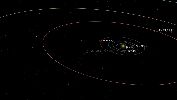
3I-ATLAS_05.gif3I/ATLAS - Orbital Path (GIF-Movie)64 visitenessun commentoMareKromium
|
|

EROS-PIA02951.jpgEros from above (1)63 visiteIn NEAR Shoemaker's long-awaited close-up images of Eros, the asteroid's small-scale features are revealing their fascinating diversity. This picture, taken July 8, 2000, from an orbital altitude of only 36 Km, shows a variety of differently shaped boulders. Some are nearly round, whereas others are elongated or even blade-shaped. Such varied shapes might arise from differences in the strength and fracturing of preexisting rock. The whole scene is about 1.4 Km across.
|
|

Comets-Comet_Ikeya_Zhang_2.jpgComet Ikeya-Zhang (from Colorado)63 visiteThis lovely early evening view of the comet in Rocky Mountain skies looks northwest over ridges and low clouds. The time exposure was recorded on March 31st from an 8.000 foot elevation near Yampa, Colorado, USA. Sporting a sweeping yellowish dust tail and blue ion tail eight to ten degrees long, Ikeya-Zhang is nestled near the horizon in the northern constellation of Andromeda. To the comet's left is the bright star Mirach or Beta Andromedae while the stretched celestial fuzzball to the comet's right is M 31 or the Andromeda galaxy, the nearest bright spiral galaxy to our own Milky Way. As the days pass, Comet Ikeya-Zhang's apparent motion through the sky is towards the right in this image. Tonight, comet-watchers blessed with clear skies should find Ikeya-Zhang posing perfectly for binoculars and cameras just above M 31, less than two degrees from the center of the bright galaxy.
|
|

McNaught-09.jpgThe "Tail" of McNaught, at Sunset...63 visiteCaption NASA originale:"What's happening over the horizon? Many a sky enthusiast who thought they had seen it all had never seen anything like this. To the surprise of many Northern Hemisphere observers, the tail of Comet McNaught remained visible even after the comet's head set ahead of the Sun. What's more, visible were bright but extremely rare filamentary striae from the comet's expansive dust tail. The cause of dust tail striae are not known for sure, but are possibly related to fragmentation of comet's nucleus. The last comet to show prominent striae was Comet Hale-Bopp in 1997.
Pictured above, the tail of Comet McNaught was caught just after Sunset last Friday above the Carnic Alps of Northern Italy".
|
|

Comets-Comet_Holmes-UW.jpgComet 17-P-Holmes is getting Bigger!63 visiteCaption NASA, da "NASA - Picture of the Day", del 5 Novembre 2007:"Comet Holmes continues to be an impressive sight to the unaided eye. The comet has diminished in brightness only slightly, and now clearly appears to have a larger angular extent than stars and planets.
Astrophotographers have also noted a distinctly green appearance to the comet's coma over the past week.
Pictured above over Spain in 3 digitally combined exposures, Comet 17P/Holmes now clearly sports a tail. The blue ion tail is created by the solar wind impacting ions in the coma of Comet Holmes and pushing them away from the Sun. Comet Holmes underwent an unexpected and dramatic increase in brightness starting only two weeks ago. The detail visible in Comet Holmes' tail indicates that the explosion of dust and gas that created this dramatic brightness increase is in an ongoing and complex event.
Comet Holmes will move only slightly on the sky over the next month (such as December 2007)".MareKromium
|
|
| 282 immagini su 24 pagina(e) |
 |
|
|
|
|
9 | |
|
|
|
|





