| Piú viste - Asteroids and Comets |

Hycean_Planet.jpgThe "Hycean Planets"91 visite(ANSA) - Milano, 26 Agosto – Identificata una nuova classe di pianeti potenzialmente abitabili al di fuori del Sistema solare: caldi, ricoperti da oceani e con un'atmosfera ricca di Idrogeno, i quali potrebbero ospitare microrganismi adatti a vivere in condizioni estreme. La scoperta è pubblicata su The Astrophysical Journal dai ricercatori dell'Università di Cambridge, che hanno chiamato questi mondi alieni 'Hycean Planets': più numerosi e meglio osservabili degli esopianeti di tipo terrestre, potrebbe accelerare la ricerca di tracce di vita portando ad avere le prime risposte già nel giro di due o tre anni. Questi nuovi esopianeti possono essere fino a 2,6 volte più grandi della Terra e possono avere temperatura atmosferiche che arrivano ai 200°: nonostante ciò presentano grandi oceani che potrebbero supportare forme di vita microbica simili ai batteri estremi che vivono sulla Terra. Inoltre hanno una zona abitabile molto più ampia rispetto agli esopianeti terrestri: ciò significa che possono ospitare la vita anche se orbitano intorno alla loro stella a distanze diverse rispetto a quelle considerate vincolanti affinché un pianeta terrestre possa presentare acqua liquida in superficie.
I ricercatori di Cambridge hanno già selezionato un numero consistente di potenziali 'Hycean Planets' che saranno i primi candidati per le osservazioni con i telescopi di nuova generazione, come il James Webb Space Telescope che sarà lanciato entro l'anno.MareKromium
|
|
Asteroids-469219-Kamo_oalewa-2.jpgKamo'oalewa91 visiteThe size of Kamo'oalewa has not yet been firmly established, but it is likely that it is approximately 40-to-100 meters (130–330 feet).Based on an assumed standard albedo for stony S-type asteroids of 0.20 and an absolute magnitude of 24.3, it measures 41 meters (135 ft) in diameter. Photometric observations in April 2017 revealed that Kamoʻoalewa is a fast rotator. Lightcurve analysis gave a rotation period of 0.467 ± 0.008 hours (28.02 ± 0.48 minutes) and a brightness variation of 0.80±0.05 magnitude (U=2). In 2021, a comprehensive physical characterization of Kamoʻoalewa was conducted using the Large Binocular Telescope and the Lowell Discovery Telescope, which found that the asteroid is composed of lunar-like silicates and may be an impact fragment from the Moon.
During the 2017 Astrodynamics Specialist Conference held in Stevenson in the U.S. state of Washington, a team composed of graduate research assistants from the University of Colorado Boulder and the São Paulo State University (UNESP) was awarded for presenting a project denominated "Near-Earth Asteroid Characterization and Observation (NEACO) Mission to Asteroid (469219) 2016 HO3", providing the first baselines for the investigation of this celestial object using a spacecraft. Recently, another version of this work was presented adopting different constraints in the dynamics.
The China National Space Administration (CNSA) is planning a robotic mission that would return samples from Kamoʻoalewa. Currently, this mission, via ZhengHe, is planned to launch in 2025.MareKromium
|
|

Comets-Comet_Hartley_2-NASA-2.jpgComet "Hartley 2" (Close-up and Dimensions)89 visitenessun commentoMareKromium
|
|

Comets-Comet_Hartley_2-NASA-0.jpgComet "Hartley 2" (an Image-Mosaic by NASA, JPL-Caltech, UMD, EPOXI Mission)89 visiteDa "NASA - Picture of the Day" del giorno 5 Novembre 2010:"Follow these 5 frames clockwise starting from the top left to track the view from the EPOXI Mission Spacecraft as it approached, passed under, and then looked back at the nucleus of comet Hartley 2 on November 4.
Its closest approach distance was about 700 Km. In fact, this encounter was the 5th time a spacecraft from planet Earth has imaged a comet close-up. But Hartley 2's Nucleus is definitely the smallest one so far, its long axis spanning only about 2 Km (such as approx. 1,2 miles).
Though Hartley 2 is small, these stunning images showing Jets of Dust and Gas indicate an impressively active surface. The Jets are seen originating from the rough surface areas, with Sunlight illuminating the Nucleus from the right. Remarkably, rough areas at both ends of the elongated Nucleus are joined by a narrower, smooth waist.
The EPOXI mission reuses the Deep Impact Spacecraft that launched a probe impacting the Nucleus of comet Tempel 1 in 2005".MareKromium
|
|

EROS-PIA02492.jpgEros in true colors87 visiteAs the NEAR Shoemaker spacecraft descends into lower orbits around Eros, it continually returns higher spatial resolution images of the asteroid. The true color image at left was taken February 12, 2000, from a range of 1.748 Km and shows details only as small as 180 meters (590 feet) across. It was taken two days before orbit insertion, as part of an image sequence designed to provide moderate-resolution color mapping of Eros at a near-constant viewing geometry. The true color image inset at right was taken February 29 from a range of 283 Km and shows much smaller details only 27 meters (89 feet) across.
|
|

Comets-Comet_SWAN-0.jpgComet SWAN87 visiteDa "NASA - Picture of the Day", del 19 Ottobre 2006:" This cosmic portrait recorded October 9th features the lovely blue-green coma of Comet SWAN posing with spiral galaxy NGC 5005 in the northern constellation Canes Venatici. At the time the comet (center) was in the close foreground, a mere 9 LM (Light-Minutes) from planet Earth, with the galaxy a more substantial 60 million LY (Light-Years) distant. Not actually related to a bird, Comet SWAN (C/2006 M4) was so named as it was first spotted in image data from the SWAN (Solar Wind ANisotropies) camera aboard the Sun-staring SOHO spacecraft. Having rounded the Sun, this comet is headed for interstellar space, but first it will make its closest approach to Earth on October 24. With binoculars, northern hemisphere observers can now spot the comet above the northwestern horizon, near the handle of the Big Dipper in the early evening sky".
|
|
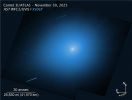
3I-ATLAS_01.gif3I/ATLAS from the HST86 visitenessun commentoMareKromium
|
|

Asteroids-3753-Cruithne-0.jpgAsteroid 3753 Cruithne85 visiteLA "Seconda Luna della Terra".MareKromium
|
|

Comets-Comet_ISON-Nucleus.jpgComet ISON (Tian Lian 1 - Satellite's View - Controversial: possible fake)84 visiteEd ecco il Nucleo di ISON: come vedete, assomiglia TANTISSIMO a quello di Tempel-1 e Wild-2. Mia opinione? Immagine genuina. Con tutto quanto ne segue e consegue... Il punto è che, a quanto leggo (ma NON sul Sito dell'Agenzia Spaziale Cinese, sul quale non posso capirci nulla), il Satellite Geostazionario Tian-Lian 1 NON ha fotocamere! E se questo è vero (ma non so se è vero), allora è evidente che siamo davanti all'ennesima bufala...MareKromium
|
|

Iustitia.jpgIustitia (Imagination)82 visitenessun commentoMareKromium
|
|
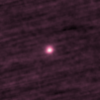
3I-ATLAS_02.gif3I/ATLAS82 visiteThis image shows the 3I/ATLAS interstellar comet as a bright, fuzzy orb in the center. Traveling through our solar system at 130,000 miles (209,000 kilometers) per hour, 3I/ATLAS was made visible by using a series of colorized stacked images from Sept. 11-25, using the Heliocentric Imager-1 (H1) instrument, a visible-light imager on the STEREO-A (Solar Terrestrial Relations Observatory) spacecraft. The colorization was applied to differentiate the image from other observing spacecraft images.MareKromium
|
|

Comets-Comet_Hartley_2-EB-LXTT3.jpgComet "Hartley 2" (credits for the additional process. and color.: Elisabetta Bonora - Lunexit Team)81 visitenessun commentoMareKromium
|
|
| 282 immagini su 24 pagina(e) |
 |
|
|
5 | |
|
|
|
|
|
|





