| Piú viste - Asteroids and Comets |

LLO-Itokawa-ST_2563511720_v.jpgThe unbelievable surface of 25143-Itokawa (HR5 - possible natural colors; elab. Lunexit)55 visitenessun commentoMareKromium
|
|

Comets-Hale-Bopp-01.jpgHale-Bopp - HST (2)54 visiteIn questi 8 frames HST l'Anomalia di cui parlavamo per il quadro precedente si vede ancora solo nelle prime due immagini (26 Settembre e 23 Ottobre). Noi diciamo con chiarezza che si tratta di qualcosa di reale e di inspiegabile; magari non sarà una Nave Spaziale aliena che si è accodata ad Hale-Bopp ma è certo che qualcosa era vicino alla cometa e 1) la seguiva oppure 2) faceva parte di essa.
Le Fonti Ufficiali non hanno detto MAI nulla, ma queste immagini parlano - chiaramente - da sole.
Che cosa, dunque, seguiva e/o accompagnava Hale-Bopp?!?...
|
|

Comets-Schwassmann_Wachmann_1-02.jpgComet Schwassmann-Wachmann 3 from HST54 visiteHubble Space Telescope is providing astronomers with extraordinary views of Comet 73P/Schwassmann-Wachmann 3. The fragile comet is rapidly disintegrating as it approaches the Sun. Hubble images have uncovered many more fragments than have been reported by ground-based observers. These observations provide an unprecedented opportunity to study the demise of a comet nucleus. The comet is currently a chain of over three dozen separate fragments, named alphabetically, stretching across the sky by several times the angular diameter of the Moon. Hubble caught two of the fragments (B and G) shortly after large outbursts in activity.
HST shows several dozen of "mini-comets" trailing behind each main fragment and probably associated with the ejection of house-sized chunks of surface material.
|
|

Comets-Schwassmann_Wachmann_1-03.jpgComet Schwassmann-Wachmann 3: fragment "B"54 visitePeriodic comet 73P/Schwassmann-Wachmann 3 has fallen apart before. A cosmic souffle of ice and dust left over from the early Solar System, this comet was seen to split into several large pieces during the close-in part of its orbit in 1995. However, this time the comet seems to be rapidly disintegrating with over 3 dozen fragments, named alphabetically, now stretching several degrees across the sky. Since comets are relatively fragile, stresses from heat and gravity and outgassing, for example, could be responsible for their tendency to breakup in such a spectacular fashion. On April 18th, 2006, HST recorded this sharp view of prolific Fragment B, itself trailing dozens of smaller pieces, each with its own cometary coma and tail. The picture spans over 3000 Km at the comet's April 18 distance of 32 MKM from planet Earth. With its brightest fragment presently too faint to be seen with the naked eye, comet Schwassmann-Wachmann 3 will pass closest to Earth on May 13 at a distance of about 11 MKM.
|
|
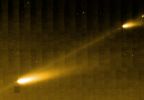
Comets-Schwassmann_Wachmann_1-04.jpgComet Schwassmann-Wachmann 3 from SST54 visiteThis image from NASA's Spitzer Space Telescope (SST) shows three of the many fragments making up Comet 73P/Schwassman-Wachmann 3. The infrared picture also provides the best look yet at the crumbling comet's trail of debris, seen here as a bridge connecting the larger fragments.
The comet circles around our Sun every 5,4 years.
In 1995, it splintered apart into four pieces, labeled "A" through "D", with "C" being the biggest. Since then, the comet has continued to fracture into dozens of additional pieces. This image is centered about midway between fragments "C" and "B"; fragment "G" can be seen in the upper right corner.
The comet's trail is made of dust, pebbles and rocks left in the comet's wake during its numerous journeys around the sun. Such debris can become the stuff of spectacular meteor showers on Earth.
This image was taken on April 1, 2006, by Spitzer's Multi-Band Imaging Photometer using the 24-micron wavelength channel.
|
|

LLP-Itokawa-ST_2539482843_v.pngFarewell to Itokawa! (1 - additional processing and coloring by Lunexit)54 visitenessun commentoMareKromium
|
|
|
|
| 282 immagini su 24 pagina(e) |
 |
|
|
|
|
|
|
|
|
24 |
|





