| Piú viste - Asteroids and Comets |

Eros-PIA02495_modest.jpgSide view and front view of a bright crater56 visiteLighting and viewing geometries make a huge difference in the appearance of Eros' surface features. One of the most striking examples is the 2.7 Km diameter crater shown in these two images. The image at left, looking at the crater nearly edge-on, was taken February 16, 2000, from a range of 341 Km. The image at right was taken high over the crater on March 2, 2000, from a range of 226 Km. In the first image the only visible part of the crater's interior is the far, bright wall, which at the time was well-lit. The lighting, in combination with the particular viewing angle, make the crater appear stunningly bright. In the second view, the brighter material occupies only part of the slightly-shaded interior, greatly reducing the overall brightness contrast between the crater and the surrounding terrain.
|
|
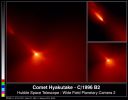
Comets-Comet_Hyakutake-PIA01290_modest.jpgThe "Hyakutake" Comet56 visiteFULL-FIELD VIEW (Left)--->This image is 3340 Km acroos and shows that most of the dust is being produced on the sunward-facing hemisphere of the comet. Also at upper left are 3 small pieces which have broken off the comet and are forming there own tails. Icy regions on the nucleus are activated as they rotate into sunlight, ejecting large amounts of dust in the jets that are faintly visible in this image. Sunlight striking this dust eventually turns it around and "blows" it into the tailward hemisphere. What might be another jet is emanating from the nightside of the nucleus, but this direction might be misleading due to the angle of the jet relative to our line-of-site.
CLOSE-UP OF NUCLEUS (Bottom Right) This expanded view of the near-nucleus region is only 760 Km across. The nucleus is near the center of the frame, but the brightest area is probably the tip of the strongest dust jet rather than the nucleus itself. Presumably, the nucleus surface lies just below this bright jet.
CLOSE-UP OF COMET FRAGMENTS (Top Right) This image shows pieces of the nucleus that apparently broke off and were first detected during ground-based observations on March 24. The Hubble image shows at least three separate objects that are probably made up of coarse-grained dust. Large fragments of the nucleus would not be accelerated into the tail, which appears to be the case in this image.
|
|

Tempel1-U-HST.jpgDeep-impact from HST56 visiteCaption NASA originale:"These 2 pictures of comet Tempel-1 were taken by NASA's HST. They show the comet before and after it ran over NASA's Deep Impact probe".
|
|

Tempel1-X.jpgDeep-impact...16 seconds after collision!56 visiteCaption NASA originale:"This image shows the initial ejecta that resulted when NASA's Deep Impact probe collided with comet Tempel-1 at 10:52 p.m. Pacific time, July 3 (1:52 a.m. Eastern time, July 4) . It was taken by the spacecraft's medium-resolution camera 16 seconds after impact".
|
|

Tenth_Planet-03.jpgThe 10th Planet? (3)56 visiteDa "NASA - Picture of the Day", del 1mo Agosto 2005:"Has a tenth planet been discovered? A newly discovered object, designated 2003 UB313 and located more than twice the distance of Pluto, is expected to be at least as large as Pluto and probably larger, given current measurements. 2003 UB313's dimness and highly tilted orbit (44°) prevented it from being discovered sooner. Many astronomers speculate that numerous other icy objects larger than Pluto likely exist in the Kuiper Belt of the far distant Solar System. If so, and if some are found closer in than 2003 UB313, it may be premature to call 2003 UB313 the tenth planet. Illustrated above is an artist's drawing showing what 2003 UB313 might look. The unusually bright star on the right is the Sun. Much of the world eagerly await the decision by the International Astronomical Union on whether 2003 UB313 will be designated a planet or given a name without subscripts".
|
|

Itokawa-11.jpgThe Landing Procedure56 visiteThe gravity and slope information and estimates of the density of boulders and regolith distribution on the surface, combined with comparisons with meteorites, will advance our interpretation and understanding of asteroid planetology.
D) Using the laser altimeter and optical navigation camera, along with range and range-rate measurements fromground-tracking stations, have led to a successful mass and density estimate for Itokawa. The density has been estimated to be 2,3 +/-0,3 gram/cc, which is a little lower than that measured for rocks on the ground or for other S-type asteroids measured to date. This may indicate that there is substantial porosity for this body and forces conventional views of these small objects to be changed drastically. When the samples are successfully returned and recovered, the actual porosity will be clarified and our knowledge of how the Earth relates to meteorites will be greatly improved.
|
|

Comets-Schwassmann_Wachmann_1-01.jpgComet Schwassmann-Wachmann 3: incoming Space debris!56 visiteDa "NASA - Picture of the Day" del 26 Aprile 2006:"A crumbling comet will soon pass near the Earth. Comet 73P/Schwassmann-Wachmann 3 is brightening and may even be visible to the unaided eye when the fragmented comet zooms past Earth during the middle of next month. Still, the small comet poses no Earth hazard, since it will pass the Earth at about 25 times the distance of the Moon. Exactly how bright Comet Schwassman-Wachmann 3 will get is unknown. It is even possible, althought unlikely, that debris from the comet will have spread out enough to cause a notable meteor shower. Pictured above, Fragment B of Comet Schwassman-Wachmann 3 was photographed two nights ago by a 8.2-meter Very Large Telescope in Chile. Visible to the lower right of the large B Fragment are many mini-comets that have broken off and now orbit the Sun separately. Each mini-comet itself sheds gas and dust and so appears to have its own hazy coma.
The comet will pass closest to the Sun on June 7, 2006".
|
|

Comets-Schwassmann_Wachmann_1-02.jpgComet Schwassmann-Wachmann 3 from HST56 visiteHubble Space Telescope is providing astronomers with extraordinary views of Comet 73P/Schwassmann-Wachmann 3. The fragile comet is rapidly disintegrating as it approaches the Sun. Hubble images have uncovered many more fragments than have been reported by ground-based observers. These observations provide an unprecedented opportunity to study the demise of a comet nucleus. The comet is currently a chain of over three dozen separate fragments, named alphabetically, stretching across the sky by several times the angular diameter of the Moon. Hubble caught two of the fragments (B and G) shortly after large outbursts in activity.
HST shows several dozen of "mini-comets" trailing behind each main fragment and probably associated with the ejection of house-sized chunks of surface material.
|
|

Eris.jpgAnother "Dwarf Planet" with satellite: 136199-Eris and Dysnomia56 visiteDa "NASA - Picture of the Day" del 18 Settembre 2006:"Is Pluto the largest Dwarf Planet? No! Currently, the largest known dwarf planet is 136199-Eris, renamed last week from 2003 UB313. Eris is just slightly larger than Pluto, but orbits as far as twice Pluto's distance from the Sun. Eris is shown above in an image taken by a 10-meter Keck Telescope from Hawaii, USA.
Like Pluto, Eris has a moon, which has been officially named by the International Astronomical Union as (136199) Eris I (Dysnomia). Dysnomia is visible above just to the right of Eris. Dwarf Planets Pluto and Eris are Trans-Neptunian Objects that orbit in the Kuiper belt of objects past Neptune. Eris was discovered in 2003, and is likely composed of frozen water-ice and methane. Since Pluto's recent demotion by the IAU from planet to dwarf planet status, Pluto has recently also been given a new numeric designation: 134340-Pluto.
Currently, the only other officially designated Dwarf Planet is 1-Ceres".
|
|

McNaught-04.jpgComet McNaught (5)56 visiteCaption NASA:"The brightest comet of recent decades was a surprising first sight for a new camera in space.
The Sun Earth Connection Coronal and Heliospheric Investigation (SECCHI) instrument onboard the Solar TErrestrial RElations Observatory (STEREO) satellite had just opened up on January 11, 2007, when it snapped the above image of Comet McNaught. Visible was a spectacular view of the ion tail of Comet McNaught being swept away from the Sun by the solar wind in filamentary rays. The comet tail is seen to extend at least seven degrees across the above image, while the central coma is so bright it saturates. Comet McNaught is now reportedly so bright that it is visible even in broad daylight by blocking out the Sun with your hand.
Comet McNaught has rounded the Sun and will slowly fade away for observers in Earth's Southern Hemisphere as it recedes from the Sun".
|
|

LLN-Itokawa-ST_2506464135_v.pngApproaching Itokawa (1 - natural colors; elab. Lunexit)56 visitenessun commentoMareKromium
|
|

LLO-Itokawa-ST_25590030-68_v.jpgThe unbelievable surface of 25143-Itokawa (HR2 - possible natural colors; elab. Lunexit)56 visitenessun commentoMareKromium
|
|
| 282 immagini su 24 pagina(e) |
 |
|
|
|
|
|
|
|
|
23 |
|





