| Piú viste - Asteroids and Comets |
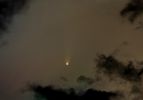
McNaught-00.jpgComet McNaught (1)57 visiteCaption NASA:"Early morning risers with a clear and unobstructed eastern horizon can enjoy the sight of Comet McNaught (C/2006 P1) in dawn skies over the next few days. Discovered in August by R. H. McNaught (Siding Spring Survey) the comet has grown bright enough to see with the unaided eye but will soon be lost in the glare of the Sun. Still, by January 11 sun-staring spacecraft SOHO should be able to offer web-based views as the comet heads toward a perihelion passage inside the orbit of Mercury. This image captures the new naked-eye comet at about 2nd magnitude in twilight skies near sunset on January 3rd. After rounding the Sun and emerging from the solar glare later this month, Comet McNaught could be even brighter".
|
|

McNaught-9.jpgComet McNaught (10)57 visiteCaption NASA:"By January 19/20, 2007, Comet McNaught's magnificent dust tail stretched for about 150 MKM (~1 AU), requiring images from both Southern and Northern Hemispheres of planet Earth to take it all in. Two such views - from Cerro Paranal in Chile (left) and the Carnic Alps in Italy - are combined in this unique graphic that also outlines a perspective view of the Comet's orbit (dotted line) and relative position of the Sun. Driven by solar radiation pressure the dust tail initially points away from the Sun, but also trails outside the comet's orbit. Astronomers try to account for the complex structure along the tail, including the pronounced striations, by considering forces acting on the dust (e.g. gravity, solar wind and radiation) as well as the release time and size of the dust grains. In the diagram, the modeled location of dust grains released at approximately the same time relative to perihelion passage, synchrones, are shown as dashed lines. The location of grains of similar size, syndynes, are shown as solid lines".
|
|

Eris_Dysnomia.jpgEris and Dysnomia57 visiteNASA's HST has teamed up with the W.M. Keck Observatory to precisely measure the mass of Eris, the largest member of a new class of Dwarf Planets in our Solar System. Eris is 1,27 times the mass of Pluto, formerly the largest member of the Kuiper Belt of icy objects beyond Neptune.
Hubble observations in 2006 showed that Eris is slightly physically larger than Pluto. But the mass could only be calculated by observing the orbital motion of the moon Dysnomia around Eris. Multiple images of Dysnomia's movement along its orbit were taken by Hubble and Keck.
Astronomer Mike Brown of the California Institute of Technology in Pasadena, Calif. and colleagues also report in this week's Science Magazine that Dysnomia is in a nearly circular 16-day orbit. This favors the idea that Dysnomia was born out of a collision between Eris and another Kuiper Belt object (KBO).
A gravitationally captured object would be expected to be in a more elliptical orbit.
The satellites of Pluto, as well as the Earth-Moon system are also believed to have been born out of a collision process where debris from the smashup goes into orbit and coalesces into a satellite.
By comparing the mass and diameter, Brown has calculated a density for Eris of 2.3 grams per cubic centimeter. This is very similar to the density of Pluto, the large Kuiper Belt object 2003 EL61, and Neptune's moon Triton which is likely a captured KBO. These higher densities imply that these bodies are not pure ice but must have a significant rocky composition.
The discovery of Eris in 2005 (originally nicknamed Xena, and officially cataloged 2003 UB313) prompted a debate over the planetary status of Pluto because astronomers realized they would have to call it the "10th" planet if Pluto retained its own planetary status, which was already under debate. This led the International Astronomical Union, in 2006, to make a new class of solar system object called dwarf planets. These are spherical bodies in hydrostatic equilibrium (objects that have sufficient gravity to overcome their own rigidity and form a spherical shape) like the planets, but unlike the major planets in the solar system, they have not gravitationally cleared out the neighborhood of particles and small debris along their orbits.
MareKromium
|
|

Comets-Comet_Holmes.jpgComet 17-P-Holmes57 visiteCaption NASA, da "NASA - Picture of the Day" del 26 Ottobre 2007:"Comet 17 P-Holmes stunned comet watchers across planet Earth earlier this week.
On October 24th, 2007, it increased in brightness over half a million times in a matter of hours. The outburst transformed it from an obscure and faint comet quietly orbiting the Sun with a period of about 7 years to a naked-eye comet rivaling the brighter stars in the constellation of Perseus. Recorded on that date, this view from Teheran, Iran, highlights the comet's (enhanced and circled) dramatic new visibility in urban skies.
The inset (left) is a telescopic image from a backyard in Buffalo, New York showing the comet's greatly expanded coma, but apparent lack of a tail. Holmes' outburst could be due to a sudden exposure of fresh cometary ice or even the breakup of the comet nucleus. The comet may well remain bright in the coming days".MareKromium
|
|

LLO-Itokawa-ST_2563511720_v.jpgThe unbelievable surface of 25143-Itokawa (HR5 - possible natural colors; elab. Lunexit)57 visitenessun commentoMareKromium
|
|

LLO-Itokawa-ST_25590030-68_v.jpgThe unbelievable surface of 25143-Itokawa (HR2 - possible natural colors; elab. Lunexit)57 visitenessun commentoMareKromium
|
|

LLP-Itokawa-ST_2539489658_v.pngFarewell to Itokawa! (2 - additional processing and coloring by Lunexit)57 visitenessun commentoMareKromium
|
|

LLR-Itokawa-ST_2485860275_v.jpgItokawa: the First (and, so far, the only) "Space Potato" (MULTISPECTRUM; credits: Lunexit)57 visitenessun commentoMareKromium
|
|

Haumea2.jpgHaumea and other "Dwarf" Companions57 visiteCaption NASA:"One of the strangest objects in the Outer Solar System was classified as a Dwarf Planet last week (September 2008) and given the name Haumea.
This designation makes Haumea the 5th designated Dwarf Planet after Pluto, Ceres, Eris, and Makemake. Haumea's smooth but oblong shape make it extremely unusual. Along one direction, Haumea is significantly longer than Pluto, while in another direction Haumea has an extent very similar to Pluto, while in the third direction is much smaller.
Haumea's orbit sometimes brings it closer to the Sun than Pluto, but usually Haumea is further away.
Illustrated above, an artist visualizes Haumea as a nearly featureless ellipsoid. Quite possibly, however, Haumea has interesting craters and surface features that currently remain unknown. Originally discovered in 2003 and given the temporary designation of 2003 EL61, Haumea was recently renamed by the IAU for a Hawaiian goddess. Haumea has two small moons discovered in 2005, recently renamed Hi'iaka and Namaka after the daughters of the Goddess".MareKromium
|
|

Asteroids-Asteroid_1994-CC-PIA12134.gifTriple Asteroid 1994-CC in motion (GIF-Movie; credits: NASA/JPL/GSSR)57 visiteCaption NASA:"Radar imaging at NASA's Goldstone Solar System Radar on June 12 and 14, 2009, revealed that near-Earth Asteroid 1994-CC is a Triple System.
Asteroid 1994 CC encountered Earth within 2,52 MKM (such as 1,56 MMs) on June 10. Prior to the flyby, very little was known about this celestial body. 1994 CC is only the second Triple System known in the near-Earth population. A team led by Marina Brozovic and Lance Benner, both scientists at NASA's Jet Propulsion Laboratory in Pasadena, Calif., made the discovery.
1994-CC consists of a central object about 700 meters (2300 feet) in diameter that has two smaller moons revolving around it. Preliminary analysis suggests that the two small satellites are at least 50 meters (164 feet) in diameter.
Radar observations at Arecibo Observatory in Puerto Rico, led by the center's director Mike Nolan, also detected all 3 objects, and the combined observations from Goldstone and Arecibo will be utilized by JPL scientists and their colleagues to study 1994-CC's orbital and physical properties.
The next comparable Earth flyby for Asteroid 1994-CC will occur in the year 2074 when the space rock trio flies past Earth at a distance of about 2,5 MKM (such as approx. 1,6 million miles). Of the hundreds of near-Earth asteroids observed by radar, only about 1% are Triple Systems".MareKromium
|
|

Eros from 120 mt - PIA03148_modest.jpgFalling down: Eros from 120 mt56 visiteCaption originale:"This is the last image of asteroid 433 Eros received from NEAR Shoemaker. Taken from a range of 120 meters, it measures 6 meters across. What we can see of the rock at the top of image measures 4 meters across. The streaky lines at the bottom indicate loss of signal as the spacecraft touched down on the asteroid during transmission of this image". La Sonda - probabilmente - si ribalta al momento del touch-down, il segnale si perde e la Missione termina per sempre. Sin qui l'ufficialità. Ufficiosamente, possiamo dirVi che la Sonda ha continuato a trasmettere dati ancora per molto tempo dopo l'impatto, ma su come abbia potuto farlo e di quali dati si trattasse, come potrete agevolmente intuire, non siamo riusciti a sapere assolutamente nulla. E' strano, però: la NASA avrebbe dovuto celebrare trionfalmente la sopravvivenza della Sonda NEAR all'impatto con l'asteroide, così come sta trionfalmente celebrando la sopravvivenza "oltre le più rosee aspettative" dei Mars Rovers, e invece...Silenzio.
|
|

Asteroids-Spirit-041007163903.jpgThe path to immortality: an asteroid named "Spirit"56 visiteEd ora qualche dato NASA ufficiale relativamente ai due asteroidi: Spirit dovrebbe avere un diametro compreso fra i 4 ed i 9 Km mentre il diametro di Opportunity oscillerebbe fra i 3 ed i 7. Sia Spirit che Opportunity sono fisicamente posizionati ad una distanza intermedia fra Marte e Giove, all'interno di un piccolo Gruppo di asteroidi conosciuto come "Hilda" ed entrambi impiegano poco meno di 8 anni per compiere un'intera orbita attorno al Sole. Nessuno dei due corpi celesti si muove su una traiettoria tale da poterlo condurre ad incrociare l'orbita di altri Pianeti e nè Spirit, nè Opportunity, inoltre (ed in base ai dati in nostro possesso), dovrebbero mai risentire in maniera critica e decisiva dell'immensa influenza gravitazionale di Giove. Ed infine una curiosità: il Gruppo di asteroidi "Hilda" si caratterizza per avere un periodo di "risonanza orbitale", rispetto a Giove, di 3 a 2 (solo un modo difficile per dire che, per ogni 2 orbite complete di Giove attorno al Sole, il Gruppo "Hilda" ne compie 3).
|
|
| 282 immagini su 24 pagina(e) |
 |
|
|
|
|
|
|
|
22 | |
|





