| Piú viste - Asteroids and Comets |

Eros-NorHem-PIA02923.jpgThe Northern Hemisphere of Eros57 visiteCaption NASA originale:"This spectacular view - looking down on the North Polar Region of Asteroid Eros - was constructed from 6 images taken February 29, 2000, from an orbital altitude of about 200 Km (approx. 124 miles). This vantage point highlights the major physiographic features of the Northern Hemisphere: the saddle seen at the bottom; the 5,3-Km diameter crater at the top and a major ridge system running between the two features that spans at least one-third of the asteroid's circumference".
Note: this a mosaic of images 0127275100, 0127275164, 0127275246, 0127275310, 0127275456, 0127275520
|
|

Eros-PIA02488.jpgCraters' "Trio"57 visiteCaption NASA originale:"The Near Earth Asteroid Rendezvous (NEAR) spacecraft snapped the image on the left (Image of the Day Feb. 13, 2000 B) during its approach to Eros on Feb. 11, 2000, from a range of 2590 Km (approx 1.609 miles). This image shows a heart-shaped depression about 5 Km long. The image mosaic on the right was taken from 204 Km on March 3, 2000 and reveals that the mysterious heart-shaped feature is actually 3 separate craters. The oblique lighting conditions and low resolution of the earlier image created the illusion of a heart shape".
|
|

Tempel 1-PIA07879.jpgComet "Tempel 1"57 visiteCaption NASA originale:"Sixty-nine days before it gets up-close-and-personal with a comet, NASA's Deep Impact spacecraft successfully photographed its quarry, comet Tempel 1, at a distance of 39,7 MMs. The image, taken on April 25, 2005, is the first of many comet portraits Deep Impact will take leading up to its historic comet encounter on July 4, 2005".
|
|

Tempel1-q.jpg13 MKM from Comet Tempel 157 visiteDa "NASA - Picture of the Day" del 29 Giugno 2005:"The Deep Impact spacecraft continues to close on Comet Tempel 1, a comet roughly the size of Manhattan. Early on July 3 (EDT), the Deep Impact spacecraft will separate in to 2 individual robotic spaceships, one called Flyby and the other called Impactor. During the next 24 hours, both Flyby and Impactor will fire rockets and undergo complex maneuvers in preparation for Impactor's planned collision with Comet Tempel 1. On July 4 (1:52 am EDT) if everything goes as scheduled, the 370-Kg Impactor will strike Tempel 1's surface at over 14.000 Km p.h.. Impactor will attempt to photograph the oncoming comet right up to the time of collision, while Flyby photographs the result from nearby. The above image was taken on 19 June from about 13 MKM out and used to help identify the central nucleus of the comet inside the diffuse coma. Telescopes around the Earth, including the HST, will also be closely watching the distant silent space bullet".
|
|

Tempel1-Z-L-050719deepseq.jpgImpact Sequence57 visiteUn nuovo Sito (segnalatoci dal Dr Feltri) il quale, staccandosi dagli schemi di ricerca convenzionali, propone - sommessamente - un nuovo Modello Interpretativo per alcuni dei fenomeni dell'Universo ("...Exploring the electric universe: from ancient mythology to cosmic plasma discharge..."). Il Modello proposto dai Ricercatori di Thunderbolts è, secondo il nostro linguaggio, un "Modello di Confine": il confine che separa i dogmi della Scienza Convenzionale dagli Archetipi della Nuova Scienza. C'è molto da discutere, ovviamente, ma c'è anche molto da leggere, meditare ed apprendere, conservando il senso comune, ma adottando logiche di grande apertura.
EccoVi l'indirizzo: http://www.thunderbolts.info/default.htm
|
|

Tempel1-ZZ-ZI.jpgA few seconds before the "Space-Fireworks"57 visiteDa "NASA - Picture of the Day" del 15 Settembre 2005:"Approaching the nucleus of comet Tempel 1 at 10 Km/sec., the Deep Impact probe's targeting camera recorded a truly dramatic series of images. Successive pictures improve in resolution and have been composited here at a scale of 5 mt per pixel - including images taken within a few meters of the surface moments before the July 4th impact. Analyzing the resulting cloud of debris, researchers are directly exploring the makeup of a comet, a primordial chunk of Solar System material. Described as a recipe for primordial soup, the list of Tempel 1's ingredients - tiny grains of silicates, iron compounds, complex hydrocarbons and clay and carbonates thought to require liquid water to form - might be more appropriate for a cosmic souffle, as the nucleus is apparently porous and fluffy.
Seen here, Tempel 1's nucleus is about 5 Km long, with the impact site between the two large craters near the bottom".
|
|

Itokawa-12.jpgNear Infrared Spectra of Candidates for Sampling Sites57 visiteIn view of the scientific results described above, JAXA has determined the landing/sampling sites candidates and the descent target point for rehearsal, along with their planned dates and times.
The landing/sampling sites must be free of obstacles and smooth enough to ensure safety, a top priority, while at the same time the surface inclination and the ground station coverage for Hayabusa must be taken into account. Taking these issues into consideration, the candidate
sites and schedule were determined.
The first site candidate is the regolith expanse in the middle of Itokawa, known as the MUSES-SEA Area and the second candidate site is the Woomera desert at the tip end of Itokawa, where the terrain is broad and flat. The rehearsal target is the area located close to the spin axis, a little east of the first site. The date and time of the planned events
(JST) are as follows:
1. Rehearsal Descent: Nov. 4, '05 - h.14:00
2. 1st Touch-down: Nov. 12, '05 - h. 15:00
3. 2nd Touch-down: Nov. 25., '05 - h. 15:00
|
|
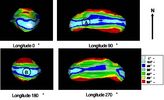
Itokawa-13.jpgGravity and Slope Map57 visiteThe purpose of the Rehearsal Descent is, first of all, to make sure that the proximity laser range finder works as intended, as its function has not been calibrated during cruise. The second purpose is to confirm whether the target marker image can be extracted against the asteroid surface, using onboard image processing that illuminates it using flash lamps onboard the spacecraft. The third purpose is to deploy and place the hopping robot MINERVA on the asteroid surface. Deploying MINERVA conflicts with the touch-down sequence, so it will be separated in advance of the sampling runs.
In conjunction with this very big challenge, JAXA is also starting a nation-wide campaign called ‘You Name the Landing Site’. The names assigned to the sites may not be officially registered by the IAU as the sites are very small. However, JAXA, as a finder, declares that the sites will be given those selected names.
|
|

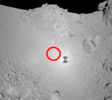
L-Itokawa.jpgThe Target Marker separated from Hayabusa (close-up)57 visiteThe Target Marker that separated from Hayabusa carried the names of 880.000 people who participated in the campaign from the World.
It was placed in the South-West area of the MUSES-Sea.
When it hit to the surface, the descent speed was about 9 cm/sec. The Target Marker was specifically designed and fabricated with an aluminum shell filled with polyimide balls (so to absorb kinetic energy through multi-collisions). This design is capable to dramatically suppress the bouncing of the probe and its function has been tested and verified via drop tower tests in a vacuum chamber on Earth.
The Target Marker (è il minuscolo punto luminoso - cerchiato in nero - che si vede accanto all'ombra di Hayabusa nel close-up di Sx) was illuminated by onboard flash lamps every 2' (...).
|
|
LLL-Itokawa.jpgTarget Marker located on Itokawa (2)57 visiteThe spacecraft shifted to safe-hold mode because of its attitude dispersion during ascent, and Sagamihara Deep Space Control Room is now carrying out the recovery operation to three-axis control mode.
It therefore takes a few more days to obtain detailed data relating the procedure. Instruments onboard are functioning very well so far.
Spacecraft Hayabusa could find, on the surface of Itokawa, the Target Marker dropped on Nov. 20 among the images taken during descent phase on Nov. 26.
On the Target Marker are etched 880.000 names from 149 Countries.
The previous images show the area named "MUSES Sea" and they were taken at 04:58 of Nov. 20, 2005 (left) and at 06:24 of Nov. 26, 2005 (right).
In this frame, the white light spot inside the red circle is the Target Marker with the 880.000 names!
|
|
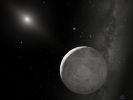
Xena.jpgXena: another "Tenth Planet"? (2003 UB313)57 visiteNASA's Hubble Space Telescope has resolved the Tenth Planet, now nicknamed Xena, for the first time and has found that it is only just a little larger than Pluto.
Though previous ground-based observations suggested that Xena was about 30% greater in diameter than Pluto, Hubble observations taken on Dec. 9 and 10, 2005, yield a diameter of 1.490 miles (with an uncertainty of 60 miles) for Xena. Pluto's diameter, as measured by Hubble, is 1.422 miles. Xena is the large object at the bottom of this artist's concept. A portion of its surface is lit by the Sun, located in the upper left corner of the image. Xena's companion, Gabrielle, is located just above and to the left of Xena.
|
|

Dactyl.JPGDactyl57 visitenessun commento
|
|
| 282 immagini su 24 pagina(e) |
 |
|
|
|
|
|
20 | |
|
|
|





