| |

| Piú viste - Asteroids and Comets |
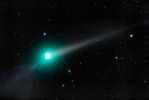
Comets-Comet_Lulin03-Richins.jpgThe Two Tails of Comet Lulin58 visiteCaption NASA:"Go outside tonight and see Comet Lulin. From a dark location, you should need only a good star map and admirable perseverance -- although wide-field binoculars might help. Yesterday, Comet Lulin passed its closest to Earth, so that the comet will remain near its brightest over the next few days. The comet is currently almost 180° around from the Sun and so visible nearly all night long, but will appear to move on the sky about 10 full moons a night. Pictured above, Comet Lulin was captured in spectacular form two nights ago from New Mexico, USA.
The central coma of the comet is appearing quite green, a color likely indicating glowing cyanogen and molecular carbon gasses. Bright stars and a distant spiral galaxy are clearly visible in the image background. The yellow dust tail, reflecting sunlight, is visible sprawling to the coma's left trailing behind the comet, while the textured bluish-glowing ion tail is visible to the coma's right, pointing away from the Sun. Over the past few weeks, from the current vantage point of Earth, these two tails appeared to point in opposite directions. Comet Lulin is expected to slowly fade over the next few weeks".MareKromium
|
|

Asteroids-Asteroid_1994-CC-PIA12134.jpgTriple Asteroid 1994-CC58 visitenessun commentoMareKromium
|
|

KBO-3-Artist_Conception.jpgKuiper's Belt Object occulting a Star58 visiteIn a paper published in the December 17th issue of the journal Nature, Hilke Schlichting of the California Institute of Technology in Pasadena, Calif., and her collaborators are reporting that the telltale signature of the small vagabond was extracted from Hubble's pointing data, not by direct imaging.
Hubble has three optical instruments called Fine Guidance Sensors (FGS). The FGSs provide high-precision navigational information to the space observatory's attitude control systems by looking at select guide stars for pointing. The sensors exploit the wavelike nature of light to make precise measurement of the location of stars.
Schlichting and her co-investigators determined that the FGS instruments are so good that they can see the effects of a small object passing in front of a star. This would cause a brief occultation and diffraction signature in the FGS data as the light from the background guide star was bent around the intervening foreground KBO.
They selected 4,5 years of FGS observations for analysis. Hubble spent a total of 12.000 hours during this period looking along a strip of sky within 20° of the Solar System's Ecliptic Plane, where the majority of KBOs should dwell. The team analyzed the FGS observations of 50.000 guide stars in total.
Scouring the huge database, Schlichting and her team found a single 0,3-second-long occultation event. This was only possible because the FGS instruments sample changes in starlight 40 times a second. The duration of the occultation was short largely because of the Earth's orbital motion around the Sun.
They assumed the KBO was in a circular orbit and inclined 14° to the Ecliptic. The KBO's distance was estimated from the duration of the occultation, and the amount of dimming was used to calculate the size of the object. "I was very thrilled to find this in the data", says Schlichting.
Hubble observations of nearby stars show that a number of them have Kuiper Belt–like disks of icy debris encircling them. These disks are the remnants of planetary formation. The prediction is that over billions of years the debris should collide, grinding the KBO-type objects down to ever smaller pieces that were not part of the original Kuiper Belt population.
The finding is a powerful illustration of the capability of archived Hubble data to produce important new discoveries. In an effort to uncover additional small KBOs, the team plans to analyze the remaining FGS data for nearly the full duration of Hubble operations since its launch in 1990.MareKromium
|
|

KBO-2-Artist_Conception.jpgKuiper's Belt Object occulting a Star58 visiteNASA's Hubble Space Telescope has discovered the smallest object ever seen in Visible Light in the Kuiper Belt, a vast ring of icy debris that is encircling the outer rim of the Solar System, just beyond Neptune.
The needle-in-a-haystack object found by Hubble is only 3200 feet across and a whopping 4,2 Billion Miles away. The smallest Kuiper Belt Object (KBO) seen previously in reflected light is roughly 30 miles across, or 50 times larger.
This is the first observational evidence for a population of comet-sized bodies in the Kuiper Belt that are being ground down through collisions. The Kuiper Belt is therefore collisionally evolving, meaning that the region's icy content has been modified over the past 4,5 BYs.
The object detected by Hubble is so faint — at 35th magnitude — it is 100 times dimmer than what Hubble can see directly.
So then how did the space telescope uncover such a small body?MareKromium
|
|

P-2010-A2-HST.jpgP/2010-A2: Extremely unusually-looking Asteroid58 visiteFirst discovered on ground based LINEAR images on January 6, 2010, the object appeared unusual enough to investigate further with the Hubble Space Telescope last week.
Pictured above, what Hubble saw indicates that P/2010 A2 is unlike any object ever seen before.
At first glance, the object appears to have the tail of a comet. Close inspection, however, shows an about 140-meter Nucleus offset from the tail center, very unusual structure near the Nucleus, and no discernable gas in the Tail. Knowing that the object orbits in the Asteroid Belt between Mars and Jupiter, a preliminary hypothesis that appears to explain all of the known clues is that P/2010 A2 is the debris left over from a recent collision between two small asteroids.
If true, the collision likely occurred at over 15.000 Km-per-hour (five times the speed of a rifle bullet) and liberated energy in excess of a nuclear bomb. Pressure from Sunlight would then spread out the debris into a trailing tail.
Future study of P/2010 A2 may better indicate the nature of the progenitor collision and may help humanity better understand the early years of our Solar System, when many similar collisions occurred. MareKromium
|
|

Comets-Garrad-PIA12985.jpgComet Garradd58 visiteThis image from the WISE mission was taken on January 2nd, 2010, during the check-out phase, before the start of the WISE survey. It is a mosaic of 3 individual WISE frames spanning an area on the sky about 7 times the size of the full Moon in portions of the constellations Bootes and Canes Venatici.
In the lower right portion of the image there is a streak of orange light. This is most likely a human-made satellite, orbiting Earth at a higher altitude than the WISE telescope, which is at 523 km above the surface. WISE sees many of these as it scans the sky.
Just above the satellite in the image is Comet C/2008 Q3 (Garradd). Comets are balls of dust and ice left over from the formation of the Solar System. As a comet approaches the Sun it is heated and releases gas and dust from its surface that is blown back by the solar wind into a long, spectacular tail. This comet was discovered in August 2008 by Gordon Garradd of the Siding Spring Observatory in Australia. This comet probably comes from the Oort Cloud, a vast collection of remnants from the formation of the Solar System thought to surround it. At the time the comet was observed by WISE, in the constellation Bootes, it was a distance of 419 million kilometers (2.789 Astronomical Units, AU) from Earth. But we are just catching it while it is near the Sun. The orbit calculated for Comet C/2008 Q3 (Garradd) is inclined to the plane of the Solar System by nearly 140 degrees and takes it very far from the Sun (trillions of kilometers). It made its closest approach to the Sun in June of 2009 at a distance of 1.8 AU (270 million km), just outside the orbit of Mars. If it comes back near the Sun at all, it won't be for hundreds of thousands of years.
In the upper left of the image is the impressive globular cluster Messier 3 (M3). M3 was discovered in the constellation Canes Venatici by famous French Astronomer, Charles Messier in 1764, and first seen to be made of stars around 1784 by the British astronomer who discovered infrared light, William Herschel. Globular clusters are huge globs of stars (hence the name) that are found orbiting in the outer reaches of most galaxies. They are thought to form around the same time that a galaxy forms. The Milky Way has over 200 known globular clusters. M3 is one of the largest and brightest globular clusters around the Milky Way. It is just barely visible to the naked eye from a dark location. M3 is made of about half a million stars, thought to be about 8 billion years old. It is about 150 light-years across (1 light-year is equal to 9.46 trillion km) and located some 34,000 light-years from Earth.
WISE sees invisible infrared light, and the colors here are mapped to 3 of the 4 wavelength bands observed by WISE. Blue represents light with a wavelength of 3.4 microns, cyan maps to 4.6 microns and red is lightat 12 microns (a micron is 1 millionth of a meter, and visible light runs from 0.4-0.7 microns). The light from relatively hot objects, like stars in M3, is seen in blue and cyan. Red color represents cooler things, like dust from the comet and its tail. When this image was taken the WISE team was still calibrating the rate of the scan mirror with the motion of the WISE telescope. The rate was not yet perfected and careful examination of this image reveals some stars that are a little smeared and not exactly aligned in the blue/cyan with the red.
MareKromium
|
|

Lutetia-03.jpgAsteroid "Lutetia"58 visiteA closer look at the asteroid that orbits between Mars and Jupiter reveals that Lutetia's Surface is battered with many craters, indicating that during the 4,5 BY (Billion Years) of existence, the primitive survivor has suffered many impacts.
The information gathered also confirm that Lutetia, discovered by French painter turned astronomer Hermann Goldschmidt in 1852, is approx. 100 Km in diameter, has a elongated body, and its longest side measures about 130 Km.
In a statement, David Southwood, ESA Director of Science and Robotic Exploration, said:“It has been a great day for exploration, a great day for European science. The clockwork precision is a great tribute to the scientists and engineers in our Member States in our industry and, not least, in ESA itself”.MareKromium
|
|

Eros - impact site - PIA03144_modest.jpgEros: NEAR-Shoemaker's Probe landing site57 visiteThis map projection of NEAR Shoemaker images shows locations and sizes of landmarks surrounding the spacecraft's planned landing site. Diameters of craters are shown in red, and diameters of boulders are shown in yellow. Diameters are given in units of meters (1 meter is about 3.3 feet). Coordinates along the left side of the map are degrees south latitude and coordinates along the bottom are degrees west longitude.
The six yellow "footprint" boxes represent approximate image size at 500, 1.000, 1.500, 2.000, 2.500 and 3.000 meters above the surface during descent. The spacecraft will take pictures continuously between each spot. The arrow marks the estimated touchdown site.
|
|

Eros from 700 mt - PIA03146_modest.jpgFalling down: Eros from 700 mt57 visiteCaption NASA:"...The image is 33 meters across. The large, oblong rock casting a big shadow measures 7.4 meters across...".
Riuscite a distinguere in questo scorcio ulteriormente ravvicinato qualche dettaglio il quale - ora, ovviamente, ingrandito - fosse già presente nel frame precedente? Noi non ci siamo riusciti.
|
|

Asteroids-Opportunity-041007163946.jpgThe path to immortality: an asteroid named "Opportunity"57 visiteL'immortalità (o quasi), in qualche modo, le Sonde Spirit ed Opportunity sono riuscite a guadagnarsela: il lavoro svolto dai due Rover, infatti, è stato (ed è tuttora) così prezioso e scientificamente significativo che si è pensato - ed è la prima volta in assoluto che accade una cosa simile - di dedicare ai due robot (e NON, quindi, ad un "essere umano"...) due asteroidi scoperti all'inizio degli anni '60, ma definitivamente riconosciuti e codificati - mediante l'assegnazione di un numero seriale ufficiale - solo nel 2002 (in questo caso, però, non si è trattato di inefficienza, bensì di ottemperanza alle rigide regole stabilite dalla IAU - International Astronomical Union - le quali "...require asteroids to be observed during 4 separate cycles around the Earth and Sun before they become eligible for numbering and naming...").
|
|

EROS-PIA02901_modest.jpgCraters on the limb of Eros57 visiteIn this image, taken April 17, 2000, from a height of 101 Km (63 miles), the shadows highlight small-scale surface features. The surface is pockmarked with craters ranging in size up to the 2,8 Km (1,74 mile) diameter crater in the center of the image. The smallest craters which can be resolved are about 20 meters (65 feet) across. In lower right corner of the image, 20-meter boulders can be seen that were not evident in images from higher altitudes.
|
|

Gaspra-Deimos-Phobos-PIA00078_modest.jpgGaspra, Deimos and Phobos57 visiteCaption NASA originale:"This montage shows asteroid 951 Gaspra (top) compared with Deimos (lower left) and Phobos (lower right), the moons of Mars. The three bodies are shown at the same scale and nearly the same lighting conditions. Gaspra is about 17 Km (10 miles) long. All three bodies have irregular shapes, due to past catastrophic conditions. However their surfaces appear remarkably different, possibly because of differences in composition but most likely because of very different impact histories. The Phobos and Deimos images were obtained by the Viking Orbiter spacecraft in 1977; the Gaspra image is the best of a series obtained by the Galileo spacecraft on October 29, 1991".
|
|
| 282 immagini su 24 pagina(e) |
|
|
|
|
|
19 | |
|
|
|
|
|
|





