| Piú viste - Asteroids and Comets |

McNaught-13.jpgMc Naught and its "Iron Tail"58 visiteCaption NASA:"Outstanding in planet Earth's sky early this year, Comet McNaught is captured in this view from the STEREO A spacecraft. McNaught's coma is so bright, it blooms into the long horizontal stripe at the bottom of the field. Brilliant Venus, near the top left corner, also produces a severe horizontal blemish in the digital image. But the sensitive camera does accurately record the striations in McNaught's famous dust tail along a region stretching over 30 MKM toward the top right of the field of view. A separate, fainter, arching tail just to the left of the dust tail was initially thought to be an example of a common ion tail, formed by electrically charged atoms carried away from the comet by the Solar Wind.
However, detailed modeling indicates that tail is actually due to Neutral Iron atoms pushed out by the pressure of sunlight - the first ever detected Neutral Iron tail from a comet. The Iron atoms are thought to originate in dust grains from the comet nucleus that contain the Iron-Sulfur mineral Troilite (FeS)". MareKromium
|
|

LLN-Itokawa-ST_2506733028_v.pngApproaching Itokawa (4 - natural colors; elab. Lunexit)58 visitenessun commentoMareKromium
|
|
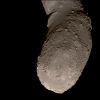
LLN-Itokawa-ST_2506694595_v.pngApproaching Itokawa (3 - natural colors; elab. Lunexit)58 visitenessun commentoMareKromium
|
|

LLO-Itokawa-ST_25326292LL77_v.jpgThe unbelievable surface of 25143-Itokawa (HR1 - possible natural colors; elab. Lunexit)58 visitenessun commentoMareKromium
|
|

Comets-Comet_Holmes-TView.jpgTelescopic View of the Comet Holmes58 visiteCaption NASA, da "NASA - Picture of the Day" del 29 Ottobre 2007:"What's happened to Comet Holmes? A normally docile comet discovered over 100 years ago, Comet 17P/Holmes suddenly became nearly one million times brighter last week, possibly over just a few hours. In astronomical terms, the comet brightened from magnitude 17, only visible through a good telescope, to magnitude 3, becoming visible with the unaided eye. Comet Holmes had already passed its closest to the Sun in 2007 May outside the orbit of Mars and was heading back out near Jupiter's orbit when the outburst occurred. The comet's sudden brightening is likely due to some sort of sunlight-reflecting outgassing event, possibly related to ice melting over a gas-filled cavern, or possibly even a partial breakup of the comet's nucleus. Pictured above through a small telescope, Comet Holmes appeared as a fuzzy yellow spot, significantly larger in angular size than Earth-atmosphere blurred distant stars. Although Comet Holmes' orbit will place it in northern hemisphere skies for the next two years, whether it will best be viewed through a telescope or sunglasses remains unknown".MareKromium
|
|

Comets-Comet_Holmes-UY.jpgComet 17-P-Holmes, from Hungary58 visiteCaption NASA:"A beautiful blue ion tail has become visible in deep telescopic images of Comet Holmes. Pointing generally away from the Sun and also planet Earth, the comet's ion tail is seriously foreshortened by our extreme viewing angle.
Still, enthusiastic comet watchers have remarked that on the whole, the compact but tentacled appearance suggests a jellyfish or even a "cosmic calamaro".
This stunning view of the comet's greenish coma and blue tail was recorded on November 4, 2007, in clear skies near Budapest, Hungary.
The colors are caused by molecules in the tenuous gas, like C2 (green) and CO+ (blue), fluorescing in sunlight". MareKromium
|
|

Comets-Comet_Holmes-UZ-1.gifBigger than the Sun!58 visiteCaption NASA:"The spherical coma of Comet Holmes has swollen to a diameter of over 1,4 MKM, making the tenuous, dusty cloud even bigger than the Sun. Scattering sunlight, all that dust and gas came from the comet's remarkably active nucleus, whose diameter before the late October outburst was estimated to be a mere 3,4 Km.
In this sharp image, recorded on November 14, 2007, with the Canada-France-Hawaii Telescope, stars are easily visible right through the outer coma, while the nucleus is buried inside the condensed, bright region. The bright region of the coma seems offset from the center, consistent with the idea that a large fragment drifted away from the nucleus and disintegrated, producing the comet's spectacular outburst. Of course, more recent images of Holmes also show the bright star Mirfak (Alpha Persei) shining through as the comet sweeps slowly through the constellation Perseus".MareKromium
|
|

EROS-GIFMovie-049.gifRolling and Floating: 433-Eros (GIF-Movie; credits: Dr G. Barca)58 visitenessun commentoMareKromium
|
|

EROS-PIA02905-1.jpgEros (Position of the BIG Pseudo-Anomaly)58 visitenessun commentoMareKromium
|
|
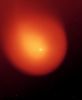
Comets-Comet_Holmes-UZ_PIA11228-1.jpgComet 17-P Holmes now in the Outer Solar System (IR)58 visiteNASA's Spitzer Space Telescope captured the picture of comet Holmes in March 2008, 5 months after the comet suddenly erupted and brightened a millionfold overnight. The contrast of the picture has been enhanced (see the next frame) to show the anatomy of the comet.
Every 6 years, comet 17P/Holmes speeds away from Jupiter and heads inward toward the Sun, traveling the same route typically without incident. However, twice in the last 116 years, in November 1892 and October 2007, comet Holmes mysteriously exploded as it approached the Asteroid Belt. Astronomers still do not know the cause of these eruptions.
Nota Lunexit: la "causa" di queste repentine eruzioni della Cometa 17-P Holmes le quali avvengono - guarda caso - durante il transito della medesima attraverso la Fascia degli Asteroidi potrebbe essere RAGIONEVOLMENTE rinvenuta nella verificazione di impatti con corpi erranti di piccole/piccolissime dimensioni (l'occorrere di impatti con uno o più oggetti di dimensioni medie o medio/grandi porterebbe inevitabilmente alla frammentazione/distruzione completa del nucleo di 17-P Holmes ed alla sua relativa e definitiva sparizione). Che gli "outbursts" possano essere (anche) l'ovvia conseguenza di un impatto ad altissima velocità è stato recentemente dimostrato dall'esperimento (come ricorderete contestatissimo) effettuato dalla NASA sulla Cometa Tempel-1, la quale fu centrata da un'ogiva metallica e, all'atto dello "scontro spaziale", aumentò la sua luminosità in maniera agevolmente percepibile anche da Terra.MareKromium
|
|
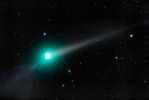
Comets-Comet_Lulin03-Richins.jpgThe Two Tails of Comet Lulin58 visiteCaption NASA:"Go outside tonight and see Comet Lulin. From a dark location, you should need only a good star map and admirable perseverance -- although wide-field binoculars might help. Yesterday, Comet Lulin passed its closest to Earth, so that the comet will remain near its brightest over the next few days. The comet is currently almost 180° around from the Sun and so visible nearly all night long, but will appear to move on the sky about 10 full moons a night. Pictured above, Comet Lulin was captured in spectacular form two nights ago from New Mexico, USA.
The central coma of the comet is appearing quite green, a color likely indicating glowing cyanogen and molecular carbon gasses. Bright stars and a distant spiral galaxy are clearly visible in the image background. The yellow dust tail, reflecting sunlight, is visible sprawling to the coma's left trailing behind the comet, while the textured bluish-glowing ion tail is visible to the coma's right, pointing away from the Sun. Over the past few weeks, from the current vantage point of Earth, these two tails appeared to point in opposite directions. Comet Lulin is expected to slowly fade over the next few weeks".MareKromium
|
|

Asteroids-Asteroid_1994-CC-PIA12134.jpgTriple Asteroid 1994-CC58 visitenessun commentoMareKromium
|
|
| 282 immagini su 24 pagina(e) |
 |
|
|
|
|
18 | |
|
|
|
|





