| Piú viste - Asteroids and Comets |

Itokawa-06.jpgOrbiting around Itokawa (3)58 visiteSpecifically, at the time of arrival at Itokawa, Hayabusa had driven its proprietary new ion engines for 26.000 hours, including their operation during an Earth flyby.
It has also perfectly completed a period of hybrid optical navigation followed by
precise guidance and navigation of the spacecraft during its station keeping period around Itokawa.
These engineering achievements are the primary mission of Hayabusa and their successful completion is a great achievement.
|
|

Itokawa-07.jpgOrbiting around Itokawa (4)58 visiteThe deep-space exploration technologies that the Top World's Space Agencies are pursuing consist of 3 major elements:
1) high efficiency electric propulsion for cruise;
2) rendez-vous with target destinations and
3) round-trip flights back to the Earth.
As of this time Hayabusa has accomplished the first and second of these elements, leading the way for the Space Exploration Agencies of the World.
Furthermore, robotic sample collection and return from an extra terrestrial object has not been executed before, and is not currently planned, except for Hayabusa, which will attempt to gather a bulk sample from Itokawa.
Hayabusa’s success clearly shows that Japan’s deep space exploration technology has reached the level of the World’s most developed Space Agencies, and that Japan is now in a Leadership Position in some select engineering fields.
Thus Hayabusa opens a New Era in the exploration of the Solar System.
|
|

Itokawa-08.jpgSurface details (1)58 visiteFor the scientific aspects of the mission, Hayabusa carries 4 instruments that have
performed successful observations to date:
1) AMICA, a Visible Imager with multi-band filters, has exposed 1500 images amounting to almost 1 GB of data;
2) NIRS, a near infrared spectrometer that has already taken 75.000 measurements distributed globally over the body;
3) LIDAR, a laser altimeter that has accumulated 1,4 million measurements globally, and
4) XRS, an X-ray spectrometer that has already received and integrated its signal for 700 hours.
In addition to these, spacecraft tracking data has been used to measure properties of the asteroid as well.
These unprecedented scientific measurements are briefly described and reported in what follows.
|
|

Itokawa-09.jpgSurface details (2)58 visiteA) Morphological and geological discoveries about Itokawa: the a-priori theoretical assumption that small near-Earth asteroids should have geologically homogeneous features was completely overturned by the observation of a wide variety of surface features and types at Itokawa. The surface is covered with huge boulders and, for the first time, naked surfaces not covered with regolith have been exposed. Previously visited asteroidswere covered with thick regolith, thus Itokawa’s surface is like nothing that has seen before, which is quite fortunate for the Hayabusa Mission. The opportunity to observe the true asteroid surface, which isusually concealed from view, advancesour understanding of spectroscopic observations of asteroids taken from Earth, and allows us to expand our knowledge of near Earth asteroids.
|
|

LL-Itokawa.jpgTarget Marker located on Itokawa (1)58 visiteOn Nov. 26, spacecraft "Hayabusa" challenged the second trial to execute landing on and sampling from the asteroid Itokawa. Hayabusa team confirmed the whole process to have been implemented and it is sure that the team succeeded in sampling materials on the surface of an asteroid for the first time in World History. Detailed data to be sent from Hayabusa will further verify the sampling.
Hayabusa started its last descent phase from the altitude of 1 km above Itokawa by command from Earth around 10:00 p.m. Nov.25 (JST). It was followed by starting the vertical descent from around 6:00 a.m. Nov.26., and, around 6:25 a.m., Sagamihara Deep Space Control Room sent a command to continue the descent.
Hayabusa challenged landing and sampling operation after a hovering phase. Hayabusa team is now sure, through the analysis of telemetry data, that a series of sequence for sampling was successfully done. Hayabusa then flew up to several kilometers altitude with normal solar paddles power, spacecraft attitude, etc.
|
|
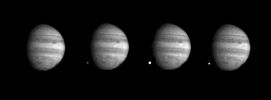
Shoemaker-Levy 9-1.jpgShoemaker-Levy 9: the W-impact (1)58 visiteThese four pictures, taken 2,3" apart, show the early meteor, or "bolide", stage of the impact of the last major fragment of Comet Shoemaker-Levy 9 into Jupiter's night side. In the first image (8:06:12 UTC), no impact is visible. In the second picture, a bright point of light appears superimposed on the dark side of Jupiter's Southern Hemisphere. In the third image, the impact has grown so bright that it saturates the CCD picture element at the center of the image of the impact flash. By remarkable coincidence, the HST took a picture of the W-impact, also in green light, within 1" of this image, providing a complementary view of very faint associated phenomena at very high altitudes in Jupiter's atmosphere, just above the planet's edge as seen from Earth. In the final Galileo image (8:06:19 UTC), the impact flash has faded appreciably.
These images are pictures 5 through 8 of a series of 56 placed on a single frame in time-lapse fashion. We interpret the rapid rise and fall of this initial peak over just 7 seconds to be the bolide phase of the W fragment's impact, analogous to the flash of light of meteors entering Earth's atmosphere. Images immediately following this show that the luminosity continues to fade over the next 15 seconds.
|
|

Shoemaker-Levy 9-2.jpgShoemaker-Levy 9: the W-impact (2)58 visiteThese four images of Jupiter and the luminous night-side impact of fragment W of Comet Shoemaker-Levy 9 are different versions of an average of 8 images taken by the Galileo spacecraft of July 22, 1994.
The frames that were averaged span about 30" near 8:06 UT.
These four "averaged" images show the scene without and with (top and bottom) spatial filtering and contrast enhancement, and without and with (left and right) a latitude/longitude grid. Grid spacing is 30 degrees, with 230° Longitude centered. The terminator is at about 265°. The impact location is about 43° South, as predicted, and at 280° Longitude. The dark spots to the right of the flash are from previous impacts.
|
|

Comets-Schwassmann_Wachmann_1-09.jpgComet Schwassmann-Wachmann 3: the whole "crumbling" Comet (3)58 visitenessun commento
|
|

LLM-Itokawa.jpg25143-Itokawa58 visiteA Japanese spacecraft has provided one of the best arguments yet in favor of a conception of asteroids which was pioneered by PSI (Planet Science Institute) scientists Don Davis and Clark Chapman in the late 70's. The evidence comes in startling closeup pictures of the tiny asteroid 25143-Itokawa, photographed by the Japanese Hayabusa spacecraft during a two-month encounter in late 2005. The asteroid illustrates the concept of a "Rubble-Pile" asteroid, which is composed of a mixture of boulders and dust gravitationally bound together.
The scientific results, recently highlighted in the journal Science, show that, unlike other asteroids recently imaged by spacecraft, which are mostly rounded and potato-like, dotted by craters, and with a few scattered boulders on the surface, Itokawa appears to be composed of massive splinter-like boulders protruding from a matrix of smaller fragments.
The largest boulders sticking out of the body appear to be some tens of meters across.
The Hayabusa science team includes PSI scientists Paul Abell and Bob Gaskell, and PSI affiliate scientists Hirdy Miyamoto and Faith Vilas.
|
|

Comets-Comet_SWAN-1.jpgThe SWAN Comet58 visiteComet SWAN, which unexpectedly flared up to naked-eye brightness, has been showing detail in its ion tail that might be described as ghostly. The ion tail is made of ionized gas, energized by ultraviolet light from the Sun and pushed outward by the solar wind. The solar wind itself is quite structured and sculpted by the Sun's complex and ever changing magnetic field. Following the wind, structure in Comet SWAN's tail can be seen to move outward from the Sun even alter its wavy appearance over time.
The blue color of the ion tail is dominated by recombining Carbon Monoxide atoms. The color of the coma surrounding the head of the comet is tinged green by slight amounts of the molecule cyanogen. This week (6-13 Nov. 2006) may be the best remaining chance for Northern Hemisphere observers to see the fading interplanetary snowball. SWAN has now past both the Earth and the Sun and will fade as it moves away from the Earth and heads out into the vast space between the stars.
|
|

Comets-Comet_Machholtz.jpgComet Machholtz, from SST58 visitenessun commentoMareKromium
|
|

McNaught-05.jpgComet McNaught (6)58 visiteCaption NASA:"After a remarkable performance in the Northern Hemisphere, the brightest comet in decades is now showing off in the South. Recorded during evening twilight on January 17, 2007, this view features the bright coma and gorgeous, sweeping tail of Comet McNaught (c/2006 P1) over Lake Horowhenua in Levin, a small town on New Zealand's North Island.
Astronomer Noel Munford reports that the five second long digital camera exposure comes close to capturing the visual appearance of the comet in a sky coloured by smoke from distant brush fires in Australia. Discovered last summer by R. H. McNaught (Siding Spring Survey), the comet grew impressively bright in early January and has even been sighted in full daylight.
In the coming days Comet McNaught will continue to move south, for now a spectacle in Southern Skies as it heads for the outer Solar System".
|
|
| 282 immagini su 24 pagina(e) |
 |
|
|
|
|
17 | |
|
|
|
|





