| Piú viste - Asteroids and Comets |

LLM-Itokawa.jpg25143-Itokawa60 visiteA Japanese spacecraft has provided one of the best arguments yet in favor of a conception of asteroids which was pioneered by PSI (Planet Science Institute) scientists Don Davis and Clark Chapman in the late 70's. The evidence comes in startling closeup pictures of the tiny asteroid 25143-Itokawa, photographed by the Japanese Hayabusa spacecraft during a two-month encounter in late 2005. The asteroid illustrates the concept of a "Rubble-Pile" asteroid, which is composed of a mixture of boulders and dust gravitationally bound together.
The scientific results, recently highlighted in the journal Science, show that, unlike other asteroids recently imaged by spacecraft, which are mostly rounded and potato-like, dotted by craters, and with a few scattered boulders on the surface, Itokawa appears to be composed of massive splinter-like boulders protruding from a matrix of smaller fragments.
The largest boulders sticking out of the body appear to be some tens of meters across.
The Hayabusa science team includes PSI scientists Paul Abell and Bob Gaskell, and PSI affiliate scientists Hirdy Miyamoto and Faith Vilas.
|
|

McNaught-02.jpgComet McNaught (3)60 visiteCaption NASA:" Bright Comet McNaught (C/2006 P1) graced the twilight this week, seen by many and often described with superlatives. Watching the skies over Krakow, Poland, Andrzej Sawow recorded this view on Wednesday - with an ordinary handheld digital camera. He notes that "... astronomy is really for everyone who loves to look at the night sky. And fortunately (sometimes) the sky generously rewards its observer". Now very close to the Sun, Comet McNaught (along with Mercury) is visible in realtime images from the SOHO spacecraft. Otherwise, skywatchers will find the comet hard to see this weekend. But southern hemisphere observers could be rewarded next week as Comet McNaught begins to climb higher in southern skies".
|
|

McNaught-01.jpgComet McNaught (2)60 visiteCaption NASA:"The brightest comet in decades is unexpectedly now visible. The most optimistic predictions have Comet McNaught (C/2006 P1) shortly becoming one of the brightest comets of the past century. For the next few days, its short tail and bright coma can be spotted with the unaided eye close to the Sun and near the horizon in both evening and morning skies. This dramatic picture of the comet shining through cloudy skies was taken near sunset on January 7, 2007, from Bad Mergentheim, Germany".
|
|

McNaught-08.jpgComet McNaught (9)60 visiteCaption NASA originale:"Comet McNaught, the Great Comet of 2007, has grown a long and filamentary tail. The spectacular tail spreads across the sky and is visible to Southern Hemisphere observers just after sunset. The head of the comet remains quite bright and easily visible to even city observers without any optical aide. The amazing tail is visible on long exposures and even to the unaided eye from a dark location. Reports even have the tail visible just above the horizon after sunset for many Northern observers as well. Comet McNaught, estimated at magnitude - 2 (minus two), was caught by the comet's discoverer in the above image just after sunset last Friday from Siding Spring Observatory in Australia.
Comet McNaught, the brightest comet in decades, is now fading as it moves further into Southern Skies and away from the Sun and Earth".MareKromium
|
|

McNaught-9.jpgComet McNaught (10)60 visiteCaption NASA:"By January 19/20, 2007, Comet McNaught's magnificent dust tail stretched for about 150 MKM (~1 AU), requiring images from both Southern and Northern Hemispheres of planet Earth to take it all in. Two such views - from Cerro Paranal in Chile (left) and the Carnic Alps in Italy - are combined in this unique graphic that also outlines a perspective view of the Comet's orbit (dotted line) and relative position of the Sun. Driven by solar radiation pressure the dust tail initially points away from the Sun, but also trails outside the comet's orbit. Astronomers try to account for the complex structure along the tail, including the pronounced striations, by considering forces acting on the dust (e.g. gravity, solar wind and radiation) as well as the release time and size of the dust grains. In the diagram, the modeled location of dust grains released at approximately the same time relative to perihelion passage, synchrones, are shown as dashed lines. The location of grains of similar size, syndynes, are shown as solid lines".
|
|

LLN-Itokawa-ST_2506733028_v.pngApproaching Itokawa (4 - natural colors; elab. Lunexit)60 visitenessun commentoMareKromium
|
|

Comets-Comet_Holmes-UV.gifComet 17-P-Holmes60 visiteCaption NASA, da "NASA - Picture of the Day" del 30 Ottobre 2007:"Go outside tonight and see Comet Holmes.
No binoculars or telescopes are needed -- just curiosity and a sky map.
Last week, Comet 17P/Holmes underwent an unusual outburst that vaulted it unexpectedly from obscurity into one of the brightest comets in recent years.
Sky enthusiasts from the Northern Hemisphere have been following the comet's progress closely. Pictured above Quebec, Canada, the coma of Comet Holmes has been noticeably expanding over the past few days. In the above picture, an image of Jupiter has been placed artificially nearby to allow for a comparison of angular sizes.
Jupiter has been scaled to the size it would appear at the current location of Comet Holmes. How Comet Holmes will further evolve is unknown, with one possibility being that the expanding gas cloud that started from its recent outburst will slowly disperse and fade".MareKromium
|
|

Comets-Comet_Holmes-UZ.gifThe Inner Coma of Comet Holmes60 visiteCaption NASA:"What's happening to Comet Holmes?
The rare comet remains visible to the unaided eyes of northern observers as an unusual small puff ball in the constellation of Perseus. A high resolution set of images of the comet's inner coma, taken last week and shown above, reveals significant detail. Close inspection shows numerous faint streamers that are possibly the result of jets emanating from the comet's nucleus. Comet Holmes has remained surprisingly bright over the past week, with luminosity estimates ranging from between visual magnitudes 2 to 3, making it brighter than most stars visible on a dark sky.
The above image of Comet Holmes was made with a small automated 0,38-meter telescope hirable over the web for a small fee".MareKromium
|
|
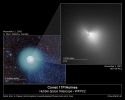
Comets-Comet_Holmes-UZ-1.jpgComet 17-P-Holmes, from Earth and from HST60 visiteNASA's HST has probed the bright core of Comet 17P/Holmes, which, to the delight of sky watchers, mysteriously brightened by nearly a millionfold in a 24-hour period beginning Oct. 23, 2007.
Astronomers used Hubble's powerful resolution to study Comet Holmes' core for clues about how the comet brightened. The orbiting observatory's Wide Field Planetary Camera 2 (WFPC2) monitored the comet for several days, snapping images on Oct. 29, Oct. 31, and Nov. 4. Hubble's crisp "eye" can see objects as small as 33 miles (54 Km) across, providing the sharpest view yet of the source of the spectacular brightening.
The Hubble image at right, taken Nov. 4, shows the heart of the comet. The central portion of the image has been specially processed to highlight variations in the dust distribution near the nucleus. About twice as much dust lies along the east-west direction (the horizontal direction) as along the north-south direction (the vertical direction), giving the comet a "bow tie" appearance.
The composite color image at left, taken Nov. 1 by an amateur astronomer, shows the complex structure of the entire coma, consisting of concentric shells of dust and a faint tail emanating from the comet's right side.
The nucleus-the small solid body that is the ultimate source of all the comet's activity- is still swaddled in bright dust, even 12 days after the spectacular outburst. "Most of what Hubble sees is sunlight scattered from microscopic particles," explained Hal Weaver of The Johns Hopkins University Applied Physics Laboratory in Laurel, Md., who led the Hubble investigation. "But we may finally be starting to detect the emergence of the nucleus itself in this final Hubble image."
Hubble first observed Comet 17P/Holmes on June 15, 1999, when there was virtually no dusty shroud around the nucleus. Although Hubble cannot resolve the nucleus, astronomers inferred its size by measuring its brightness. Astronomers deduced that the nucleus' diameter was approximately 2.1 miles (3.4 kilometers), about the length of New York City's Central Park. They hope to use the new Hubble images to determine the size of the comet's nucleus to see how much of it was blasted away during the outburst.
Hubble's two earlier snapshots of Comet Holmes also showed some interesting features. On Oct. 29, the telescope spied three "spurs" of dust emanating from the nucleus, while the Hubble images taken on Oct. 31 revealed an outburst of dust just west of the nucleus.
The Hubble images, however, do not show any large fragments near the nucleus of Comet Holmes, unlike the case of Comet 73P/Schwassmann-Wachmann 3 (SW3). In the spring of 2006 Hubble observations revealed a multitude of "mini-comets" ejected by SW3 after the comet increased dramatically in brightness.
Ground-based images of Comet Holmes show a large, spherically symmetrical cloud of dust that is offset from the nucleus, suggesting that a large fragment broke off and subsequently disintegrated into tiny dust particles after moving away from the main nucleus.
Unfortunately, the huge amount of dust near the comet's nucleus and the comet's relatively large distance from Earth (149 million miles, or 1.6 astronomical units, for Holmes versus 9 million, or 0.1 astronomical unit for SW3), make detecting fragments near Holmes nearly impossible right now, unless the fragments are nearly as large as the nucleus itself.
The Hubble Comet Holmes observing team comprises H. Weaver and C. Lisse (The Johns Hopkins University Applied Physics Laboratory); P. Lamy (Laboratoire d'Astrophysique de Marseille, France); I. Toth (Konkoly Observatory, Hungary); M. Mutchler (Space Telescope Science Institute); W. Reach (California Institute of Technology); and J. Vaubaillon (California Institute of Technology).
MareKromium
|
|

Asteroids-Asteroid_2002JF56-PIA09230-01.jpgFormer "Unknown Asteroid" is now "Asteroid 2002 JF56"60 visiteThe two "spots" in this image are a composite of two images of asteroid 2002 JF56 taken on June 11 and June 12, 2006, with the Multispectral Visible Imaging Camera (MVIC) component of the New Horizons Ralph imager. In the bottom image, taken when the asteroid was about 3,36 MKM (approx. 2,1 MMs) away from the Spacecraft, 2002 JF56 appears like a dim star. At top, taken at a distance of about 1,34 MKM (such as about 833.000 miles), the object is more than a factor of six brighter.
The best current, estimated diameter of the asteroid is approx. 2,5 Km.
The asteroid observation was a chance for the New Horizons team to test the spacecraft's ability to track a rapidly moving object. On June 13 New Horizons came to within about 102.000 Km of the small asteroid, when the Spacecraft was nearly 368 MKM (about 228 MMs) from the Sun and about 273 MKM (approx 170 MMs) from Earth.MareKromium
|
|

EROS-PIA02905-1.jpgEros (Position of the BIG Pseudo-Anomaly)60 visitenessun commentoMareKromium
|
|

EROS-GIFMovie-051.gif433-Eros: features in motion! (GIF-Movie; credits: Dr G. Barca)60 visitenessun commentoMareKromium
|
|
| 282 immagini su 24 pagina(e) |
 |
|
|
|
|
15 | |
|
|
|
|





