| Piú viste - Asteroids and Comets |

Comets-Wild_2-03.jpgSome surface features of Wild 259 visiteCaption NASA originale:"These images taken by NASA's Stardust spacecraft highlight the diverse features that make up the surface of comet Wild 2. The three pictures on the left side show a variety of small pinnacles and mesas seen on the limb of the comet. The picture on the right shows the location of a 2-Km (1,2-mile) series of aligned scarps, or cliffs, that are best seen in the stereo images".
|
|
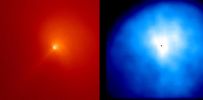
Comets-Comet_Hyakutake-PIA01288_modest.jpgThe "Hyakutake" Comet59 visiteOriginal caption:"These are 2 images of the inner coma of Comet Hyakutake made on April 3 and 4, 1996, using the NASA HST-WFPC2. The 1st one, shown in red, was taken through a narrow-band red filter that shows only sunlight scattered by dust particles in the inner coma of the comet. The 2nd one, shown in blue, was taken with an ultraviolet "Woods" filter image that shows the distribution of scattered ultraviolet radiation from H atoms in the inner coma (the "coma" is the head - or dusty-gas atmosphere - of a comet). The square field of view is 14.000 Km on a side and the Sun is toward the upper right corner of the image. H atoms represent the most abundant gas in the whole coma of the comet. They are produced when solar ultraviolet light breaks up molecules of water, the major constituent of the nucleus of the comet. The inner yellow region near the center of the red dust image is dominated by the contribution from the dust which shows sunward directed spiral jets to the upper right".
|
|

Comets-Machholz___Meteor.jpgComet Machholz and a "corkscrew" meteor59 visiteCaption NASA originale:"Meteor trains (train--->trajectory) that twist noticeably are rare but have been noted before. The underlying reason for unusual meteors trains is that many meteors are markedly non-spherical in shape and non-uniform in composition. Meteors, usually sand sized grains that originate in comets, will disintegrate as they enter the Earth's atmosphere. Non-uniform meteors may evaporate more on one side than another. This may cause a rotating meteor to wobble slightly in its path, and also to spray fast moving debris in a nearly spiral path. The fast moving meteor debris ionizes molecules in the Earth's atmosphere that subsequently glow when they reacquire elections. Surely no meteor is perfectly uniform and spherical, so that a slight swagger that is below perceptibility is likely typical. Meteors may well have seeded Earth with the prebiotic molecules that allowed for the development of life".
|
|

Tempel1-S-ImpactConfirmation.jpgTempel-1 from Kitt Peak National Obs.59 visiteOriginal caption:"The image was taken through an R band filter and has the smoothed dust light profile removed to enhance the jets. North is up, East to the left, the Sun at PA (Position Angle) 290 and the FOV is 2,5 arcmin (which is now 96.500 km at the comet)".
T. Farnham and Jianyang Li
(University of Maryland)
|
|

Tempel1-VV-nhvcaxf9000910-PIA02131.jpgImpact Time!59 visiteWhen NASA's Deep Impact probe collided with Tempel-1, a bright, small flash was created, which rapidly expanded above the surface of the comet. This flash lasted for more than a second and its overall brightness is close to that predicted by several models. After the initial flash, there was a pause before a bright plume quickly extended above the comet surface. The debris from the impact eventually cast a long shadow across the surface, indicating a narrow plume of ejected material, rather than a wide cone. The Deep Impact probe appears to have struck deep, before gases were heated and explosively released. The impact crater was observed to grow in size over time. A preliminary interpretation of these data indicate that the upper surface of the comet may be fluffy, or highly porous. The observed sequence of impact events is similar to laboratory experiments using highly porous targets, especially those that are rich in volatile substances. The duration of the hot, luminous gas phase, as well as the continued growth of the crater over time, all point to a model consistent with a large crater.
|
|

Tenth_Planet-01.jpgThe 10th Planet? (2)59 visitePerchè escludere a priori, come fa la NASA, che il Decimo Pianeta abbia una superficie TOTALMENTE RIFLETTENTE?
Scusateci la provocazione, ma sarebbe sufficiente ipotizzare - per assurdo, se volete - che questo ipotetico Decimo Pianeta sia:
1) una sfera costituita prevalentemente di ghiaccio (un'eventualità tutt'altro che remota);
2) un corpo capace di emanare luce propria (una piccola stella?);
3) una sfera metallica (ossìa, per esempio, una gigantesca astronave che si trova "parcheggiata" ai confini del Sistema Solare).
Stupidaggini "Cosmiche"? Fantascienza di basso livello? Forse.
Ma se ci pensate (e se conoscete almeno un poco la storia del Sistema Solare e delle meccaniche - per lo più teoriche - che ci hanno permesso di stimarne le dimensioni complessive), l'ipotesi più improbabile (molto in voga negli anni '60/'70 ma poi ritenuta inverosimile ed abbandonata) è proprio quella che immagina il Decimo Pianeta come un corpo roccioso di dimensioni medio-grandi!
|
|

Itokawa.gifAsteroid "Itokawa": a new "shooting" against a Celestial Body59 visiteJapan's JAXA Space Agency launched the Hayabusa Mission to rendezvous with asteroid Itokawa. Last week, the small robotic Hayabusa spacecraft arrived at asteroid Itokawa and stationed only 20 Km away. Although a long term goal is to find out how much ice, rock and trace elements reside on the asteroid's surface, a shorter term goal is to determine the mass of the asteroid by measuring the attraction of the drifting Hayabusa spacecraft. During the next few months, Hayabusa will also image and map asteroid Itokawa. The above time-lapse image sequence was taken by Hayabusa upon final approach, showing the general oblong shape of the asteroid. In November, a small coffee-can sized robot dubbed MINERVA is scheduled for release and is expected to hop around the asteroid taking pictures. Also in November, Hayabusa will fire pellets into asteroid Itokawa and collect some of the debris in a return capsule. In December, Hayabusa will fire its rockets toward Earth and drop the return capsule in June 2007.
|
|

Itokawa.jpgHayabusa's "shadow"!59 visiteWhat's that unusual looking spot on asteroid Itokawa? It's the shadow of the robot spacecraft Hayabusa that took the image. Japan's Hayabusa Mission arrived at the asteroid in early September and has been imaging and maneuvering around the floating space mountain ever since. The above picture was taken earlier this month (November 2005).
Asteroid Itokawa spans about 300 mt.
One scientific goal of the Hayabusa mission is to determine out how much ice, rock and trace elements reside on the asteroid's surface, which should give indications about how asteroids and planets formed in the early Solar System. A can-sized robot MINERVA that was scheduled to hop around the asteroid's surface has not, so far, functioned as hoped. Later this month, Hayabusa is scheduled to descend to asteroid Itokawa and collect surface samples in a return capsule. In December, Hayabusa will fire its rockets toward Earth and drop the return capsule down to Earth's Australian outback in 2007 June.
|
|

Itokawa~0.jpgClosing on Itokawa59 visiteItokawa: un asteroide che sembra contraddire tutto quanto viene dato per acquisito nel campo delle forme esteriori e dei rilievi superficiali dei corpi (teoricamente) esposti a pesantissimi azioni di impatto sin dagli albori della loro esistenza. Pensate a 433-Eros, oppure a Ceres, o Dactyl o a qualsiasi altro corpo similare che abbiamo avuto occasione di vedere da distanza ravvicinata. Forse il solo asteroide AnneFrank non sembra presentare una particolare craterizzazione (ma le immagini, di cattiva qualità, non possono essere considerate definitorie) e quindi si viene a porre nel novero delle rarità. Tuttavia, quello che vediamo adesso, è ben più che un'eccezione e molto di più di un'Anomalìa: Itokawa NON ha alcun cratere superficiale visibile e le sue forme, spigolose ed a tratti aguzze, costituiscono una novità assoluta per i Ricercatori e gli Studiosi di Scienze Planetarie.
Original caption:"Where are the craters on asteroid Itokawa? No one knows. The Japanese robot probe Hayabusa recently approached the Earth-crossing asteroid and is returning pictures showing a surface unlike any other Solar System body yet photographed -- a surface possibly devoid of craters. One possibility for the lack of common circular indentations is that asteroid Itokawa is a rubble pile -- a bunch of rocks and ice chunks only loosely held together by a small amount of gravity. If so, craters might be filled in whenever the asteroid gets jiggled by a passing planet -- Earth in this case. Alternatively, surface particles may become electrically charged by the Sun, levitate in the microgravity field, and move to fill in craters. Over the weekend, Hayabusa lowered itself to the surface of the strange asteroid in an effort to study the unusual body and collect surface samples that could be returned to Earth in 2007".
|
|

Itokawa-2.jpgItokawa in natural colors59 visiteThis is the composite color image of Itokawa taken at September 12, 2005. This image composed of three images with different filters as red, green and blue. The irregular shape of this body is clearly seen and Hayabusa science observations started.
Hayabusa will approach Itokawa at a distance of 0,3 BKM from Earth. At this distance, even light takes about 17' to travel, so if Hayabusa needed an emergency instruction from Earth, it would not reach the probe in time. Therefore, Hayabusa is designed to pilot itself: to use the on-board camera and laser to read the asteroid's geography and judge when to approach it and where to land.
The exploration of small Solar System Bodies will contribute to improve our understanding of the Earth itself and it will also ead us to a more comprehensive interpretation of the constituents and potential resources that these celestial objects may have.
|
|

Itokawa-03.pngThe Southern Hemisphere of Itokawa59 visiteAfter reaching the sub-solar point, Hayabusa started to travel out of the ecliptic plane to observe the polar regions of Itokawa. This image shows the Southern Hemisphere
of Itokawa. Due to the low altitude and solar elevation angles, we can see detailed topography in the high-latitude regions. There are even some boulders on Muses-Sea, which looked very smooth in previous observations. Imagine one of these boulders flying in space. If it came to the Earth's vicinity, we would observe it as a tiny independent near-Earth asteroid. It has long been conjectured that meteorites are fragments of asteroids delivered to the Earth's surface, but it remains to be proven. The samples of Itokawa collected and returned by Hayabusa could provide the first direct evidence of the link between asteroids and meteorites.
|
|

Itokawa-04.jpgOrbiting around Itokawa (1)59 visiteHayabusa arrived at its exploration target, near Earth asteroid Itokawa, on Sept., 12th, 2005 after having been propelled there via ion engines and an Earth swing-by. Since then, it has successfully performed orbital maneuvers, precisely keeping its position relative to Itokawa. The Hayabusa Project Team has made many discoveries while carrying out their ambitious scientific observations of Itokawa. This release summarizes and reports the major scientific and engineering achievements in advance of Hayabusa’s unprecedented and historic descent to the surfaceof Itokawa for sample collection middle to later this month (November 2005).
|
|
| 282 immagini su 24 pagina(e) |
 |
|
|
|
|
14 | |
|
|
|
|





