| Piú viste - Asteroids and Comets |

Eros from 700 mt - PIA03146_modest.jpgFalling down: Eros from 700 mt61 visiteCaption NASA:"...The image is 33 meters across. The large, oblong rock casting a big shadow measures 7.4 meters across...".
Riuscite a distinguere in questo scorcio ulteriormente ravvicinato qualche dettaglio il quale - ora, ovviamente, ingrandito - fosse già presente nel frame precedente? Noi non ci siamo riusciti.
|
|

EROS-PIA02906_modest.jpgHorizon view61 visiteThis image of Eros, taken from the NEAR Shoemaker spacecraft on May 2, 2000, from an orbital altitude of 52 kilometers (32 miles), shows a view toward Eros' horizon. The section shown is about 1.8 kilometers (1.1 miles) across. This particular view provides a snapshot of three of the most common types of features seen on the asteroid: craters whose rims have been rounded by erosion due to smaller impacts and blanketing by the impact debris, or regolith (impact debris); variations in the brightness of material on the walls of the craters; and a scattering of boulders ranging in size from nearly 100 meters (328 feet) down to about 8 meters (26 feet).
|
|

Comets-Wild_2-02.jpgWild 2 - stereo image pair61 visitenessun commento
|
|
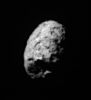
Comets-Wild_2-00.jpgApproaching Wild 2 (1)61 visiteCaption NASA originale:"This image was taken during the close approach phase of Stardust's Jan 2, 2004 flyby of comet Wild 2. It is a distant side view of the roughly spherical comet nucleus. One hemisphere is in sunlight and the other is in shadow analogous to a view of the quarter moon. Several large depressed regions can be seen. Comet Wild 2 is about 5 Km (3,1 miles) in diameter".
|
|
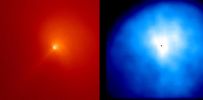
Comets-Comet_Hyakutake-PIA01288_modest.jpgThe "Hyakutake" Comet61 visiteOriginal caption:"These are 2 images of the inner coma of Comet Hyakutake made on April 3 and 4, 1996, using the NASA HST-WFPC2. The 1st one, shown in red, was taken through a narrow-band red filter that shows only sunlight scattered by dust particles in the inner coma of the comet. The 2nd one, shown in blue, was taken with an ultraviolet "Woods" filter image that shows the distribution of scattered ultraviolet radiation from H atoms in the inner coma (the "coma" is the head - or dusty-gas atmosphere - of a comet). The square field of view is 14.000 Km on a side and the Sun is toward the upper right corner of the image. H atoms represent the most abundant gas in the whole coma of the comet. They are produced when solar ultraviolet light breaks up molecules of water, the major constituent of the nucleus of the comet. The inner yellow region near the center of the red dust image is dominated by the contribution from the dust which shows sunward directed spiral jets to the upper right".
|
|
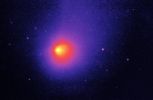
Comets-Schwassmann_Wachmann_1-00.jpgComet Schwassmann-Wachmann I and two asteroids61 visiteSchwassmann-Wachmann 1 (its nucleus is about 30 Km in diameter and is too small to be resolved by the SST while the micron-sized dust grains in the coma and tail stream out away from the Sun) is thought to be a member of a relatively new class of objects called "Centaurs," of which 45 objects are known. These are small icy bodies with orbits between those of Jupiter and Neptune. Astronomers believe that Centaurs are recent escapees from the Kuiper Belt, a zone of small bodies orbiting in a cloud at the distant reaches of the Solar System. Two asteroids, 1996 GM36 (left) and 5238 Naozane (right) were serendipitously captured in the comet image. Because they are closer to us than the comet and have faster orbital velocities, they appear to move relative to the comet and background stars, thereby producing a slight elongated appearance. The SST data have allowed astronomers to use thermal measurements, which reduce the uncertainties of visible-light albedo (reflectivity) measurements, to determine their size.
|
|

Tempel1-PIA07881.jpgTempel-1, from Kitt Peak (pseudo-colors)61 visiteCaption NASA originale:"The Kitt Peak National Observatory's 2,1-meter telescope observed comet Tempel 1 on April 11, 2005, when the comet was near its closest approach to the Earth. A pinkish dust jet is visible to the SouthWest, with the broader neutral gas coma surrounding it. North is up, East is to the left and the field of view is about 80.000 Km wide. The Sun was almost directly behind the observer at this time. The red, green and blue bars in the background are stars that moved between the individual images.
This pseudo-color picture was created by combining three black and white images obtained with different filters. The images were obtained with the HB Narrowband Comet Filters, using CN (3870 A - shown in blue), C2 (5140 A - shown in green) and RC (7128 A - shown in red).
The CN and C2 filters capture different gas species (along with the underlying dust) while the RC filter captures just the dust".
|
|

Tempel1-VV-nhvcaxf9000910-PIA02131.jpgImpact Time!61 visiteWhen NASA's Deep Impact probe collided with Tempel-1, a bright, small flash was created, which rapidly expanded above the surface of the comet. This flash lasted for more than a second and its overall brightness is close to that predicted by several models. After the initial flash, there was a pause before a bright plume quickly extended above the comet surface. The debris from the impact eventually cast a long shadow across the surface, indicating a narrow plume of ejected material, rather than a wide cone. The Deep Impact probe appears to have struck deep, before gases were heated and explosively released. The impact crater was observed to grow in size over time. A preliminary interpretation of these data indicate that the upper surface of the comet may be fluffy, or highly porous. The observed sequence of impact events is similar to laboratory experiments using highly porous targets, especially those that are rich in volatile substances. The duration of the hot, luminous gas phase, as well as the continued growth of the crater over time, all point to a model consistent with a large crater.
|
|

Tempel1-ZZ-ZHRI_PressRelease1-PIA02133-br.jpgOne hour after the impact61 visiteE', a nostro parere, la filosofia - perversa e pervertitrice? - che si cela dietro questi "esperimenti" (o presunti tali) che fa rabbrividire: essa dice, molto chiaramente, che la Terra ed il Cielo, per chi può (e 'chi può' vuol dire 'chi ha la FORZA di potere') sono soltanto luoghi di esercizio.
Sono oggetti, cose delle quali si può disporre come si vuole e quando si vuole. E non importa se, nel performare questi "esperimenti", si mette a repentaglio la Natura stessa: ciò che conta è fare, fare quello che si vuole, mascherando la reale arroganza con la falsa sete di conoscenza.
Ecco il punto (e perdonateci l'acredine che emerge da queste poche righe): i Padroni del Mondo non solo fanno quello che vogliono e lo fanno in maniera violenta e discutibile, ma lo fanno anche, sempre più spesso, mascherando la loro immensa ignoranza e presunzione dietro un volto amichevole che dice "quello che facciamo, lo facciamo per il bene di tutti".
Per il bene di tutti? Davvero?!?...
|
|

Tempel1-XXX-streakoflight.jpgSpace Fireworks...61 visiteCaption NASA originale:"...In the almost 2 hours of time that elapsed during the imaging of the comet, its position changed against the background stars. When all of the images of the motion are added together, the resulting streak of light is shown in the image above. Starting from the left, the comet was its natural brightness. The streak brightens significantly in the middle, immediately after impact of the probe".
Nota: i primi resoconti sui risultati scientifici dell'esperimento ci dicono che la NASA ha "scoperto" che sulla superficie della cometa Tempel-1 c'era (c'è) uno strato di polvere simile al borotalco, ergo più sottile di quanto ci si aspettasse. Inutile dire che, se messo in questi termini, il significato dell'esperimento va ad esaurirsi in un qualcosa che fa solo sorridere (di imbarazzo).
La realtà è molto più complessa e coinvolge la natura, la struttura e la composizione dei cd. "corpi cometari" in rapporto agli altri "corpi rocciosi" presenti nel Sistema Solare...
|
|

Tempel1-XXXX-ITS_PressRelease2.jpgThe nucleus of comet Tempel-161 visite...e su questi aspetti (critici) dell'esperimento, non abbiamo ancora dati da presentare e commentare.
Dati che, a quanto dice il Prof. R. Hoagland, non verranno MAI (?) resi noti.
Vi suggeriamo, a tal proposito, di leggere il suo nuovo (discutibile, ma comunque interessante) editoriale, pubblicato sul Sito "The Enterprise Mission" e dal titolo "Captain's Blog - Space News & General Commentary by Richard C. Hoagland".
Nota: questa bella immagine del nucleo della cometa è stata ottenuta dai sensori di puntamento dell'Impactor, circa 5 minuti prima dell'urto.
L'impatto, a titolo di curiosità, è avvenuto fra i due piccoli crateri dal bordo scuro che possiamo vedere in basso, quasi a ridosso del margine inferiore del nucleo stesso (o del Polo Sud, se preferite).
|
|

Asteroids-Sylvia_compo680.jpg87 Sylvia and the Founders of Rome61 visiteDa "NASA - Picture of the Day" del 17 Agosto 2005:"Discovered in 1866, Main Belt Asteroid 87 Sylvia lies 3.5 AU from the Sun, between the orbits of Mars and Jupiter. Also shown in recent years to be one in a growing list of double asteroids, new observations during August and October 2004 made at the Paranal Observatory convincingly demonstrate that 87 Sylvia in fact has two moonlets - the first known triple asteroid system. At the center of this composite of the image data, potato-shaped 87 Sylvia itself is about 380 Km wide. The data show inner moon, Remus, orbiting Sylvia at a distance of about 710 Km once every 33 hours, while outer moon Romulus orbits at 1360 Km in 87,6 hours. Tiny Remus and Romulus are 7 and 18 Km across respectively. Because 87 Sylvia was named after Rhea Silvia, the mythical mother of the Founders of Rome, the discoverers proposed Romulus and Remus as fitting names for the two moonlets (...)".
|
|
| 282 immagini su 24 pagina(e) |
 |
|
|
|
|
12 | |
|
|
|
|





