| Piú viste - Before the Moon and Walking on the Moon (partially edited) |

47-Ranger9.jpgThe "Central Peak" of Alphonsus Crater106 visiteCaption NASA originale:"Ranger 9 image taken 54 seconds before impact. The upraised area at lower center is the central peak of Alphonsus Crater floor. This image was taken from a distance of 136 Km. The impact point of Ranger 9 is to the right of the central reticle, about 60% of the way from the central reticle to the edge of the frame. The image is 60 Km across and North is at 12:30 (Ranger 9, A060)".
Location & Time Information
Date/Time (UT): 1965-03-24 T 14:07:26
Distance/Range (km): 135.96
Central Latitude/Longitude (deg): -13.04, 003.06 W
Orbit(s): Impact - Hard Landing
|
|

APOLLO 4 AS 04-01-413.jpgAS 04-01-413 - The "Blue Planet" in transit (4)105 visitenessun commento
|
|

15-V-Parry.jpgFrà Mauro, Parry and Bonpland Crater, from Lunar Orbiter 5 (3D)104 visiteOriginal caption:"Stereoscopic view of 3 adjoining craters; Frà Mauro to the North (left), Parry (upper right) and Bonpland (lower right). The area where the 3 rims meet is about 1200 meters higher than the crater floors. The two linear rilles form a "V" whose apex is at the left edge of the photograph. They dissect the crater floors and rims alike. The more westerly rille is bordered on the West (near the center of the anaglyph) by a chain of domes. The adjacent areas of the rille is nearly filled with dark, smooth material that appears to have come from the domes".
|
|

49-Rangers9.jpgThe last images from Ranger 9103 visiteCaption NASA originale:"This image shows the last 2 pictures taken by Ranger 9 before impact onto the Lunar Surface. The images show the floor of Alphonsus Crater at 12.84° S, 2.39° W. North is at 1:00 in both images. The top image was taken by camera P3 at a distance of 600 m just 0,25 seconds before impact. The frame is about 70 m across. The lower frame is from camera P1. It includes most of the area on the left of the P3 frame and was taken from 1,2 Km 4,5 seconds prior to impact. The image is approximately 50 meters across. Part of the P3 frame is missing because Ranger 9 did not finish transmitting before impact. These were the last images from the Ranger Programme, which ended with this Mission (Ranger 9, P012)".
Location & Time Information
Date/Time (UT): 1965-03-24 T14:08:19.5
Distance/Range (km): 1
Central Latitude/Longitude (deg): -12.84, 002.39 W
Orbit(s): Impact - Hard Landing
|
|
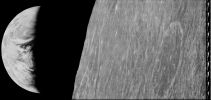
01-Lunar_Orbiter_1_-_The_Moon_and_Earth.jpgCrescent Earth from the Lunar Orbiter 1 (credits: NASA/LOIRP)103 visiteCaption NASA:"Pictured above is the first image ever taken of the Earth from the Moon. The image was taken in 1966 by Lunar Orbiter 1 and heralded by then-journalists as the Image of the Century. It was taken about two years before the Apollo 8 crew snapped its more famous color cousin. Recently, modern technology has allowed the recovery of Higher Resolution images from old data sources such as Lunar Orbiter tapes than ever before. Specifically, recovery of the above image was initiated 20 years ago by Nancy Evans, and completed recently by Dennis Wingo and Keith Cowing who lead the Lunar Orbiter Image Recovery Project.
Images like this one carry more than aesthetic value -- i.e.: by making a comparison to recent High Definition images of the Moon enables investigations into how the Moon has been changing".MareKromium
|
|

15-U-Tobias.jpgTobias Mayer Crater, from Lunar Orbiter 5 (3D)102 visiteOriginal caption:"Stereoscopic view of an area sw of the Crater Tobias Mayer in Oceanus Procellarum. The highland ridge in the middle portion of the anaglyph is about 35 Km long and 2 Km high. A smooth mare dome abuts the western flank of the ridge. The dome is about 20 Km in diameter and exhibits an elongate summit crater, about 5 Km long.
A sinuous rille meanders across the lower part of the photograph, detouring around the base of the dome. Note the presence of several crater chains in the lower half and a large highland mass at upper left".
|
|

APOLLO 8 AS 08-12-2198.jpgAS 08-12-2198 - The Moon from orbit (3)101 visitenessun commento
|
|

03-Korolev Basin.jpgThe "far side" of the Moon: Korolev Basin from Lunar Orbiter 1101 visiteCaption NASA originale:"Lunar Orbiter 1 view of the Korolev Basin on the far side of the Moon. The basin is located at 3° S, 158° W and is about 440 Km in diameter, the largest crater in the image, to the left and slightly above the center. Adjacent to Korolev, at about 5:00, is the crater Galois and at 6:30 is the smaller Doppler crater. The rim of the South Pole - Aitken Basin - is faintly visible running just below these craters. North is up (Lunar Orbiter 1, frame M-40)".
Location & Time Information
Date/Time (UT): 1966-08-22 T 14:58
Distance/Range (km): 1466
Central Latitude/Longitude (deg): -06.44/211.26
|
|

18-Rima Hadley.jpgHadley Rille100 visiteCaption NASA originale:"Lunar Orbiter 5 view of Hadley Rille and the surrounding region on the Moon. Hadley Rille is the sinuous depression running from the top to the bottom of the image. To the right are the 1 to 2 Km high Apennine mountains. Apollo 15 landed near the very rightmost extension of the rille, near the top of the image. The large crater in the center of the image is the 30 Km diameter Hadley C.
A HR image of the rille is available as L05-H105. North is up (Lunar Orbiter 5, frame M-105)".
Location & Time Information
Date/Time (UT): 1967-08-14 T 12:41
Distance/Range (km): 132
Central Latitude/Longitude (deg): +25.09/002.95
|
|

APOLLO_8_AS_08-14-2383.jpgAS 8-14-2383 - Rising Earth (HR)100 visitenessun commento
|
|

APOLLO 8 Re-Entry.jpgS69-15592 - The re-entry of Apollo 8100 visiteThe final sightings, both deliberate and accidental, of each mission would come during reentry over the Pacific. NASA added camera pods to the Apollo Range Instrumentation Aircraft (later --> Advanced Instrumentation Aircraft, ARIA) platforms, generating pictures such as S69-15592 of Apollo 8 (this one), originally found at "http://science.ksc.nasa.gov/mirrors/images/html/as8.htm"
Numerous bits of debris, presumably from the Service Module, appear as well as the fireball around the Command Module.
Additional pictures by airline passengers exist at least for Apollo 13.
|
|

APOLLO 4 AS 04-01-212.jpgAS 04-01-212 - The "Blue Planet" in transit (2)99 visite...la Luna (ergo dopo Apollo 17) ci siamo fermati?
Che cosa è successo?
Erano davvero "totalmente sprecati" i miliardi di Dollari impiegati nel Programma Spaziale?
La Luna non serviva davvero a nessuno?
Era meglio investire in "Scudi Spaziali" e "Polizia Internazionale"?
Ci siamo "ritirati" o "ci hanno mandati via"?...
Pensate a queste domande, di tanto in tanto, o magari la prossima volta che Vi troverete a guardare la Luna, magari dopo un temporale: credeteci, è il momento migliore!...
|
|
| 143 immagini su 12 pagina(e) |
 |
|
|
|
|
|
|
9 | |
|
|





