| Piú viste - Before the Moon and Walking on the Moon (partially edited) |

APOLLO 8 AS 08-18-2867 ANOMALY.jpgAS 08-18-2867 - A streak in the Sky: another Star-like object?116 visiteQuesto star-like obejct è più una "striscia" che un "punto": lo potete vedere sulla Vostra Dx, circa a mezza altezza dell'immagine.
Il materiale in nostro possesso è costituito solo da questa fotografia la quale, ancorchè bella (e chiara!), non è da sola sufficiente a fornirci adeguati supporti argomentativi. Non sembra uno star-like object analogo ai tanti sino ad ora incontrati, ma in tutta onestà noi non ci sentiamo di avanzare ipotesi circa la sua possibile origine.
|
|
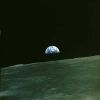
APOLLO 10 AS 10-35-5242.jpgAS 10-35-5242 - Earth-rise116 visiteCome potete vedere, tutti gli star-like objects, in questo frame, sono spariti. La macchina da ripresa non è cambiata così come non sono stati cambiati nè il rullino, nè i tempi di esposizione durante lo scatto. Tre foto identiche, scattate in rapida sequenza, nelle quali due contengono "tracce" di star-like objects ed una no. Questa circostanza non è sicuramente un elemento decisivo per l'espressione di un parere, però è sicuramente un dato importante, che deve far riflettere con prudenza (sempre), ma...
|
|

12-Davy Crater Chain.jpgThe "Davy Crater Chain" from Lunar Orbiter 4 - A comet impact?116 visiteCaption NASA originale:"Lunar Orbiter 4 image of the Davy Crater Chain on the Moon. The chain stretches from Davy Y at left to the large, bright Davy G (diameter 15 Km). Note the even spacing of the craters. The chain may be the result of secondary impacts, volcanic activity, or an impactor which broke apart shortly before impact, similar to Comet Shoemaker/Levy 9 on Jupiter. North is up (Lunar Orbiter 4, frame 108-H2)".
Location & Time Information
Date/Time (UT): 1967-05-18 T 17:16:51
Distance/Range (km): 2719
Central Latitude/Longitude (deg): -14.26/357.64
|
|

15-Rima Hadley.jpg"Hadley Rille" from Lunar Orbiter 5 (HR)116 visiteCaption NASA originale:"Lunar Orbiter 5 view of Hadley Rille (Rima Hadley) on the Moon. This high-resolution view of the V-shaped valley clearly shows blocks along the walls and at the bottom. The sides slope at about 20° and the rille is 1 to 1,5 Km from rim to rim. Apollo 15 landed about 2 Km from the rim of Hadley Rille and explored it in detail. North is up. This is a detail from the lower left corner of frame H3. The medium resolution, regional view is shown in frame lo5_m105 (Lunar Orbiter 5, frame 105-H3)".
Location & Time Information
Date/Time (UT): 1967-08-14 T 12:41
Distance/Range (km): 132
Central Latitude/Longitude (deg): +25.09/002.95
|
|

ZZ-ZZ-The Blair Cuspids-L.jpgThe "Blair Cuspids": possible shapes and visual appearance from Lunar datum (2)116 visiteThese profile images are really negative images of the shadows of the 5 objects indicated by the numbers in the previous frame. The background has been blacked out by hand to emphasize the overall shape of each object. The shadows have been compressed in the direction of their length, according to the trigonometric relationship between an object's height (-->H), the length of its shadow (-->Ls), and the tangent of the Sun's elevation angle (-->A), above the surface on which the shadow falls. This relationship is: H = Ls tan(A).
Because the first four Cuspids appear to be situated on a fairly horizontal surface, the value of angle A was taken from the NASA support data to be the Sun's elevation above the horizon - 10,9° - and the images of the shadows were compressed by the value of that angle's tangent, such as 0,193°.
A greater compression, corresponding to a Sun angle of 8° (tan(8) = 0,14) was used for the profile of Cuspid 5 because its shadow falls over the surface of the rectangular "trench", which is sloping downward away from the Sun, thus effectively decreasing the Sun's elevation above the surface. (…)
The detailed contours of the objects are lost in these profiles due to the irregularities of the lunar surface and due to the blurring caused by the image compression algorithm. However, the general shapes of all the objects – except the first – can still be clearly seen to differ radically from the shapes of common lunar boulders and ridges.
The profiles suggest that Cuspids 2 through 5 have heights greater than their widths, which would be a very unstable placement for a randomly placed boulder and even more unusual for a cluster of them.
The hills and ridges of the Moon tend to be very low and rounded. The great lunar mountain Pico Mons in Mare Imbrium, for example, has a height only 16% of its width.
Cuspids 2 though 4 are conical or pyramidal, while Cuspid 5 (still the tallest even with a lower Sun angle assumed) appears to be a cylinder. Based on the assumption that the sun's elevation is 8° above the slope on which Cuspid 5's shadow is being cast, the object itself would have a height of approximately 15 meters. (…)
|
|
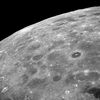
APOLLO 8 AS 08-12-2192.jpgAS 08-12-2192 - The "Far-Side" of the Moon...is not "too far"! (1)116 visitenessun commento
|
|

APOLLO 6 AS 06-02-819.jpgAS 06-02-819 - The Horizon of Earth115 visiteSolo poche parole per farVi notare, da questa immagine e per le prossime, non solo la nitidezza dei particolari e - ovviamente - la bellezza della Terra, ma anche l'incredibile risultato tecnologico ottenuto con dei mezzi che, visti i progressi (reali?!?) ottenuti negli ultimi 35 anni, fanno semplicemente sorridere. Abbiamo mandato decine di Uomini intorno alla Terra, fra la Terra e la Luna e sulla Luna, in 12 anni di Missioni. Ci sono stati incidenti, alcuni anche tragici (Apollo 1), ma non ci siamo mai...
|
|

02-Taruntius Crater.jpgTaruntius Crater form Lunar Orbiter 1114 visiteCaption NASA originale:"Lunar Orbiter 1 image of Taruntius crater on the Moon. The crater at the top of the image is 56 km in diameter. Note the central peak and internal concentric ridges and rilles. North is up. (Lunar Orbiter 1, frame M-31)".
Location & Time Information
Date/Time (UT): 1966-08-20 T 13:46:59
Distance/Range (km): 247
Central Latitude/Longitude (deg): +02.54/047.96
|
|

46-Ranger9.jpgApproaching Alphonsus Crater113 visiteCaption NASA originale:"Ranger 9 image of Alphonsus Crater (diameter 108 Km) from a distance of 442 Km, taken about 3 minutes before impact in the upper right portion of the crater. At left is the northeastern edge of Mare Nubium. The crater adjacent to Alphonsus at the bottom is the 39 Km diameter Alpetragius. Davy Crater is at upper left. North is at 12:30. Ranger 9 impacted the Moon on 24 March 1965 at 14:08:20 UT (Ranger 9, A035)".
Location & Time Information
Date/Time (UT): 1965-03-24 T 14:05:18
Distance/Range (km): 442.26
Central Latitude/Longitude (deg): -13.443, 004.79 W
Orbit(s): Impact - Hard Landing
|
|

15-T-SchroteriVallis.jpgSchroteri Valley, from Lunar Orbiter 5 (3D)113 visiteOriginal caption:"Stereoscopic view of a part of Schroter's Valley, the meandering depression running from the upper right to the lower left corner of the anaglyph. This rille is about 7 Km wide and up to 1300 m deep. Within its flat floor is a second, sinuous rille whose tightly packed meandor loops are about 200 m deeper. The ridge that is seen in the upper left portion of the photograph is about 1600 m higher than the plateau surface into which the Valley is cut".
|
|

APOLLO 4 AS 04-01-735.jpgAS 04-01-735 - The "Blue Planet" in transit (7)108 visitenessun commento
|
|

APOLLO 4 AS 04-01-307.jpgAS 04-01-307 - The "Blue Planet" in transit (3)108 visitenessun commento
|
|
| 143 immagini su 12 pagina(e) |
 |
|
|
|
|
|
8 | |
|
|
|





