| Piú viste - Before the Moon and Walking on the Moon (partially edited) |

63-Guericke Crater.jpgGuericke Crater - The Crater114 visitenessun commento
|
|

APOLLO 8 AS 08-12-2144.jpgAS 08-12-2144 - The Moon from orbit (1)113 visiteCarenza di interesse, di motivazione, di denaro da investire o che cosa?
Guardate queste fotografie della Luna riprese dall'Apollo 8 (per non parlare delle immagini riprese dal Lunar Orbiter intorno alla metà degli anni '60): sono più belle (in termini di nitidezza e qualità dei particolari) di molte di quelle scattate dalla Sonda Clementine o da altre Sonde create (oggi!) per la Luna o passate accanto alla Luna prima di dirigersi verso altre mete più lontane.
Può essere solo un caso?
|
|

07-Kepler Crater.jpgKepler Crater from Lunar Orbiter 3113 visiteCaption NASA originale:"Lunar Orbiter 3 oblique image of Kepler crater on the Moon. The crater is 32 km in diameter and is located near the outer rim of the Imbrium Basin. Kepler is located at 8° N, 38° W, southwest of Mare Imbrium. North is at 11:00 (Lunar Orbiter 3, frame M-162)".
Location & Time Information
Date/Time (UT): 1967-02-21 T 05:02
Distance/Range (km): 156
Central Latitude/Longitude (deg): +06.91/321.90
|
|

APOLLO 10 AS 10-30-4421.jpgAS 10-30-4421 - Mare Crisium112 visiteQuesto è il frame originale (in versione compressa) da cui Mike Bara ha preso spunto per la sua ricerca e per la relativa teorizzazione (che potete leggere per intero sul Sito "Lunar Anomalies Homepage"). Purtroppo, su questa tematica (e su altre affini), chi sa - anzi: chi "dovrebbe saperne" - più di tutti (la NASA), tace.
Noi prendiamo atto di questa mancanza di collaborazione da parte dell'Ente Spaziale più famoso del Mondo e continuiamo a cercare, seguendo i dettami della nostra coscienza e muovendoci in linea con la nostra cultura e filosofia.
Staremo a vedere...
|
|

ZZ-ZZ-The Blair Cuspids-L.jpgThe "Blair Cuspids": possible shapes and visual appearance from Lunar datum (2)112 visiteThese profile images are really negative images of the shadows of the 5 objects indicated by the numbers in the previous frame. The background has been blacked out by hand to emphasize the overall shape of each object. The shadows have been compressed in the direction of their length, according to the trigonometric relationship between an object's height (-->H), the length of its shadow (-->Ls), and the tangent of the Sun's elevation angle (-->A), above the surface on which the shadow falls. This relationship is: H = Ls tan(A).
Because the first four Cuspids appear to be situated on a fairly horizontal surface, the value of angle A was taken from the NASA support data to be the Sun's elevation above the horizon - 10,9° - and the images of the shadows were compressed by the value of that angle's tangent, such as 0,193°.
A greater compression, corresponding to a Sun angle of 8° (tan(8) = 0,14) was used for the profile of Cuspid 5 because its shadow falls over the surface of the rectangular "trench", which is sloping downward away from the Sun, thus effectively decreasing the Sun's elevation above the surface. (…)
The detailed contours of the objects are lost in these profiles due to the irregularities of the lunar surface and due to the blurring caused by the image compression algorithm. However, the general shapes of all the objects – except the first – can still be clearly seen to differ radically from the shapes of common lunar boulders and ridges.
The profiles suggest that Cuspids 2 through 5 have heights greater than their widths, which would be a very unstable placement for a randomly placed boulder and even more unusual for a cluster of them.
The hills and ridges of the Moon tend to be very low and rounded. The great lunar mountain Pico Mons in Mare Imbrium, for example, has a height only 16% of its width.
Cuspids 2 though 4 are conical or pyramidal, while Cuspid 5 (still the tallest even with a lower Sun angle assumed) appears to be a cylinder. Based on the assumption that the sun's elevation is 8° above the slope on which Cuspid 5's shadow is being cast, the object itself would have a height of approximately 15 meters. (…)
|
|

APOLLO 10 AS 10-31-4562 ALBEDO.jpgAS 10-31-4562 - Bright Crater (1)111 visiteAlbedo, ovvero: quella frazione della luce ricevuta da una superficie e che viene da essa diffusa. L'albedo, dunque, dipende dalla costituzione della superficie (cioè da cosa essa "è fatta"). E' naturale che una superficie completamente ghiacciata (come Enceladus) o ammantata di nuvole (come Venere o la Terra stessa) avrà un'albedo maggiore di una superficie rocciosa e scura. La Luna, per esempio - e nonostante le apparenze che potrebbero ingannare -, assorbe più del 90% della luce solare che riceve e...
|
|

05-Copernicus Crater.jpgOblique view of Copernicus Crater from Lunar Orbiter 2110 visiteCaption NASA originale:"Lunar Orbiter 2 northword - looking oblique view of Copernicus Crater on the Moon. Copernicus crater extends across the background of the picture, about 100 Km in diameter. Note the radial ridges, mounds and cones around the crater. The keyhole shaped Fauth crater sits atop one of the ridges 60 Km south of Copernicus (Lunar Orbiter 2, frame M-162)".
Location & Time Information
Date/Time (UT): 1966-11-24 T 00:05:43
Distance/Range (km): 130
Central Latitude/Longitude (deg): +05.48/340.00
|
|

61-Guericke Area-1.jpgGuericke Crater - The Map110 visitenessun commento
|
|

APOLLO 8 AS 08-18-2906.jpgAS 08-18-2906 - The Moon and a Star107 visiteUn'immagine davvero suggestiva della Luna (come la vedremmo dalla Terra attraverso un buon binocolo o anche con l'ausilio di un telescopio astronomico di modeste dimesioni. In alto, sulla Dx della Luna (Sn di chi guarda), una stella.
|
|
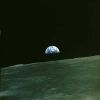
APOLLO 10 AS 10-35-5242.jpgAS 10-35-5242 - Earth-rise107 visiteCome potete vedere, tutti gli star-like objects, in questo frame, sono spariti. La macchina da ripresa non è cambiata così come non sono stati cambiati nè il rullino, nè i tempi di esposizione durante lo scatto. Tre foto identiche, scattate in rapida sequenza, nelle quali due contengono "tracce" di star-like objects ed una no. Questa circostanza non è sicuramente un elemento decisivo per l'espressione di un parere, però è sicuramente un dato importante, che deve far riflettere con prudenza (sempre), ma...
|
|

02-Taruntius Crater.jpgTaruntius Crater form Lunar Orbiter 1107 visiteCaption NASA originale:"Lunar Orbiter 1 image of Taruntius crater on the Moon. The crater at the top of the image is 56 km in diameter. Note the central peak and internal concentric ridges and rilles. North is up. (Lunar Orbiter 1, frame M-31)".
Location & Time Information
Date/Time (UT): 1966-08-20 T 13:46:59
Distance/Range (km): 247
Central Latitude/Longitude (deg): +02.54/047.96
|
|

12-Davy Crater Chain.jpgThe "Davy Crater Chain" from Lunar Orbiter 4 - A comet impact?107 visiteCaption NASA originale:"Lunar Orbiter 4 image of the Davy Crater Chain on the Moon. The chain stretches from Davy Y at left to the large, bright Davy G (diameter 15 Km). Note the even spacing of the craters. The chain may be the result of secondary impacts, volcanic activity, or an impactor which broke apart shortly before impact, similar to Comet Shoemaker/Levy 9 on Jupiter. North is up (Lunar Orbiter 4, frame 108-H2)".
Location & Time Information
Date/Time (UT): 1967-05-18 T 17:16:51
Distance/Range (km): 2719
Central Latitude/Longitude (deg): -14.26/357.64
|
|
| 143 immagini su 12 pagina(e) |
 |
|
|
|
|
7 | |
|
|
|
|





