| Piú viste - Before the Moon and Walking on the Moon (partially edited) |

52-The Shard-02.jpgThe famous "Shard", on the Moon (3)148 visitenessun commento
|
|

APOLLO 9 AS 09-19-2951.jpgAS 09-19-2951 - The "Blue Planet" and something else... (2)147 visite...un rottame spaziale proveniente dallo stesso Apollo 9?
Forse nulla di tutto ciò: probabilmente è solo la Navicella Madre (ripresa da un angolo visuale davvero infelice - il quale ce la fa apparire di forma vagamente rotondeggiante) che si sta allontanando dal LM, durante una fase del training.
|
|

ZZ-The Blair Cuspids Area(un)-iv_090_h1.jpgThe "Blair Cuspids' Area" (unedited)147 visiteFu un certo Dr William BLAIR - un antropologo che lavorava alla Boeing (la Società produttrice del Lunar Orbiter) - che rimase particolarmente colpito da queste "anomalie" e dedicò ad esse un profondo studio il quale ancora oggi mantiene, al pari delle "cuspidi", un grande fascino ed interesse. Il Dr Blair si era infatti convinto, osservando l'immagine ripresa dal Lunar Orbiter, che simili strutture rispondevano, in termini geometrici, ad una sorta di "trama" che ricordava - per certi versi - i tracciati...
|
|

30-Tycho-S7.jpgTycho Crater from Surveyor 7 Lander146 visiteCaption NASA originale:"Surveyor 7 mosaic of the rim area of Tycho from the highland region, north of the Crater. Surveyor 7 landed 10 January 1969 at 40.88° S, 11.45° W and took about 21.000 photos over a month, some of which were used to make up this mosaic. The block in the foreground is about half a meter across and the crater is about 1,5 meters in diameter. The hills on the horizon are about 13 Km away (Surveyor 7, 68-H-40)".
Location & Time Information
Date/Time (UT): 1968-01
Distance/Range (km): 0,001
Central Latitude/Longitude (deg): -40.88,348.55 E
Orbit(s): Lander
|
|
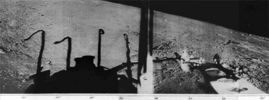
56-Luna13 - Panorama-02.jpgLunik 13: Oceanus Procellarum (2)144 visiteThe Luna 13 spacecraft was launched toward the Moon from an Earth-orbiting platform and accomplished a soft landing on December 24, 1966, in the Region of "Oceanus Procellarum". The petal encasement of the spacecraft was opened, antennas were erected, and radio transmissions to Earth began 4 minutes after the landing. On December 25 and 26, 1966, the spacecraft television system transmitted panoramas of the nearby lunar landscape at different sun angles. Each panorama required approximately 100 minutes to transmit. The spacecraft was equipped with a mechanical soil-measuring penetrometer, a dynamograph, and a radiation densitometer for obtaining data on the mechanical and physical properties and the cosmic-ray reflectivity of the lunar surface. It is believed that transmissions from the spacecraft ceased before the end of December 1966.
|
|
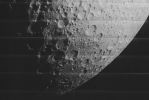
AA-A-MOON - LO-4-193M-5-enhanced.jpgThe Moon from the Lunar Orbiter 4 (5)143 visitecompletamento della panoramica
|
|

AA-A-MOON - LO-4-193M-3-enhanced.jpgThe Moon from the Lunar Orbiter 4 (3)142 visiteprosieguo della panoramica
|
|

29-G-Surveyor6_full.jpgSurveyor 6 - Panorama142 visiteOriginal caption:"This panorama of the cratered lunar surface was constructed from images returned by the US Surveyor 6 lander.
Surveyor 6 was not the first spacecraft to accomplish a soft landing on the Moon ... but it was the first to land and then lift off again! After the spacecraft touched down near the center of the Moon's nearside in November of 1967, NASA controllers commanded it to hop. Briefly firing its rocket engine and lifting itself some 4 mt above the surface, the Surveyor moved about 2,5 meters to one side before setting down again. The hopping success of Surveyor 6 essentially marked the completion of the Surveyor series main mission - to determine if the lunar terrain was safe for the planned Apollo landings".
|
|

57-Luna13 - Panorama-03.jpgLunik 13: Oceanus Procellarum (3)140 visiteNon comprendiamo bene che cosa si intenda con l'espressione "...it is believed..." che le trasmissioni si interruppero poco prima della fine del Dicembre 1966. Non pensiamo che esista un "si crede" in questo campo, ma prendiamo atto ed andiamo avanti. Quello che ci sembra importante dire e sottolineare, relativamente a questo frame, è che la sua qualità intrinseca è eccellente, la definizione buona ed i suoi contenuti - anche considerato che eravamo del 1966 - davvero strabilianti.
La superficie della Luna appare con grande chiarezza e, già dal tassello n. 2, si intravedono almeno 2 o 3 Star-Like Objects (dunque un elemento ricorrente nella fotografia lunare e NON solo riscontrato in frames "Made in USA"). Come ci danno evidenza le ombre delle antenne del Lander, il Sole è ancora piuttosto basso all'orizzonte; l'area circostante il Lander è alquanto accidentata - più pietrosa, si direbbe, che polverosa - ma non impervia. Intravediamo qualche cratere di modestissime dimensioni e, forse, un "hollow"...
|
|

APOLLO 10 AS 10-31-4568 ALBEDO.jpgAS 10-31-4568 - Bright Crater (3)138 visiteNotate come esso sia brillante, praticamente bianco, in contrasto alla porzione rimanente della superficie Lunare fotografata, che sembra di colore grigio spento.
La luminosità del cratere (anzi, delle sue pareti interne), dunque, da che cosa dipende? Si tratta di un effetto derivante dalle sue caratteristiche superficiali (per esempio è lastricato di rocce cristalline), oppure è una conseguenza del particolare angolo di incidenza dei raggi del Sole sul suo profilo?
|
|

OO-APOLLO 11 - TV IMAGE.jpg"Hello to the World!" (TV - Live from the Moon)138 visiteArmstrong "saluta" il Mondo, il Mondo "salutava" Armstrong: l'Uomo era arrivato sulla Luna.
Pochi anni dopo, tutta questa epopea (forse una delle più grandi nella Storia dell'Umanità), veniva svillaneggiata e derisa grazie alla smania di notorietà dell'Ing. Kaysing e, forse, grazie anche alla necessità di "coprire il copribile".
"...Meglio far credere all'Umanità che non ci siamo mai stati, piuttosto che dire all'Umanità quello che ci abbiamo trovato..."
|
|

ZZ-ZZ-The Blair Cuspids-H.jpgThe "Blair Cuspids": possible shapes and visual appearance from Lunar datum (1)138 visitevedi il commento al frame successivo
|
|
| 143 immagini su 12 pagina(e) |
 |
|
|
5 | |
|
|
|
|
|
|





