| Piú viste - The Chinese Moon Program |

Luna-08.jpegWhat a color!199 visiteNone of the pictures taken by Chang'E-4 Chinese Lunar Lander in January 2019 have colors similar to the photos taken by Armstrong, Aldrin and the other 10 astronauts. The question is why?MareKromium
|
|

Luna-05.jpgNice "Duo", awful picture185 visiteThis photo of Earth and the Lunar Far Side, maybe our best ever, was taken yesterday by the Chinese Lunar Satellite DSLWP-B (Longjiang-2). The Dwingeloo telescope downloaded the photo from the satellite.
Nota: se questa immagine - palesemente "ritagliata", anche per occhi non abituati alla fotografia spaziale (si guardi il bordo Lunare - Lunar Limb -, confrontandolo con immagini "vere" per capire bene... - viene definita come la "Best Ever" (migliore di sempre). Beh, evidentemente chi aiuta l'Agenzia Spaziale Cinese a fare propaganda si è dimenticato delle straordinarie immagini ottenute non solo a non tanto dalla NASA, quanto dall'Agenzia Spaziale Sovietica con la Sonda ZOND-3 nel 1969 (!). E comunque, se questa scadentissima "cartolina" del Sistema Terra-Luna è la "best ever", non osiamo immaginare la "worst" one...MareKromium
|
|

Luna-20.jpgThe "Dark Side of the Moon": Hills in the distance136 visitenessun commentoMareKromium
|
|

Luna-19.jpgThe "Dark Side of the Moon": Antenna MAST131 visitenessun commentoMareKromium
|
|
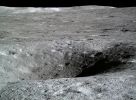
Luna-13.jpgThe "Dark Side of the Moon": relatively small (Secondary) Impact Crater124 visitenessun commentoMareKromium
|
|

New_Mineral.jpgChangesite-(Y) - What is it?118 visite(XINHUA) - PECHINO, 9 Settembre 2022 - Scienziati Cinesi hanno scoperto un nuovo minerale lunare attraverso la ricerca sui campioni recuperati dalla Luna nell'ambito della missione cinese Chang'e-5. Lo hanno annunciato oggi congiuntamente la China National Space Administration (CNSA) e la China Atomic Energy Authority (CAEA). Si tratta del primo nuovo minerale scoperto sulla Luna dalla Cina e il sesto scoperto dall'Umanità. La nuova scoperta rende la Cina il terzo Paese al mondo ad aver scoperto un nuovo minerale sulla Luna, ha affermato Dong Baotong, vicedirettore del CAEA.
Il nuovo minerale, che è stato chiamato Changesite-(Y): è una specie di "cristallo colonnare trasparente ed incolore". È stato scoperto da un'analisi delle particelle di Basalto Lunare da parte di un gruppo di ricerca del Beijing Research Institute of Uranium Geology, una filiale della China National Nuclear Corporation. Il Changesite-(Y) è stato ufficialmente approvato come nuovo minerale dalla Commissione sui Nuovi minerali, Nomenclatura e Classificazione dell'Associazione Internazionale di Mineralogia.MareKromium
|
|

Luna-04.jpgThe Chang'e 4 Lander from MRO117 visiteThe Regolith Layer existing on the Surface of the Von Kármán Crater has a thickness of more than 10 meters and below it there is a (rocky) "Multilayer" formed by the Ejecta Material of (other) surrounding Impact Craters, which is as thick as more than about 30 meters. Underneath, we can also find three Basalt Magma Covers.MareKromium
|
|

Luna-01.jpgLunar Far Side110 visiteUnder the Surface fine-grained Regolith, superpositions among these Crater Materials and mare Basalt Units establish shallow Regolith Stratigraphic sequences. The low-frequency data (CH-1, 60 MHz) show a deep Stratigraphic Structure to the depth of approx. 360 mt that indicates the previous Geological evolution history of the Von Kármán Crater.
The LPR results (will) provide an important scientific basis for understanding the Geological History of the Far Side of the Moon.MareKromium
|
|

Luna-18.jpgThe "Dark Side of the Moon": on the edge...108 visitenessun commentoMareKromium
|
|

Luna-07.jpg103 visiteChang'E 3 (left - Sx -, M147290066LR) and Chang'e 4 (right - Dx -, M1303619844LR) are very similar in size and instrumentation. The Chang'E 3 image looks a bit fuzzier because the Landing Site is at 44° North Latitude where the LRO orbit is about twice as far from the Moon relative to the Chang'e 4 Site, at 45° South Latitude.
Each panel is roughly 463 meters (such as about 1520 feet) wide, large arrows indicate Landers and small arrows indicate Rovers.MareKromium
|
|

Luna-12.jpgThe "Dark Side of the Moon": the Chang-e 4 Rover103 visitenessun commentoMareKromium
|
|

Luna-17.jpgThe "Dark Side of the Moon": Horizon103 visitenessun commentoMareKromium
|
|
| 20 immagini su 2 pagina(e) |
1 |
|





