| Piú viste - The Moon from JAXA - The "Kaguya" Lunar Probe |

Kaguya-003-20071107.jpgThe Western Side of the Oceanus Procellarum76 visiteCaption JAXA:"This is a still image taken out from the second moving image shooting when the KAGUYA Probe flew from the South to the North, on the Western Side of the "Oceanus Procellarum".
The dark part on the right of the above image is the Ocean and the light area on the left is called the "highland".
The moving image was taken at 05:51 a.m. on Oct. 31st, 2007 (JST) by eight-fold speed intermittent shooting (eight minutes is converged to one minute) from the KAGUYA, and the data was received at the JAXA Usuda Deep Space Center on the same day". MareKromium
|
|

Kaguya-006-20071107.jpgWhere the first two pictures were taken...76 visitenessun commentoMareKromium
|
|

Kaguya-008-20071113.jpgThe setting "Blue Marble", from Lunar Orbit (Kaguya is near the Lunar South Pole)76 visiteCaption JAXA:"This still image was cut out from a moving image (tele shot) taken by the HDTV onboard the KAGUYA at 12:07 p.m. on November 7, 2007 (Japan Standard Time, JST,) then sent to the JAXA Usuda Deep Space Center.
In the image, the Moon's surface is near the South Pole, and we can see the Australian Continent (center left) and the Asian Continent (lower right) on the Earth.
(In this image, the upper side of the Earth is the Southern Hemisphere, thus the Australian Continent looks upside-down)".MareKromium
|
|
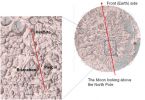
Kaguya-001-20071107.jpgThe View on Map: North Polar Region75 visiteThe area around the North Pole shot by the first image taking (encircled by a blue line) and KAGUYA's orbit (red arrow)
MareKromium
|
|

Kaguya-007-20071113.jpgThe rising "Blue Marble", from Lunar Orbit (Kaguya is near the Lunar North Pole)75 visiteCaption JAXA:"The Japan Aerospace Exploration Agency (JAXA) and NHK (Japan Broadcasting Corporation) have successfully performed the world's first high-definition image taking of an Earth-rise* by the Lunar Explorer "KAGUYA" (SELENE,) which was injected into a lunar orbit at an altitude of about 100 km on October 18, 2007 (Japan Standard Time. Following times and dates are all JST.)
The Apollo project was the first mission to take images of Earth rising over the Moon. The KAGUYA successfully shot high-definition images of the Earth-rise showing an impressive image of the blue Earth which was the only floating object in pitch-dark space.
These are the World's first high-definition earth images taken from about 380.000 Km away from the Earth in space.
The image taking was performed by the KAGUYA's onboard High Definition Television (HDTV) for space use developed by NHK. The moving image data acquired by the KAGUYA was received at the JAXA Usuda Deep Space Center, and processed by NHK.
The satellite was confirmed to be in good health through telemetry data received at the Usuda Station".
* Note: we use the expression "Earth-rise" in this press release, but the Earth-rise is a phenomenon seen only from satellites that travel around the Moon, such as the KAGUYA and the Apollo Class spaceships.
The Earth-rise cannot be observed by a person who is on the Moon as they can always see the Earth at the same position.
This still image was cut out from a moving image (wide shot) taken by the HDTV onboard the KAGUYA at 02:52 p.m. on November 7, 2007 (JST) then sent to the JAXA Usuda Deep Space Center.
In the image, the Moon's surface is near the North Pole, and the Arabian Peninsula and Indian Ocean can be observed on the Earth disc.MareKromium
|
|
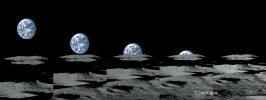
Kaguya-009-20071113.jpgThe setting "Blue Marble", from Lunar Orbit (full sequence - Kaguya is near the Lunar South Pole)72 visiteCaption JAXA:"These images are the Earth setting to the horizon near the Moon's South Pole.
It took about 70 seconds from the left image to the right image (complete setting)". MareKromium
|
|
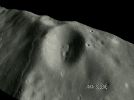
Kaguya-012-20071128_kaguya_tc02_03_l.jpgDyson Crater (1)72 visiteCaption JAXA:"The Terrain Camera (TC) can observe the Moon surface during the day-time of the Moon using 2 cameras that respectively face the slightly diagonal forelooking and afterlooking of the satellite. It can take 3-D (stereo) images of the Moon's globe with a world's first Super High Definition (SHD) of 10 meters.
3-D terrain images acquired by TC HighRes Stereo-Pair Cameras are important data to study the evolution process of the Moon's unique terrain.
With detailed investigation of the crater distribution, we can estimate more precisely when each area of the Moon has been formed and can study more details of when the Moon was born and how its inside and surface have been changing.
Furthermore, data acquired by the TC is expected to be useful for studying topographical characteristics and illumination map to determine the best location for a future Moon base and to consider manned activities on the Moon".MareKromium
|
|

Kaguya-004-20071107.jpgThe View on Map: Oceanus Procellarum71 visiteThe West Area of the "Oceanus Procellarum" shot by the second image taking (encircled by a blue line) and KAGUYA's orbit (red arrow).
MareKromium
|
|

003-Kaguya-20071009_kaguya_05l.jpgKaguya is approaching the Moon (1)70 visiteCaption JAXA:"The upper right dark area is a Lunar Ocean: it is the Western rim of the Oceanus Procellarum".
(This image was taken around 14:50 on Oct. 5th (JST), at a distance of about 1.500 Km from the Moon) MareKromium
|
|

Kaguya-013-20071128_kaguya_tc02_04.jpgDyson Crater (2)69 visitenessun commentoMareKromium
|
|

000-Kaguya.jpgThe Kaguya (SELENE) Probe67 visiteThe SELenological and ENgineering Explorer "KAGUYA"(SELENE), Japan’s 1st large Lunar Explorer, was launched by the H-IIA rocket on September 14, 2007 (JST). The mission, which is the largest Lunar Mission since the Apollo Program, is being keenly anticipated by many countries.
The major objectives of the Mission are to understand the Moon’s origin and evolution and to observe the Moon in various ways in order to utilize it in the future. The Lunar Missions that have been conducted so far have gathered a large amount of information on the Moon, but the mysteries of its origin and evolution have been left unsolved.
KAGUYA will investigate the entire Moon in order to obtain information on its elemental and mineralogical composition, geography, surface and sub-surface structure, the remnant of its magnetic field and its gravity field.
The results are expected to lead to a better overall understanding of the Moon’s evolution. At the same time, the observation equipment installed on the orbiting satellite will observe plasma, the electromagnetic field and high-energy particles. The data obtained in this way will be of great scientific importance for exploring the possibility of using the moon for human endeavors.MareKromium
|
|

Kaguya-010-20071113.gifRelative locations of the KAGUYA Probe, the Moon, and the Earth66 visitenessun commentoMareKromium
|
|
| 55 immagini su 5 pagina(e) |
2 |  |
|
|





