| Piú viste - A Tribute To Mars Global Surveyor |

Craters-Unnamed_Crater_with_Tiled_Floor-MGS-PCF-LXTT.jpgUnnamed Crater in Vastitas Borealis (Natural Colors; credits for the additional process. and color.: Dr Paolo C. Fienga - Lunexit) 226 visiteCaption NASA originale:"This MGS-MOC image shows Polygonal Cracks formed in the material that nearly fills an Impact Crater on the Martian Northern Plains. The light-toned patches in the Cracks are the remains of Ice, left over from the preceding Winter.
On Earth, Polygons such as these are most common in the Polar Regions and form in the presence of ground ice. Whether the same is true for Mars remains to be determined, but, certainly, this is a good possibility".
Location near: 65,7° North; 277,5° West
Image width: ~3 Km (~1,9 mi)
Illumination from: lower left
Season: Northern Spring MareKromium
|
|

South_Polar_Features-Defrosting_Dunes-A-M0702775-PCF-LXTT.jpgSouth Polar Features: Defrosting Dunes (Absolute Natural Colors; credits for the additional process. and color.: Dr Paolo C. Fienga - Lunexit Team)226 visitenessun commentoMareKromium
|
|

Craters-Unnamed_Crater_in_Terra_Sabaea-02.jpgUnnamed Crater in Terra Sabaea (Absolute Natural Colors; credits for the additional process. and color.: Dr Paolo C. Fienga - Lunexit Team)226 visiteCaption originale:"This MGS-MOC image shows a 1,5 mt (~5 feet) per pixel view of an Impact Crater that is approximately 3 Km (about 9840 ft) in diameter. It is located in South-Western Terra Sabaea".
Location near: 21,9° South Lat. and 338,6° West Long.
Image width: ~3 km (~1,9 mi)
Illumination from: upper left
Season: Southern Summer MareKromium
|
|
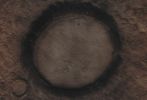
Craters-Unnamed_Impact_Crater-PIA07836-PCF-LXTT.jpgUnnamed Impact Crater wth "Black Rim" in Vastitas Borealis (Absolute Natural Colors; credits for the additional process. and color.: Dr Paolo C. Fienga - Lunexit Team)225 visiteCaption NASA originale:"This MGS-MOC image shows a nearly-filled (and very old) impact crater on the Northern Plains".
Location near: 47,3° North Lat. and 294,0° West Long.
Image width: ~3 Km (~1,9 mi)
Illumination from: lower left
Season: Northern Summer MareKromium
|
|

Craters-Buried_Crater-01.jpgUnder the Sand (Absolute Natural Colors; credits for the additional process. and color.: Dr Paolo C. Fienga - Lunexit Team)224 visiteCaption NASA originale:"This MGS-MOC image shows a partially-buried crater in the North Polar Region of Mars.
The circular feature is surrounded and partly overlain by some of the many, many sand dunes in the area. The steepest slopes on each dune — their "slip faces" — face toward the SouthEast, indicating that the dominant winds responsible for sand transport in this Region come from the NorthWest".
Location near: 76,0° North; 82,2° West
Image width: ~3 Km (~1,9 mi)
Illumination from: lower left
Season: Northern SpringMareKromium
|
|

Craters-Unnamed_Crater_in_Hellas_Planitia-1-MGS.jpgUnnamed Crater in Hellas Planitia (Absolute Natural Colors; credits for the additional process. and color.: Dr Paolo C. Fienga - Lunexit Team)223 visiteCaption NASA originale:"This MGS-MOC image shows a large crater that formed by meteor impact into the layered material in which the buried crater is encased. The layered rock, in this case, has a light tone similar to the sedimentary rocks being explored by the MER Opportunity, thousands of kilometers away in Sinus Meridiani".
Location near: 24,9° South; 299,3° West
Image width: ~3 Km (~1,9 mi)
Illumination from: upper left
Season: Southern Summer MareKromium
|
|
Elysium_Planitia-M1103342.jpgFeatures of Elysium Planitia (Absolute Natural Colors; credits for the additional process. and color.: Dr Paolo C. Fienga - Lunexit Team)221 visitenessun commentoMareKromium
|
|

Chaotic_Terrain-Eos_Chaos-04.jpgFeatures of Eos Chaos: High Slope (Natural Colors; credits for the additional process. and color.: Dr Paolo C. Fienga - Lunexit Team)219 visiteLocation near: 12,9° South Lat. and 49,5° West Long.
Image width: ~3 Km (~1,9 mi)
Illumination from: lower left
Season: Southern SummerMareKromium
|
|

Martian_Mountains-MGS-00.jpgCharitum Montes (Natural Colors; credits: NASA/MGS/MSSS)215 visiteWhat causes the unusual white color on some Martian Mountains? The answer can be guessed by noticing that the bright areas disappear as springtime takes hold in the South of Mars: dry ice. Dry CO2 ice sublimates directly to gas from its frozen state. The frosty mountains, named "Charitum Montes", have been covered with CO2 ice over the Martian Winter. The serene scene pictured above is not a photograph, but rather a computationally constructed digital illusion resulting from the fusion of two color images from the Mars Orbital Camera and topographic data from the Mars Orbiter Laser Altimeter. Both instruments operate from the Mars Global Surveyor robot spacecraft currently orbiting Mars.
|
|

Craters-Kunowsky_Crater-2004_06-PCF-LXTT.jpgFrost and Wavy Clouds on Kunowsky Crater (Absolute Natural Colors; credits for the additional process. and color.: Dr Paolo C. Fienga - Lunexit Team)215 visiteCaption NASA originale:"This red wide angle MGS-MOC image, acquired in March 2004, shows Kunowsky Crater ringed by seasonal Frost. Kunowsky Crater is about 67 Km (~42 mi) in diameter. Wavy Clouds form to the East of the Crater in early Spring as winds circulate from West to East. The Crater is located at about 57,1° North Lat. and 9,7° West Long.". MareKromium
|
|

Craters-Unnamed_Crater_in_Terra_Cimmeria-MGS-PCF-LXTT.jpgUnnamed Impact Crater wth Gullies (Absolute Natural Colors; credits for the additional process. and color.: Dr Paolo C. Fienga - Lunexit Team)214 visiteCaption NASA originale:"This MGS-MOC image shows a 1,5 mt (~5 feet) per pixel view of an Unnamed Crater in the Terra Cimmeria Region of Mars. Several Gullies extend from near the top of the Crater Rim, downslope toward the Floor of the Crater. Liquid water might have played a role in their genesis".
Location near: 37,7° South Lat. and 191,6° West Long.
Image width: ~3 Km (~1,9 mi)
Illumination from: upper left
Season: Southern SummerMareKromium
|
|
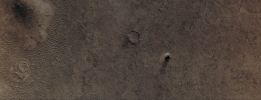
Aeolian_Features-Dust_Devil-MGS-02.jpgRunning Winds... (Absolute Natural Colors; credits for the additional process. and color.: Dr Paolo C. Fienga - Lunexit Team)211 visitenessun commentoMareKromium
|
|
| 512 immagini su 43 pagina(e) |
 |
|
|
|
6 | |
|
|
|
|
|








