| Piú viste - A Tribute To Mars Global Surveyor |

Channels-Unnamed_Channel_with_White_Ripples-MGS-00.jpgWhite Ripples and Landslide (1 - Original NASA/MGS/MSSS b/w Frame)66 visiteCaption NASA originale:"This MGS-MOC image shows light-toned Ripples covering the Floors of Troughs in the Adamas Labyrinthus Region of Northern Elysium Planitia. The Ripple Crests generally run perpendicular to the trend of each Trough, indicating that the Dominant Winds involved in shaping these Ripples blow up and down, through the Troughs, independently from the direction of the Winds that blow across the Plains outside the Troughs themselves".
Location near: 32,7° North Lat. and 251,1° West Long.
Image width: ~3 Km (~1,9 mi)
Illumination from: lower left
Season: Northern Spring
|
|
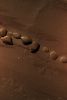
Volcanoes-Tharsis_Tholus-MGS.jpgPit-chain near Tharsis Tolus (MULTISPECTRUM; credits: Lunexit)66 visitenessun commentoMareKromium
|
|

South_Polar_Features-Fog_over_Chasma_Australe-PCF-LXTT.jpgFog over Chasma Australe (Absolute Natural Colors; credits for the additional process. and color: Dr Paolo C. Fienga - Lunexit Team)66 visiteCaption NASA originale:"Fog is a common occurrence in some areas of the retreating South Polar Seasonal Frost Cap. Fogs are commonly banked-up against steep Slopes or found inside Defrosting Craters.
This MGS-MOC image captured mid-afternoon Fog banked against the Layered Walls of Chasma Australe, a Trough in the South Polar Region of Mars. The Frost-covered Layers of Chasma Australe can be seen on the right side of this image, while the billowy Fog is to the left.
Sunlight illuminates this scene from the upper left. The Fog, probably composed of water ice crystals, casts shadows on the Chasm's Wall.
This picture is located near 83,5° South Lat. and 257,9° West Long; it covers an area about 3 Km (1.9 mi) wide". MareKromium
|
|

Craters-Unnamed_Craters-Utopia_Planitia-00.jpgOld Buried Unnamed Craters in Northern Utopia Planitia (Original NASA/MGS/MSSS b/w Frame)65 visiteOriginal caption:"This MGS-MOC image shows 2 circular features on the Plains of Northern Utopia. A common sight on the Martian Northern Plains, these rings indicate the locations of Buried Impact Craters".
Location near: 65,1° North Lat. and 261,2° West Long.
Image width: ~2 Km (~1,2 mi)
Illumination from: lower left
Season: Northern Summer
|
|

Dunes-Brashear_Crater-PIA03656-00.jpgDark Dunes on Brashear Crater's Floor (Original NASA/MGS/MSSS b/w Frame)65 visiteOriginal caption:"This MGS-MOC image shows a field of Dark Sand Dunes on the North/Western side of the Floor of Brashear Crater. The Dunes formed largely from Winds that blew from the South-East (lower right)".
Location near: 253,7° South Lat. and 119,4° West Long.
Image width: ~3 Km (~1,9 mi)
Illumination from: upper left
Season: Southern Summer
|
|

South_Polar_Features-Spiders-00.jpgSpiderland (Original NASA/MGS/MSSS b/w Frame)65 visiteCaption originale:"This MGS-MOC image shows an area adjacent to the South Polar Residual Cap that hosts several intricate fracture networks. Each network consists of multiple fractures radiating from a central location. Their origin is not understood - some investigators have speculated that these are sites of release of carbon dioxide from beneath the ground, but this explanation seems inadequate to explain all attributes of the features.
MOC images have shown that these features have not been changing from year to year during the course of the MGS mission".
Location near: 87,1° South Lat. and 234,1° West Long.
Image width: ~3 Km (~1,9 mi)
Illumination from: upper left
Season: Southern Summer
|
|
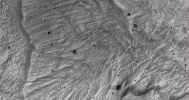
Landslides-Tithonium_Chasma-MGS-02.jpgHuge Landslide near Tithonium Chasma (Original NASA/MGS/MSSS b/w Frame)65 visiteCaption originale:"This MGS-MOC image shows a small portion of a large landslide deposit located on the floor of western Tithonium Chasma".
Location near: 4,3° South Lat. and 87,9° West Long.
Image width: ~3 Km (~1,9 mi)
Illumination from: lower left
Season: Southern Summer
|
|

Terra_Cimmeria-Gullies-PIA02919-1.jpgGullies in Terra Cimmeria (Original RAW Frame)65 visiteCaption originale NASA:"This MGS-MOC image shows two suites of gullies within a single impact crater in the Terra Cimmeria Region. The gullies near the top of the image are located on the northern wall of the crater, while the lower suite resides on a lower bench in the crater's northern wall complex. Gully erosion has cut into the layered rock exposed on the crater wall. Water may have been involved in their formation".
Location near: 38,2° South; 190,6° West
Image width: ~3 Km (~1,9 mi)
Illumination from: upper left
Season: Southern Summer
|
|

Craters-Unnamed_Fresh_Crater_in_Noctis_Labyrinthus-MGS.jpgFresh Crater (Original NASA/MGS/MSSS b/w Frame)65 visiteCaption NASA originale:"This MGS-MOC image shows a relatively Fresh Crater with dark, rayed Ejecta on an upland plain above one of the many depressions in the Eastern Labyrinthus Noctis Region. The presence of the dark rays emanating from the Crater suggests that the impact was a relatively recent event compared to other Craters of similar diameter in the scene. Over time, the dark Ejecta will fade and blend in with its surroundings, owing to settling of Dust from the Atmosphere".
Location near: 9,7° South Lat. and 94,8° West Long.
Image width: ~3 Km (~1,9 mi)
Illumination from: upper left
Season: Southern Summer
|
|
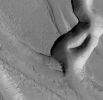
Troughs-Olympica_Fossae-MGS-3.jpgThe Troughs of Olympica Fossae (2 - Original NASA/MGS/MSSS b/w Frame)65 visitenessun commento
|
|

South_Polar_Features-Swiss_Cheese_Terrain-02.jpgSummertime at the South Pole (2)65 visitenessun commento
|
|

Volcanic_Features-Channels-Tharsis_Region-00.JPGChannels on Lava Flows in Tharsis (Original NASA/MGS/MSSS b/w Frame)65 visiteCaption NASA originale:"This MGS-MOC image shows ancient, Dust-covered Lava Flows and remains of leveed Lava Channels located on a Plain North/West of Jovis Tholus.
Jovis is a relatively small volcano in the Tharsis Region of Mars".
Location near: 22,4° North Lat. and 122,0° West Long.
Image width: ~3 Km (~1,9 mi)
Illumination from: lower left
Season: Northern Winter
|
|
| 512 immagini su 43 pagina(e) |
 |
|
|
|
|
38 | |
|
|
|
|








