| Piú viste - A Tribute To Mars Global Surveyor |

Chasmas-Melas_Chasma-01.jpgSample scarp edge in layered unit in Melas Chasma or... Frozen Waterfalls on Mars? (1)68 visiteMuovendoci sulla strada indicata dal Dr J.P. Skipper (Mars Anomaly Research), abbiamo visitato il seguente indirizzo: www.msss.com/moc_gallery/m07_m12/images/M11/M1100111.html
ed abbiamo prelevato l'immagine (o la 'striscia', se preferite) "MGS-MOC Narrow-Angle Image M11-00111" che vedete in questo primo frame. Come per la maggior parte delle immagini MGS-MOC, è difficile notare qualcosa "a prima vista" (a parte l'assoluta enigmaticità del paesaggio ripreso...), a meno che non si sappia esattamente dove andare a guardare. Noi, grazie al lavoro già svolto dal Dr Skipper, lo sapevamo ed allora, con un pizzico di pazienza e di buona volontà, siamo andati a recuperare i dettagli di qualcosa che 'sembra' essere un vero e proprio sistema di cascate gigantesche e...Completamente ghiacciate. L'immagine originale è enorme per le nostre capacità e quindi abbiamo dovuto 'spezzarla' in tre sezioni, una più spettacolare dell'altra.
Dal prossimo frame, inizieremo fornendoVi alcuni dati tecnici di assoluta importanza.
|
|
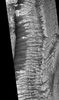
Chasmas-Melas_Chasma-02.jpgSample scarp edge in layered unit in Melas Chasma or... Frozen Waterfalls on Mars? (2)68 visiteL'immagine è stata ottenuta da un'altezza di circa 377 Km e l'ora locale del luogo ripreso (il MLT dell'area fotografata, insomma...) corrisponde alle 13:43 circa.
Se foste interessati ai dettagli più minuti, sappiate che tutti i dati tecnici relativi a queste immagini sono reperibili all'indirizzo che Vi abbiamo già fornito in sede di commento al frame precedente.
Proviamo ora a guardare, con attenzione, queste incredibili (e, a dire il vero, abbastanza indecifrabili) 'cascate' (--->waterfalls): ma che cosa stiamo guardando, effettivamente?!?
|
|

Chasmas-Melas_Chasma-05.jpgSample scarp edge in layered unit in Melas Chasma or... Frozen Waterfalls on Mars? (5)68 visiteNo, come dicevamo precedentemente questi rilievi NON SONO - a nostro umile parere - l'evidenza di "cascate congelate".
Il congelamento di una massa d'acqua quale può essere quella di un sistema di ciclopiche cascate (cascate dinanzi alle quali le 'Niagara Falls' farebbero la figura dei 'ruscelletti'...) verrebbe a generare, a nostro parere, un rilievo sostanzialmente diverso rispetto a quello che vediamo in questi frames.
E allora?
E allora quello che abbiamo davanti potrebbe davvero essere, sia pure in versione macro, quello che appare nelle Grotte che citavamo in sede di commento al frame precedente: colonne di minerali, originariamente disciolti (in percentuali elevatissime) nell'acqua corrente i quali, nelle ere, si sono solidificati ed hanno generato queste incredibili strutture le quali, dopo essere state viste ed esaminate, hanno lasciato di sasso quasi tutti i Ricercatori del Mondo.
Diciamo 'quasi', perchè gli Scienziati ed i Ricercatori NASA non hanno MAI dato peso a queste immagini ed a ciò che esse sembrano rappresentare: un'Opera della Natura ancora più enigmatica dei Canyons che caratterizzano la Valles Marineris, delle 'Black Dunes' delle aree polari, sub-polari e presso-polari, dei crateri 'squadrati', dei cosiddetti 'Sun-Bathers', della Sfinge e delle Piramidi (o presunte tali) di Cydonia Mensae e di tantissimi altri rilievi Marziani che affascinano ed impressionano l'immaginario di milioni di Appassionati.
Si, queste strutture indecifrabili, che fanno rabbrividire al solo pensiero (pensate alle loro dimensioni ed a quello che proveremmo osservandole da distanza ravvicinata...), hanno affascinato proprio tutti, ad eccezione della NASA e dei suoi 'Scienziati' i quali, semplicemente, hanno ignorato questi frames e li hanno 'asetticamente' rubricati come semplici 'esempi di bordi di scarpate accedenti a complessi stratiformi' nella Regione di Melas Chasma.
Marte.
|
|

Craters-Unnamed_Crater_in_Amenthes_Region-m1103890a.jpgUnnamed Crater in Amenthes Region (Original NASA/MGS/MSSS b/w Frame)68 visitenessun commento
|
|

Channels-Inverted_Channels_in_Arabia_Terra-PIA03643-00.jpgInverted channels of Arabia Terra (1 - Original NASA/MGS/MSSS b/w Frame)68 visiteOriginal caption:"This MGS-MOC image shows a somewhat sinuous, nearly flat-topped Ridge, located in Eastern Arabia Terra. The ridgetop was once the Floor of a Valley, perhaps carved by running water. The Valley Floor, or material that covered the Floor, was more resistant to erosion than the surrounding rock into which the Valley was cut. Thus, over time, the Valley disappeared and its Floor was left standing high as a Ridge. Inverted Valleys are common on Mars, but they also occur on Earth".
Location near: 10,8° North Lat. and 313,2° West Long.
Image width: width: ~3 Km (~1,9 mi)
Illumination from: lower left
Season: Northern Winter
|
|

Chaotic_Terrain-Eos_Chaos-00.jpgFeatures of Eos Chaos: Circular Butte (Original NASA/MGS/MSSS b/w Frame - 1)68 visiteOriginal caption:"This MGS-MOC image shows light-toned, Layered Rock Outcrops in Eos Chaos, located near the East end of the Valles Marineris Trough System. The Outcrops occur in the form of a distinct, circular Butte (image 1) and a high Slope (image 2). The rocks might be sedimentary rocks, similar to those found elsewhere exposed in the Valles Marineris System and the Chaotic Terrain to the East of the Region".
Location near: 12,9° South Lat. and 49,5° West Long.
Image width: ~3 Km (~1,9 mi)
Illumination from: lower left
Season: Southern Summer
|
|

Craters-Terby_Crater-02.jpgThe Sedimentary Layers of Terby Crater (2 - Original NASA/MGS/MSSS b/w Frame)68 visitenessun commento
|
|

Craters-Unnamed_Crater-Layered_Outcrop-Thaumasia_Region-00.jpgLayered Rocky Outcrops (Original NASA/MGS/MSSS b/w Frame)68 visiteCaption NASA originale:"This MGS-MOC image shows light-toned, layered rock outcrops in the central pit of an impact crater in the Thaumasia Planum Region of Mars. The outcrops were tilted and broken-up by the extreme energy of the impact that formed the crater in which they occur. These are layers of rock that were brought up by the impact from horizontal beds that lie below the floor of the crater".
Location near: 21,7° South Lat. and 69,4° West Long.
Image width: ~3 Km (~1,9 mi)
Illumination from: upper left
Season: Southern Summer
Nota: difficile pensare, per spiegare i rilievi catturati in questo frame, ad una costruzione logica più improbabile di quella proposta dalla NASA...
|
|

South_Polar_Features-Swiss_Cheese_Terrain-04.jpgThe "drawings" of the South Polar Residual Cap (2)68 visitenessun commento
|
|

Aeolian_Features-Dust_Devil-MGS-00.jpgRunning Winds... (Original NASA/MGS/MSSS b/w Frame)68 visiteCaption NASA originale:"This MGS-MOC image shows a bright plain West of Schiaparelli Crater, which is host to several features, some of them long-lived and others that are transient. The circular features scattered somewhat randomly throughout the scene are impact craters, all of which are in a variety of states of degradation.
Toward the right (Dx - South-West) corner of the image, there is a small hill surrounded by ripples of windblown sediment, and near the center (a little to the left) of the image, there is an active DD casting a shadow to the east as it makes its way across the plain".
Location near: 5,9° South; 348,2° West
Image width: ~3 Km (~1,9 mi)
Illumination from: upper left
Season: Southern Autumn
|
|

Channels-Unnamed_Channel_with_White_Ripples-MGS-01.jpgWhite Ripples and Landslide (2 - Original NASA/MGS/MSSS b/w Frame)68 visiteAlla NASA non hanno dubbi: le "creste" di color chiaro che coprono il fondo della quasi totalità dei letti degli antichi fiumi e torrenti Marziani, non sono altro che dune di sabbia "indurita" e levigata dal vento il quale, attraverso refoli e correnti ascendenti e discendenti - ed a prescindere dalla direzione principale dalla quale soffia - modella con maestria il fondo dei letti asciutti di questi canali.
Che dire? La risoluzione di questa immagine - come di tante altre che potrebbero essere di aiuto ai Ricercatori - è pessima e quindi...
Dobbiamo aspettare ancora ma, nel frattempo, guardate bene questo dettaglio del frame: il punto di incrocio fra i due maggiori "troughs" (in basso a Dx) non Vi sembra che abbia qualche "lacuna prospettica"? Come si incrociano, di fatto ed in relazione alla piana alla quale accedono, i due letti asciutti? C'è qualcosa che non va?!?...
|
|

Craters-Unnamed_Crater_with_Gullies-MGS-0.jpgUnnamed Crater with Gullies (Original NASA/MGS/MSSS b/w Frame)68 visiteCaption NASA originale:"This MGS-MOC image shows gullies and cracked and stressed gully apron deposits in a South mid-Latitude crater. Gullies can also be seen in the deep shadow on the North wall of the crater. These gullies might have formed by the erosive action of liquid water, sometime in the not-too-distant martian past".
Location near: 36,7° South; 206,2° West
Image width: ~3 Km (~1,9 mi)
Illumination from: upper left
Season: Southern Autumn
Nota: attenzione a quello che la NASA ha scritto in sede di commento: adesso il passato al quale fare riferimento per pensare ad acqua che scorre "allo stato liquido" su Marte non è più remoto (un miliardo di anni o giù di lì); adesso questo passato è "...not too distant..." e cioè "passato prossimo". RicordateVi, in futuro, di quello che stiamo scrivendo da mesi: un frame dopo l'altro ed una parola dopo l'altra, la NASA si sta (lentamente ma) costantemente ridefinendo in chiave possibilista molte delle proprie posizioni (da anni più che consolidate) su molti aspetti/enigmi del Pianeta Rosso.
A quando l'ammissione di una "forma vitale" attuale, magari sotterranea?!?...
|
|
| 512 immagini su 43 pagina(e) |
 |
|
|
|
|
34 | |
|
|
|
|








