| Piú viste - A Tribute To Mars Global Surveyor |
![South_Polar_Regions-South_Pole-MGS-mg90s000[1]-PCF-LXTT-2.jpg](albums/userpics/10060/small_South_Polar_Regions-South_Pole-MGS-mg90s000%5B1%5D-PCF-LXTT-2.jpg "Nome del file=South_Polar_Regions-South_Pole-MGS-mg90s000[1]-PCF-LXTT-2.jpg
Dimensione del file=195KiB
Dimensioni=2000x2000
Aggiunta il=Giu 15, 2011")
South_Polar_Regions-South_Pole-MGS-mg90s000[1]-PCF-LXTT-2.jpgThe South Pole of Mars (Absolute Natural Colors; credits for the additional process. and color.: Dr Paolo C. Fienga - Lunexit Team)267 visitenessun commentoMareKromium
|
|

Tithonium_Chasma-MGS-PCF-LXTT-2.jpgTithonium Chasma (Natural Colors; credits for the additional process. and color.: Dr Paolo C. Fienga - Lunexit Team)266 visitenessun commentoMareKromium
|
|

Vastitas_Borealis-M0306119-1.jpgVastitas Borealis260 visiteLongitude of image center: 28,26° West
Latitude of image center: 71,68° North
Scaled pixel width: 268,68 meters
Scaled image width: 130,88 Km
Scaled image height: 114,11 Km
Solar Longitude (Ls): 180,32°
Local True Solar Time: 14,19 decimal hours
Emission Angle: 3,74°
Incidence Angle: 74,85°
Phase Angle: 72,45°
North Azimuth: 97,87°
Sun Azimuth: 312,21°
Spacecraft Altitude: 430,20 Km
Slant Distance: 431,01 KmMareKromium
|
|

Clouds-South_Polar_Regions-Chasma_Australe-2003_10_29_M0904025-PCF-LXTT-1.jpgFogs and Clouds over Chasma Australe (Absolute Natural Colors; credits for the additional process. and color.: Dr Paolo C. Fienga - Lunexit Team)258 visitenessun commentoMareKromium
|
|

Vastitas_Borealis-M0301821.jpgVastitas Borealis257 visiteLongitude of image center: 29,58° West
Latitude of image center: 66,50° North
Scaled pixel width: 267,54 meters
Scaled image width: 130,27 Km
Scaled image height: 114,38 Km
Solar Longitude (Ls): 168,37°
Local True Solar Time: 14,28 decimal hours
Emission Angle: 3,69°
Incidence Angle: 66,00°
Phase Angle: 63,52°
North Azimuth: 96,29°
Sun Azimuth: 314,23°
Spacecraft Altitude: 428,08 Km
Slant Distance: 428,87 KmMareKromium
|
|

North_Polar_Cap-M0105057-PCF-LXTT.jpgFrame M0105057 - The North Polar Cap (Absolute Natural Colors; credits for the additional process. and color.: Dr Paolo C. Fienga - Lunexit Team)256 visitenessun commentoMareKromium
|
|

North_Polar_Features-North_Polar_Margin-Chasma_Boreale-PIA07052-PCF-LXTT.jpgNorth Polar "Scarp" (Absolute Natural Colors; credits for the additional process. and color.: Dr Paolo C. Fienga - Lunexit Team)254 visiteCaption NASA:"This 1,6 meters (~5 feet) per pixel Mars Global Surveyor (MGS) Mars Orbiter Camera (MOC) image shows a typical North Polar Scarp and associated dark windblown Sand Dunes. Layers of material -- possibly Dust and Ice -- are exposed by the Scarp. The small white patches in the image are remnants of seasonal Frost. When this North Polar image was acquired in late September 2004, most of the Polar Frost had sublimed away. This image is located near 85,1° North Lat. and 210,8°West Longitude. The scene covers an area of approximately 3 Km (about 1,9 mi) across, and is illuminated by sunlight from the lower left.MareKromium
|
|

North_Polar_Features-Clouds-MGS-PCF-LXTT.jpgNorth Polar extremely Low-altitude Dust-Clouds (Absolute Natural Colors; credits for the additional process. and color.: Dr Paolo C. Fienga - Lunexit Team)252 visitenessun commentoMareKromium
|
|
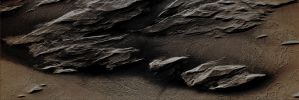
Volcanic_Regions-Rocky_Outcrops-MGS-01.jpgStreamlined Rocky Outcrops near Olympus Mons (Enhanced Absolute Natural Colors; credits for the additional process. and color.: Dr Paolo C. Fienga - Lunar Explorer Italia) 251 visiteCaption NASA originale:"This MGS-MOC image shows wind-eroded "Streamlined" Rocky Outcrops overlying Lava Flow Surfaces located to the West of Olympus Mons. Outcrops with this appearance are also called Yardangs.
Yardangs typically form in Sedimentary Rock or Volcanic Ash that contains some amount of Sand. The weathering of the Rock due to the Aeolian action cause the release of sand-sized particles from the Outcrops and, in time, such a form of erosion slowly shape the rock into the classic, inverted boat hull-like shapes of Yardangs".
Location near: 13,2° North Lat. and 160,1° West Long.
Image width: ~3 Km (~1,9 mi)
Illumination from: lower left
Season: Northern SpringMareKromium
|
|

Craters-Louth_Crater-FHA00989.jpgLouth Crater (Absolute Natural Colors; credits for the additional process. and color.: Dr Paolo C. Fienga - Lunexit Team)250 visiteLongitude of image center: 258,32° West
Latitude of image center: 70,58° North
Scaled pixel width: 270,95 meters
Scaled image width: 132,28 Km
Scaled image height: 117,97 Km
Solar Longitude (Ls): 111,09°
Local True Solar Time: 13,96 decimal hours
Emission Angle: 5,68°
Incidence Angle: 50,22°
Phase Angle: 46,39°
North Azimuth: 96,97°
Sun Azimuth: 313,08°
Spacecraft Altitude: 429,28 Km
Slant Distance: 431,16 KmMareKromium
|
|

Flow_Features-Zephyria_Planum-PIA03066.jpgFlow Features in Zephyria Planum (Absolute Natural Colors; credits for the additional process. and color.: Dr Paolo C. Fienga - Lunexit Team) 250 visiteOriginal caption:"This MGS-MOC image shows the broken, platy texture of Flow Surfaces in the Zephyria Region of Mars. Some investigators have suggested that these materials represent the remains of an ice-covered lake; others suggest that these are the Surfaces of hardened Lava that - when it was erupting - was very hot and fluid. Although not illustrated here, a key piece of evidence against the ice-covered lake hypothesis is that there are some small Craters formed on these Surfaces, and some of them have Boulders in their Ejecta Blanket. The Boulders indicate that the material is rock-solid".
Location near: 5,3° North Lat. and 208,6° West Long.
Image width: width: ~3 Km (~1,9 mi)
Illumination from: lower left
Season: Northern AutumnMareKromium
|
|

North_Polar_Features-Polygons-PIA07354-1.jpgNorth Polar "Polygons" (Absolute Natural Colors; credits for the additional process. and color.: Dr Paolo C. Fienga - Lunexit Team)249 visitenessun commentoMareKromium
|
|
| 512 immagini su 43 pagina(e) |
 |
3 | |
|
|
|
|
|
|
|
|








