| Piú viste - A Tribute To Mars Global Surveyor |

South_Polar_Storm-PIA11982.jpgSouth Polar Dust Storm76 visiteCaption NASA:"This nearly global mosaic of observations made by the Mars Color Imager on NASA's Mars Reconnaissance Orbiter on April 2, 2009, shows billowing clouds of dust being lifted into the Atmosphere by a storm near the edge of the Seasonal Polar Cap of Southern Mars.
The season on Southern Mars is late Spring. Late Southern Spring and early Southern Summer are a peak time of the Martian year for major Dust Storms.
Atmospheric haze due to suspended dust from recent storm activity is evident elsewhere on the Planet, including the Skies over Mars rovers Opportunity (MER-B) and Spirit (MER-A).
Black areas in the mosaic are the result of data drops or high angle roll maneuvers by the Orbiter that limit the camera's view of the Planet.
Equally-spaced blurry areas that run from South-to-North (bottom-to-top) result from the high off-nadir viewing geometry, a product of the spacecraft's low-orbit.
Malin Space Science Systems, San Diego, provided and operates the Mars Color Imager. NASA's Jet Propulsion Laboratory, a division of the California Institute of Technology in Pasadena, manages the Mars Reconnaissance Orbiter for NASA's Science Mission Directorate, Washington. Lockheed Martin Space Systems, Denver, is the prime contractor for the project and built the Spacecraft".MareKromium
|
|

Craters-Unnamed_Crater-PIA07508-PCF-LXTT.jpgImpact Crater and Windstreak (Natural Colors; credits for the additional process. and color.: Dr Paolo C. Fienga - Lunexit Team)76 visiteCaption NASA:"This MGS-MOC image shows a 1,2-Km-diameter North mid-latitude crater with a bright wind streak".
Location near: 30,8° North Lat. and 131,8° West Long.
Image width: ~3 Km (~1,9 mi)
Illumination from: lower left
Season: Northern Summer MareKromium
|
|

Volcanoes-Olympus_Mons.jpgOlympus Mons (Natural Colors; NASA/JPL/MSSS)75 visitenessun commento
|
|

Thaumasia_Region-The_Electric_Dunes-00.jpgThaumasia Dunes: the brightest dunes of Mars (CTX Frame)75 visiteTre frames che ci mostrano delle "dune" nella Regione di Thaumasia (n.b.: è la NASA che parla di dune, allorchè descrive l'oggetto di queste immagini ma noi, a dire il vero, non abbiamo la minima idea di che cosa esattamente stiamo guardando in questo frame...) la cui riflettività - o albedo - è, semplicemente, strepitosa e, nel contempo, tale da generare dubbi e domande.
Sono questi, forse, i presunti ed enigmatici 'tubi' metallici (in effetti questi corpi luminescenti possono anche assomigliare a delle reti di tubazioni...) che coprono parte della superficie di Marte e che lasciano supporre l'esistenza di una qualche forma di colonizzazione occorsa in passato o ancora in divenire?
O si tratta di dune ricoperte di ghiaccio d'acqua?
O magari di semplici dune quarzifere?
Che cosa stiamo guardando?!?...
|
|
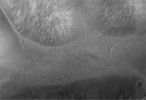
Chaotic_Terrain-Aram_Chaos-R2200155-02.jpgThe "Many Faces" of Aram Chaos (3 - EDM n. 2 - Original NASA/MGS/MSSS b/w Frame)75 visiteUna speculazione ulteriore del Dr Skipper è che una possibile forma di Civiltà Indigena Marziana stia cercando di "salvare il salvabile", ossìa - impiegando sistemi e tecnologie che non riusciamo a comprendere (nè a vedere) - stia tentando in tutti i modi di mantenere almeno un minimo di acque correnti sulla superficie di Marte.
"If so and there are actually extensive civilization populations on Mars, it may seem strange at first blush that so many of them appear to be so focused on water on such a generally arid planet to the point of even getting in the water that is left with their developments. On the other hand, if these populations have historically been part of this drying planetary reality for a very long time and have a historical memory base of more water plentiful times, it may be understandable that they may a bit compulsively try to preserve as much as possible a current semblance of the older loved conditions. Of course there may be other reasons as well"
|
|

North_Polar_Features-Dunes-MGS-03.JPGNorth Polar Dunes (Original NASA/MGS/MSSS b/w Frame)75 visiteCaption NASA originale:"This MGS-MOC image shows dunes covered with a seasonally-deposited layer of solid Carbon Dioxide (CO2) in the North Polar Region of Mars. The dark spots indicate areas where the CO2 frost has begun to change, either by being sublimed away, or by becoming rougher or coarser-grained, such that it appears darker than surrounding frost. Over the course of the Spring season, the frost will be completely removed and the dark sands that make up the dune field will be visible by Summer".
Location near: 77,7° North; 41,7° West
Image width: ~3 Km (~1,9 mi)
Illumination from: lower left
Season: Northern Spring
|
|

Craters-Unnamed_Crater-South_Polar_Regions-PIA03921-PCF-LXTT.jpgUnnamed South Polar Defrosting Crater (Absolute Natural Colors; credits for the additional process. and color.: Dr Paolo C. Fienga - Lunar Explorer Italia)75 visitenessun commentoMareKromium
|
|

Claritas_Fossae-Smoke-MU.gifDark Smoke moving over Claritas Fossae (GIF-Movie; credits: Mars Unearthed)75 visitenessun commentoMareKromium
|
|

Aeolian_Features-Dust_Devils-2005_03.jpgLight-toned DD Streaks in Schiaparelli Crater (Original NASA/MGS/MSSS b/w Frame)74 visiteCaption NASA originale:"In honor of Giovanni V. Schiaparelli's 170th birthday (04-03-1835/04-03-2005), we present this MGS-MOC image showing light-toned dust devil streaks on the southern floor of Schiaparelli Crater".
Location near: 5,3° South Lat. and 343,3° West Long.
Image width: ~3 km (~1.9 mi)
Illumination from: upper left
Season: Southern Autumn
|
|

Channels-Bahram_Vallis-M1000914-01.jpgBahram Vallis' River and Landslides (Original NASA/MGS/MSSS b/w Frame - EDM)74 visitenessun commento
|
|

Meridiani_Planum-Tepe-2005_09.jpg"Tepe" in Sinus Meridiani (Original NASA/MGS/MSSS b/w Frame)74 visiteOriginal caption:"This MGS-MOC image shows a lonely, light-toned Butte (----> collina "a ceppo") composed of Sedimentary Rock in Northern Sinus Meridiani. The dark landscape that surrounds the Butte was once covered by the same rocks that make up this lonely remnant".
Location near: 2,5° North Lat. and 4,2° West Long.
Image width: ~3 Km (~1,9 mi)
Illumination from: lower left
Season: Northern Autumn
|
|

Craters-Terby_Crater-01.jpgThe Sedimentary Layers of Terby Crater (1 - Original NASA/MGS/MSSS b/w Frame)74 visiteOriginal caption:"This MGS-MOC image shows some of the light-toned, layered, Sedimentary Rock Outcrops in Northern Terby Crater. Terby is located along the North edge of Hellas Planitia. The Sedimentary Rocks might have been deposited in a greater, Hellas-filling sea — or not. Today, the rocks are partly covered by dark-toned Sediment and Debris".
Location near: 27,2° South Lat. and 285,3° West Long.
Image width: ~3 km (~1,9 mi)
Illumination from: upper left
Season: Southern Summer
|
|
| 512 immagini su 43 pagina(e) |
 |
|
|
|
|
29 | |
|
|
|
|








