| Piú viste - A Tribute To Mars Global Surveyor |

Mars-03.jpgMars' Solar Longitude 145° (3) - Mare Cimmerium and Mare Elysium84 visitenessun commento
|
|

Channels-Unnamed_Channel_in_Stygis_Catena-PIA07133-00.jpgAncient Riverbed in Stygis Catena (Original NASA/MGS/MSSS b/w Frame)84 visiteCaption NASA originale:"This MGS-MOC image shows a Trough (trough---> canale) in the Stygis Catena Region, East of the Martian Volcano Elysium Mons. The Trough probably formed by collapse (collapse--->geol. "cedimento" del terreno). Large, dark Boulders can be seen on the Trough Floor in this Volcanic Region. The image is located near 24,4° North Lat. and 210,4° West Long. The image covers an area about 3 km (approx. 1,9 mi) wide and sunlight illuminates the scene from the lower left".
|
|

Craters-Holden_Crater-4-M0302733.jpgHolden Crater floor near intersection with Uzboi Vallis84 visitenessun commento
|
|

Volcanoes-Arsia_Mons-02-PIA04294_fig2.jpgArsia Mons and its "clouds" (2) - 24 April 2003, Ls 173° (Extremely Saturated Natural Colors; credits NASA/JPL/MSSS)84 visiteOriginal caption:"This image was taken on April 24, 2003, such as in late Southern Autumn on Mars. These pictures prove that some parts of Mars experience weather phenomena that repeat each year, at about the same time. In some Regions, the repeated event may be a dust storm that appears every year, like clockwork, in such a way that we can only wish the weather were so predictable on Earth. One of the repeated weather phenomena occurs each year near the start of Southern Winter over Arsia Mons, which is located near 9° South Latitude, 121° West Longitude. Just before Southern Winter begins, sunlight warms the air on the slopes of the volcano. This air rises, bringing small amounts of dust with it. Eventually, the rising air converges over the volcano's caldera, the large, circular depression at its summit. The fine sediment blown up from the volcano's slopes coalesces into a spiraling cloud of dust that is thick enough to actually observe from orbit".
|
|

Craters-Eberswalde_Crater-1-PIA04293_modest.jpgEberswalde Crater and Delta in HR84 visiteOriginal caption:"Scientifically, perhaps the most important result from use of the MOC on NASA's MGS during that spacecraft's extended mission has been the discovery and documentation of a 'fossil delta'. The feature is located in a crater northeast of Holden Crater, near 24,0° South Latitude and 33,7° West Longitude. Since the announcement of the discovery of the delta in November 2003, the International Astronomical Union has provided a provisional name (pending final approval) for the crater in which the landforms occur.
The crater has been named Eberswalde (a German town).
This image offers a HR view of a portion of the fossil delta than any seen earlier. North is up. At the bottom of the frame, the image includes the north end of a looping, inverted, meandering channel. The image covers an area of about 3 by 3 Km (about 1,9x1,9 miles). It was produced using a technique called "compensated pitch and roll targeted observation," in which the rotation rate of the spacecraft is adjusted to match the ground speed under the camera. At full resolution, this map-projected image is at 50 centimeters (20 inches) per pixel".
|
|

Chaotic_Terrain-Aram_Chaos-R2200155-01.jpgThe "Many Faces" of Aram Chaos (2 - EDM n. 1 - Original NASA/MGS/MSSS b/w Frame)84 visiteIl Dr Skipper, per quanto attiene la Regione di Aram Chaos, ritiene di aver individuato (e secondo noi ha ragione) delle aree le quali ci mostrano la presenza di acque superficiali: prevalentemente si tratta di laghi e piccoli fiumi.
Egli dice che, a suo parere, queste aree rappresentano solo un modesto residuo di quelle che, un tempo, circolavano sulla superficie di Marte e che comuque anche queste acque stanno - di fatto - recedendo.
O meglio: esse stanno avviandosi a rinforzare quello che è già il sistema acquifero Marziano. Un sistema fatto di acque correnti e che, come già in molti credono (anche alla NASA...) è prevalentemente - diremmo al 95% - sotterraneo.
"I suspect that water poured into this Aram Chaos depression over a very long period of time saturating it and the subterranean ground systems under it with water. Then came along the current general long lasting dry period producing the remnants of an old very rough uneven lake bed bottom where shallow water still flows down elevated uneven portions of the chaotic terrain accumulating in the lowest catch basin areas you seen here. The cracked plate evidence seen in my first image in the right split screen in the southern part of Aram Chaos is probably washed in and compacted bottom old lake bed sediment collections in more elevated terrain there that has eventually drained dry into the lower areas and the sediment has cracked like great dry mud flats in the process"
|
|

Craters-Unnamed_Crater_in_Terra_Sabaea-02.jpgUnnamed Crater in Terra Sabaea (Original NASA/MGS/MSSS b/w Frame)84 visiteCaption originale:"This MGS-MOC image shows a 1,5 mt (~5 feet) per pixel view of an Impact Crater that is approximately 3 Km (about 9840 ft) in diameter. It is located in South-Western Terra Sabaea".
Location near: 21,9° South Lat. and 338,6° West Long.
Image width: ~3 km (~1,9 mi)
Illumination from: upper left
Season: Southern Summer
|
|

Volcanic_Features-Collapse_Pit_Chain-MGS.JPGCollapse Pit-Chain in Tharsis Region (Original NASA/MGS/MSSS b/w Frame)84 visiteCaption NASA originale:"This MGS-MOC image shows a chain of collapse pits on a dust-mantled, lava-covered plain North-East of Ascraeus Mons (one of the giant volcanoes located in the Tharsis Region of Mars).
Pit chains are associated with collapse which may be driven by several processes including, but not limited to, crustal extension owing to tectonic processes and the collapse of the roof of a lava tube".
Location near: 14,8° North Lat. and 99,1° West Long.
Image width: ~3 Km (~1,9 mi)
Illumination from: lower left
Season: Northern Winter
|
|
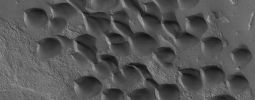
Craters-Wirtz_Crater-Dunes-MGS.jpgThe Dunes of Wirtz Crater (Original NASA/MGS/MSSS b/w Frame)84 visiteCaption NASA originale:"This MGS-MOC image shows dark Sand Dunes, formed by winds blowing from the South-West (upper right), in Wirtz Crater. The Crater is named for Carl Wilhelm Wirtz (1876–1939), a German astronomer".
Location near: 49,0° South Lat. and 25,5° West Long.
Image width: ~3 Km (~1,9 mi)
Illumination from: upper left
Season: Southern Autumn
|
|

South_Polar_Features-Defrosting_Dunes-2005_06-PCF-LXTT.jpgDefrosting Dunes (Natural Colors; credits for the additional process. and color.: Dr Paolo C. Fienga - Lunexit Team)84 visitenessun commentoMareKromium
|
|

Chasmas-Eos_Chasma-M1200712-02.jpgDustfalls in Eos Chasma (2 - Original NASA/MGS/MSSS b/w - EDM n.2)83 visitenessun commento
|
|

Craters-Tikhonravov_Crater-PIA03962-00.jpgSedimentary Rocks inside Tikhonravov Crater - Arabia Terra (Original NASA/MGS/MSSS b/w Frame)83 visiteCaption NASA originale:"This MGS-MOC image shows Layered Sedimentary Rocks exposed by erosion, then mantled by Dust, in Tikhonravov Crater in central Arabia Terra. Dark Slope Streaks occur where some of the Dust has slid down the layered Slopes".
Location near: 13,8° North Lat. and 324,8° West Long.
Image width: ~3 Km (~1,9 mi)
Illumination from: lower left
Season: Northern Autumn
|
|
| 512 immagini su 43 pagina(e) |
 |
|
|
|
|
24 | |
|
|
|
|








