| Piú viste - A Tribute To Mars Global Surveyor |

Chasmas-Melas_Chasma-06.jpgSample scarp edge in layered unit in Melas Chasma or... Frozen Waterfalls on Mars? (6)115 visitenessun commento
|
|

Volcanoes-Arsia_Mons-03-PIA04294.jpgArsia Mons and its "clouds" (3) - 25 February 2005 (Extremely Saturated Natural Colors; credits NASA/JPL/MSSS)115 visiteOriginal caption:"The spiral dust cloud over Arsia Mons repeats each year, but observations and computer calculations indicate it can only form during a short period of time each year. Similar spiral clouds have not been seen over the other large Tharsis volcanoes, but other types of clouds have been seen. The spiral dust cloud over Arsia Mons can tower 15 to 30 Km (9 to 19 miles) above the volcano. The white and bluish areas in the images are thin clouds of water ice. In the 2005 case, more water ice was present than in the previous years at the time the pictures were obtained. For scale, the caldera of Arsia Mons is about 110 Km (about 68 miles) across, and the summit of the volcano stands about 10 Km (6 miles) above its surrounding plains"
|
|

Valles_Marineris-MGS.jpgPortion of the Valles Marineris Canyon System (Natural Colors; credits: NASA/MGS/MSSS)114 visitenessun commento
|
|

Dunes-Dark_Dunes-Chasma_Boreale-PIA07350-00.jpgDark Dunes in Chasma Boreale (Original NASA/JPL/MSSS b/w Frame)114 visiteCaption NASA originale:" This MGS-MOC image shows Dark Sand Dunes overlying an eroded, layered substrate in Chasma Boreale, amid the materials of the Martian North Polar Cap.
Location near: 84,5° North Lat. and 358,3° West Long.
Image width: ~3,0 Km (~1,9 mi)
Illumination from: lower left
Season: Northern Summer".
|
|

Craters-Unnamed_Crater_with_Dark_Streaks-2003_08.jpgDark Slope Streaks on the edge of an Unnamed Crater (Saturated Natural Colors; credits: NASA/MGS/MSSS)114 visiteCaption NASA originale:"This June 2003 MGS-MOC image shows a crater rim mantled with fine dust near 7.6°N, 171.8°W. Occasional avalanches of dust have created dark streaks that are tapered at their source and broaden downslope.
A suite of particularly large streaks are seen in the lower right quarter of the picture. The MOC narrow angle camera does not take color images; this full-resolution (1,5 m/pixel; 5 ft/pixel) picture has been "colorized" using data from a previous color image of Mars.
Sunlight illuminates this scene from the lower left".
|
|

North_Polar_Regions-The_Erg-PIA07282.jpgOutcrops in the North polar Erg (Original NASA/MGS/MSSS b/w Frame)113 visiteCaption NASA originale:"This Mars Global Surveyor (MGS) Mars Orbiter Camera (MOC) image, acquired during Northern Summer in December 2004, shows dark, windblown Sand Dunes in the North Polar Erg: a vast Sea of Sand Dunes that surrounds the North Polar Cap. These landforms are located near 80,3° North Lat. and 144,1° West Long. Light-toned features in the image are exposures of the substrate that underlies the immense Erg. The image covers an area of about 3 Km (1,9 mi) wide and is illuminated by sunlight from the lower left".
Nota Lunexit: le "light-toned features", a nostro avviso, sono soltanto degli affioramenti rocciosi (Rocky Outcrops).
|
|

Craters-Lomonosov_Crater.jpgLomonosov Crater in Wintertime111 visiteCaption NASA originale:"On April 20, 2000 (Wintertime on Mars), the Mars Orbiter Camera (MOC) onboard Mars Global Surveyor (MGS) captured this view of a chilly Lomonosov Crater. The rims of the crater appear white because they are covered with wintertime frost. A dark patch just right of center on the crater floor is a sand dune field. Both low-lying ground fogs (fuzzy, patchy areas around the lower perimeter of the crater) and higher cloud layers (fuzzy white arcs seen within the crater and towards the upper right) obscure much of the surface. The Sun, only 12° above the horizon, bathes the scene in a reddish-brown hue. Lomonosov Crater is about 150 Km (93 mi) across and located on the martian northern plains at 64.8° N, 8.8° W. The crater is named for the 18th Century Russian chemist, Mikhail V. Lomonosov (1711-1765)".
|
|

North_Polar_Regions-Chasma_Boreale-MGS-00.jpgBrown Dunes in Chasma Boreale (Original NASA-MSSS-MGS b/w frame)111 visiteCaption NASA originale:"This Mars Global Surveyor (MGS) Mars Orbiter Camera (MOC) image shows layers and dunes in Chasma Boreale, a large depression in the North Polar Region".
Location near: 85,2°N; 10,4°W
Image width: ~3 Km (~1.9 mi)
Illumination from: lower left
Season: Northern Summer
|
|

Craters-Unnamed_Crater.gifThawing (GIF-Movie; credits for the additional process.: Mars Unearthed)111 visitenessun commentoMareKromium
|
|
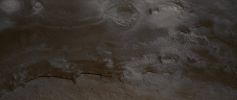
Chaotic_Terrain-Iani_Chaos-MGS.jpgFeatures of Iani Chaos (Absolute Natural Colors; credits for the additional process. and color.: Dr Paolo C. Fienga - Lunexit Team)111 visitenessun commentoMareKromium
|
|

North_Polar_Features-Cl-louds-Mars_Weather-PIA05079.jpgWeather Patterns over the North Pole of Mars (Natural Colors; credits: NASA/MGS/MSSS)110 visiteMars Global Surveyor entered Mars orbit on 12 September 1997. The 8 Earth Years that MGS has been in orbit span portions of 5 Martian Years. One of the critical science activities that the MOC has been engaged in for the past 8 years has been to document daily changes in the Martian Weather. Each day that MOC is operating, the red and blue wide angle cameras are used to build up a daily global map. These maps provide a record of the Planet's changing meteorological conditions. One important discovery that has been made is that the Red Planet has "repeatable weather patterns". In light of weather-related problems and disruptions that occur every year on Earth, one can only imagine how nice it would be if our planet followed a similar, repeated pattern. The 4 pictures shown here provide an example of one of the weather phenomena that repeat each MY. Each picture shows the North Polar Region of Mars during the Northern Summer Season. Each picture is a composite of several images acquired at different visible wavelengths to give a color view of the planet. Each picture was taken about 1 Mars year apart, and each shows an annular (circular) cloud located over the same terrain each summer.
The first picture, acquired in April 1999, is actually not from the MGS MOC instrument. It was obtained by the Hubble Space Telescope (HST) Wide Field Planetary Camera 2 (WFPC2) and was originally released by the Space Telescope Science Institute on 19 May 1999. The reason there is no MOC image for April 1999 is a product of the MGS spacecraft's 8-year history at Mars. MGS was certainly in orbit at the time, and it was taking data during the month of April. However, the camera did not obtain any images between 17 and 28 April because the spacecraft encountered, and then had to be recovered from, a problem. It was at this time that the spacecraft team realized that there is something obstructing the full movement of MGS's high gain antenna. A work-around was created and the mission has continued, ever since, but the down-side was that MOC did not have the opportunity in 1999 to provide detailed observations of the north polar, summertime, annular cloud.
The remaining three pictures show MGS MOC views of the cloud feature, as it appeared in the subsequent 3 Mars years. Each year, the cloud appeared at about the same time or slightly earlier than in the previous year. Despite its superficial resemblance to a hurricane or cyclone on Earth, the northern summer annular cloud does not rotate. The cloud forms as different currents of air merge in the morning hours in the polar region; by afternoon, the annular cloud typically dissipates or breaks up into smaller clouds.
MGS MOC has observed other repeated phenomena over the course of its 8-year mission orbiting Mars. These include dust storms that repeat, year after year, in the same location within a week or two of the time it occurred in the previous year. They also include dust devils in northern Amazonis, which start up shortly after the first day of spring, and keep occurring nearly every afternoon until a few days into the autumn season. MOC is continuing its mission to monitor the planet -- in 2006, MOC's weather observations will be used to provide guidance for the aerobraking maneuvers of the Mars Reconnaissance Orbiter (MRO). MOC images will show whether dust storms are occurring, and whether the dust suspended by these storms will impact the density of the atmosphere at the altitudes that MRO is passing through to slow the spacecraft and change its orbit to the one desired for the MRO primary mission.
|
|
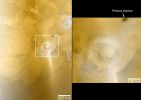
Volcanoes-Arsia_Mons.jpgArsia Mons with Water-Ice Clouds and the shadow of Phobos (credits NASA/JPL/MSSS)109 visiteCaption originale:"This pair of MGS-MOC color images shows early Autumn Clouds over the Arsia Mons Volcano, plus the shadow of the innermost of the Martain Moon Phobos. The picture on the left is taken from the MOC daily global map acquired at 7,5 km (~4,7 mi) per pixel on 28 January 2006, about a week after the start of Southern Autumn.
The picture on the right was taken at the same time, but at a higher resolution of 489 mt (~1604 ft) per pixel.
Both pictures are composites of MOC red and blue wide angle images, and both are oriented such that North is up and East is to the right. Arsia Mons and the other large Tharsis volcanoes commonly develop afternoon orographic (i.e., topographically-controlled) water ice clouds at this time of year. The equatorial Tharsis volcano, Pavonis Mons, is also under a deck of Water-Ice Clouds; it is located toward the upper right corner of the left, lower-resolution image.
Sunlight glints off the dusty Surface and the Clouds and Aerosols in the Atmosphere, producing the bright diagonal Streak located just South/East (lower right) of Arsia Mons. A Water-Ice Haze is seen on the left side of the lower-resolution image. The dark oval to the North-East of Arsia Mons, as noted above, is the shadow of Phobos".
|
|
| 512 immagini su 43 pagina(e) |
 |
|
|
|
|
16 | |
|
|
|
|








