| Piú viste - A Tribute To Mars Global Surveyor |

Controversial_Features-The_Villa-AB108405-SF-00.jpgUnusual Squared Structure on Mars (1)123 visiteUn grandissimo complimento all'Amico Lettore Lorenzo Leone il quale ha individuato, all'interno di un frame già di per sè complesso da studiare in ragione delle peculiari caratteristiche superficiali della Regione ripresa (Candor Chasma), una possibile Anomalìa di Superficie (da lui stesso battezzata "Villa").
L'Anomalìa in questione si risolve in (almeno) due basamenti squadrati i quali, nel sovrapporsi, sembrano formare una vera e propria (e diremmo molto avvenieristica) costruzione. La porzione superiore dell'edificio, per altro, sembra denotare l'esistenza di un'apertura a forma circolare su di essa, così ricordandoci sia un possibile "osservatorio", sia un "reservoir" (e cioè un raccoglitore e contenitore di acque piovane a cielo aperto). Come ovvio tutte le nostre congetture sono puramente speculative, ma un piccolo - ed importantissimo - dato di fatto ci sembra inconfutabile: la superficie del Pianeta Rosso ha già evidenziato e continua ad evidenziare rilievi superficiali anomali ed assolutamente...
|
|

Craters-Galle_Crater-Happy_Face_Crater-MGS-2.jpgGalle Crater (Saturated Natural Colors; credits: NASA/MGS/MSSS)122 visiteIl nome che è stato dato al cratere qui ripreso dal Mars Global Surveyor spiega già tutto: da questa angolazione, infatti, si potrebbe dire che un dotato burlone sia andato a disegnare un bel "viso sorridente" sulla superficie di Marte. Ovviamente si tratta di un semplice effetto ottico determinato dalla particolare prospettiva in cui si trovava la Sonda rispetto al cratere nel momento della ripresa.
Eppure - credeteci! - c'è stato qualcuno che ha pensato che questa "Faccia Felice" fosse un altro degli enigmatici "Monumenti di Marte", dopo la Sfinge e le Piramidi di Cydonia Mensae.
|
|

South_Polar_Regions-PIA03007.jpgDefrosting South Polar Region (Absolute Natural Colors; credits for the additional process. and color.: Dr Paolo C. Fienga - Lunexit Team)122 visiteDefrosting Southern Regions
Original caption:"This MGS-MOC image shows a second view of varied Springtime defrosting patterns formed in a dune field and surrounding polygon-patterned ground in the South Polar Region of Mars. (...) The feature sporting an outline of dark spots and an interior of smaller, closely-spaced dark spots and dark-outlined polygons is a patch of windblown or wind-eroded sand that was covered by carbon dioxide frost during the previous Autumn and Winter. The fainter, larger polygon pattern on either side of the patch of defrosting sand is formed in the substrate upon which the sand patch is sitting. Polygonal forms such as these might indicate the presence of ice below the surface".
Location near: 79,9°S; 125,9°W
Image width: width: ~3 Km (~1,9 mi)
Illumination from: upper left
Season: Southern SpringMareKromium
|
|
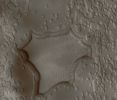
South_Polar_Regions-SPRC.jpgSublimation at the South Polar Residual Cap (Absolute Natural Colors; credits: Dr Paolo C. Fienga - Lunexit Team)122 visiteCaption NASA:"This MGS-MOC image shows a portion of the South Polar Residual Cap where the effects of Sublimation are apparent.
Over extended periods of time, Sublimation "eats" away at the smoother appearing material (largely composed of frozen CO2), darkening the Scarps and creating the irregularly shaped depressions that are present throughout much of the scene".
Location near: 87,1° South Lat. and 69,3° West Long.
Image width: ~3 Km (~1,9 miles)
Illumination from: upper left
Season: Southern SummerMareKromium
|
|

Volcanic_Features-Lava_or_Mud_Flows-01.jpgControversial Features of Zephyria Planum (Absolute Natural Colors; credits for the additional process. and color.: Dr Paolo C. Fienga - Lunexit Team)122 visiteOriginal caption:"This MGS-MOC image shows a portion of a shallow Channel carved in the Plains of the Zephyria Region of Mars. This feature might be the result of the passing of either extremely fluid Lava or, perhaps, Mud".
Location near: 5,1° North Lat. and 203,7° West Long.
Image width: ~3 Km (~1,9 mi)
Season: Northern WinterMareKromium
|
|

Terra_Meridiani-E0200373-02.jpgBizarre-looking Features in Terra Meridiani (Original NASA/MGS/MSSS b/w M0705535 - EDM n.2)119 visitevedi i commenti svolti in precedenza
|
|

Dunes-S2200554sub-00.jpgMigrating Dunes (Original NASA/MGS/MSSS b/w Frame)119 visiteCaption NASA originale:"This MGS-MOC image shows a suite of dunes in one of the several North Polar Dune Fields. The bright surfaces adjacent to some of the dunes are patches of frost. These dunes spend much of the Autumn, Winter, and Spring seasons covered with CO2 frost. Only in late Spring and in Summer are the dark windblown sands fully exposed.
Over the course of the 9+ years of the MGS mission, the MOC team has sought evidence that sand dunes may be migrating downwind over time. However, no clear examples of the movement of a whole dune have been identified. On Earth, such movement is typically detectable in air photos of the smallest active dunes over periods of a few years. Owing to the fact that the North Polar Dunes spend much of each Martian Year under a cover of frost, perhaps these move much more slowly than their frost-free, terrestrial counterparts. The sand may also be somewhat cemented by ice or minerals, likewise preventing vigorous dune migration in the present environment.
This view covers an area approximately 3 km (1.9 mi) wide and is illuminated by sunlight from the lower left. The dunes are located near 79.8°N, 127.1°W, and the picture was acquired on 11 September 2006.
|
|

Volcanoes-Arsia_Mons-E05-1721_1722_arsia100.jpgArsia Mons Volcano and "spiral clouds" (Natural Colors; credits: NASA/JPL/MSSS)118 visiteCaption NASA originale:"One of the benefits of the MGS-MOC Extended Mission is the opportunity to observe how the planet's weather changes during a second full martian year. This picture of Arsia Mons was taken on June 19, 2001; Southern Spring equinox occurred the same day. Arsia Mons is a volcano nearly large enough to cover the state of New Mexico. On this particular day (the first day of Spring), the MOC wide angle cameras documented an unusual spiral-shaped cloud within the 110 Km diameter caldera - such as the summit crater - of the giant volcano. Because the cloud is bright both in the red and blue images acquired by the wide angle cameras, it probably consisted mostly of fine dust grains. The cloud's spin may have been induced by winds off the inner slopes of the volcano's caldera walls resulting from the temperature differences between the walls and the caldera floor, or by a vortex as winds blew up and over the caldera. Similar spiral clouds were seen inside the caldera for several days; we don't know if this was a single cloud that persisted throughout that time or one that regenerated each afternoon".
|
|

South_Polar_Features-Thawing_Time.gifThawing (GIF-Movie; credits for the additional process.: Mars Unearthed)118 visitenessun commentoMareKromium
|
|

Martian_Eclipse-moc2_msss_3shadow100-00.jpgMOC Views of Martian Solar Eclipses (Original NASA/MGS/MSSS b/w Frame)117 visiteThe shadow of the martian moon, Phobos, has been captured in many recent wide angle camera views of the red planet obtained by the Mars Global Surveyor (MGS) Mars Orbiter Camera (MOC). Designed to monitor changes in weather and surface conditions, the wide angle cameras are also proving to be a good way to spot the frequent solar eclipses caused by the passage of Phobos between Mars and the Sun.This picture shows three samples of MOC's global image swaths, each in this case with a shadow of Phobos visible (arrow). The first scene (left) was taken on September 1, 1999 and shows the shadow of Phobos cast upon southern Elysium Planitia. The large crater with dark markings on its floor at the lower right corner is Herschel Basin. The second scene shows the shadow of Phobos cast upon northern Lunae Planum on September 8, 1999. Kasei Valles dominates the upper right and the deep chasms of Valles Marineris dominate the lower third of the September 8 image. The picture on the right shows the shadow of Phobos near the giant volcano, Olympus Mons (upper left), on September 25, 1999. Three other major volcanoes are visible from lower-center (Arsia Mons) and right-center (Pavonis Mons) to upper-middle-right (Ascraeus Mons).
|
|

Craters-Newton_Crater-00-39S_166W_30.jpgGullies inside Newton Crater - Terra Sirenum (Natural Colors; credits: NASA/MGS/MSSS)116 visiteCaption NASA originale:"Both pictures show gullies (gully--->plur.: gullies: "gole" o "crepacci scoscesi") on the walls of two different meteor impact craters that occur in Newton Basin in Sirenum Terra, Mars. This picture, showing gullies in a crater at 42.4°S, 158.2°W, exhibits patches (patch-->geol.: "placche" o "macchie") of wintertime frost on the crater wall and dark-toned sand dunes on the floor. Its resolution is 1,5 meters (5 feet) per pixel - objects the size of school buses can be resolved in the full size image. The gullies in these craters originate at a specific layer and may have formed by release of groundwater to the martian surface in geologically recent times".
|
|

Chasmas-Melas_Chasma-06.jpgSample scarp edge in layered unit in Melas Chasma or... Frozen Waterfalls on Mars? (6)115 visitenessun commento
|
|
| 512 immagini su 43 pagina(e) |
 |
|
|
|
|
15 | |
|
|
|
|








