| Piú viste - A Tribute To Mars Global Surveyor |

Phobos-Phobos_Monolith-10.jpgThe Phobos' Monoliths in context (an Image-Mosaic in Absolute Natural Colors; credits for the additional process. and color.: Marco Faccin and Paolo C. Fienga/Lunar Explorer Italia/Italian Planetary Foundation)153 visiteTanto per ricordare agli Amici "Anomaly Hunters" che di Monoliti (o, come suggeriamo noi, di "Parallelepipedal-shaped Ejecta Boulders"), su Phobos, ce ne sono ALMENO due. E comunque, se proprio vogliamo parlare di Anomalìe, potremmo discutere non solo (e non tanto!) della forma dei due rilievi controversi ed indicati da una freccia, quanto della loro (straordinaria ed inspiegabile, oltre che totalmente fuori contesto, a nostro parere) Albedo...MareKromium
|
|

Utopia_Planitia-Smoke-D-M0202863-PCF-LXTT.jpgControversial Surface Feature in Utopia Planitia (EDM n.2)152 visiteUn irrequieto camino vulcanico si nasconde al di sotto di questo cratere e sta dando chiari segnali di risveglio? Oppure si tratta di fumi esausti che arrivano da un'installazione sotterranea?
O magari è un'illusione ottica e quello che appare come uno sbuffo di fumo nero è solo un dark wind-streak, come ne abbiamo già visti tanti su Marte e Venere?
Domande, domande, domande...
|
|

Craters-Exhumed_CFrater_in_Vastitas_Borealis-PIA03926-01.jpgA very unusually-looking Exhumed Crater (Absolute Natural Colors; credits for the additional process. and color.: Dr Paolo C. Fienga - Lunexit Team)152 visiteCaption NASA originale:"This MGS-MOC image shows a circular feature on the Martian Northern Plains. It was once a crater formed by meteoritic impact. It was completely filled and buried by and within layered material. Later, the layered materials have begun to be eroded away, re-exposing the old crater rims in the process".
Location near: 44,9° North Lat. and 264,7° West Long.
Image width: ~3 Km (~1,9) mi
Illumination from: lower left
Season: Northern Autumn
Nota: a giudicare dalle fattezze emergenti dalle sabbie, più che un antico cratere sepolto ed ora in corso di 'riesumazione', diremmo che potrebbe trattarsi di un modesto rilievo vulcanico (un "camino" infossato), caratterizzato da un discreto numero di caldere. Certo, non si è mai sentito parlare di un 'vulcano sepolto' e poi riportato alla luce dal concorso degli agenti geologici ed atmosferici ma, in fondo, anche le ipotesi più 'sfrontate', alle volte, possono rivelarsi esatte. MareKromium
|
|

Craters-Unnamed_Crater_in_Chrise_Planitia-PIA07304.jpgUnnamed Crater in Chrise Planitia (Original NASA/MGS/MSSS b/w Frame)151 visiteCaption NASA originale:"This MGS-MOC image shows an impact crater in Chryse Planitia, not too far from the Viking 1 Lander site, that seems to resemble a bug-eyed head. The 2 odd depressions at the north end of the crater (the "eyes") may have formed by wind or water erosion. This Region has been modified by both processes, with water action occurring in the distant past via floods that poured across western Chryse Planitia from Maja Valles, and wind action common occurrence in more recent history. This crater is located near 22.5°N, 47.9°W". Che dire? Forse gli Alieni (diremmo che in questo caso potrebbe trattarsi dei "Grigi"...) non solo posseggono "tecnologia e senso artistico" ma anche un cospicuo "senso dell'umorismo": solo così, infatti, potremmo spiegare un simile "autoritratto"!
Scherzi a parte, in questo MGS frame è ripresa un'opera della Natura davvero incredibile e che, sicuramente, qualcuno interpreterà alla stregua della "Sfinge di Cydonia".
Naturale o Artificiale? That is the question...
|
|

Dunes-PIA07152-01.jpgDark Dunes and Yardangs inside Herschel Crater (Absolute Natural Colors; credits for the additional process. and color.: Dr Paolo C. Fienga - Lunexit Team)151 visitenessun commentoMareKromium
|
|

Craters-Unnamed_Crater_in_Terra_Tyrrhena-MGS-04.jpgUnnamed Crater and Dunes in Terra Tyrrhena (Absolute Natural Colors; credits for the additional process. and color.: Dr Paolo C. Fienga - Lunexit Team150 visitenessun commentoMareKromium
|
|

Thaumasia_Region-M1700805-PCF-LXTT.jpgA "Lake of Sand" in Thaumasia Region (Natural Colors; credits for the additional process. and color.: Dr Paolo C. Fienga - Lunar Explorer Italia)149 visitenessun commentoMareKromium
|
|

Craters-Unnamed_Crater_in_Terra_Tyrrhena-02.jpgUnnamed Crater and Dunes in Terra Tyrrhena (Absolute Natural Colors; credits for the additional process. and color.: Dr Paolo C. Fienga - Lunexit Team)149 visiteCaption originale:"This MGS-MOC image shows a portion of a Field of Dark Sand Dunes superposed on the light-toned Floor of an Unnamed Crater in Eastern Tyrrhena Terra. The orientation of the Dunes — with the steep faces toward the South — suggests that winds generally blew from North to South at the time the Dunes were formed".
Location near: 14,6° South Lat. and 262,3° West Long.
Image width: ~3 Km (~1,9 mi)
Illumination from: lower left
Season: Southern SummerMareKromium
|
|
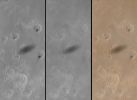
Martian_Eclipse-moc2_msss_3shadow100-01.jpgMOC Views of Martian Solar Eclipses (Original NASA/MGS/MSSS - Natural Color Frame)148 visiteThis picture shows wide angle red (left), blue (middle) and color composite (right) views of the shadow of Phobos (elliptical feature at center of each frame) as it was cast upon western Xanthe Terra on August 26, 1999, at about 2 p.m. local time on Mars. The image covers an area about 250 Km (155 miles) across and is illuminated from the left. The meandering Nanedi Valles is visible in the lower right corner of the scene. Note the dark spots on three crater floors - these appear dark in the red camera image (left) but are barely distingished in the blue image (middle), while the shadow is dark in both images. The spots on the crater floors are probably small fields of dark sand dunes.
|
|

Volcanoes-Olympus_Mons-PCF-LXTT-2.jpgOlympus Mons, from MGS (Natural Colors; credits: NASA & Lunar Explorer Italia)148 visitenessun commentoMareKromium
|
|

Acidalia_Planitia-Unusual_Landforms-M0300102-PCF-LXTT-02.jpgUnusual Landforms in Acidalia Planitia (EDM n.2 - Enhanced Absolute Natural Colors; credits for the additional process. and color.: Dr Paolo C. Fienga - Lunexit Team)148 visitenessun commentoMareKromium
|
|

Volcanoes-Olympus_Mons_and_Tharsis_Region.jpgTharsis Region (Natural Colors; credits: NASA/MGS/MSSS)147 visite"Mars Global Surveyor's camera, MOC, provided this hemispheric view of the northern Tharsis region on June 1, 1998. This picture shows the giant volcano, Olympus Mons, and one of the Tharsis Montes volcanoes, Ascraeus Mons. Another volcano, Alba Patera, is lurking under the haze and clouds at the top of the image. Olympus Mons is about 550 Km wide.
The Terminator - such as the line that divides night and day - was located west of Olympus Mons (left part of the image). It is Winter in the northern hemisphere of Mars and the high latitudes (i.e.: north of Olympus Mons in this picture) exhibit clouds and haze. These clouds most likely contain water ice".
Non possiamo non notare l'enfasi che viene spesso posta, in sede di commento originale alle immagini, sul fatto che le nuvole Marziane "MOLTO PROBABILMENTE" (ossia "QUASI CERTAMENTE") contengono ACQUA.
E allora noi rivolgiamo alla NASA - ancora - la stessa domanda: ma siamo certi che su Marte non piove da qualche milione di anni?
Risposta? Silenzio totale
|
|
| 512 immagini su 43 pagina(e) |
 |
|
|
|
|
12 | |
|
|
|
|








