| Piú viste - Mars through the Viking Orbiters |
![vo1_840a16[1]-PCF-LXTT.jpg](albums/userpics/10060/small_vo1_840a16%5B1%5D-PCF-LXTT.jpg "Nome del file=vo1_840a16[1]-PCF-LXTT.jpg
Dimensione del file=36KiB
Dimensioni=1085x969
Aggiunta il=Giu 29, 2011")
vo1_840a16[1]-PCF-LXTT.jpgFrame Viking Orbiter 1 n. 840a16 (Natural Colors; credits for the additional process. and color.: Dr Paolo C. Fienga - Lunexit Team)103 visitenessun commentoMareKromium
|
|
![vo2_421b64[1]-PCF-LXTT.jpg](albums/userpics/10060/small_vo2_421b64%5B1%5D-PCF-LXTT.jpg "Nome del file=vo2_421b64[1]-PCF-LXTT.jpg
Dimensione del file=665KiB
Dimensioni=2029x2201
Aggiunta il=Giu 29, 2011")
vo2_421b64[1]-PCF-LXTT.jpgFrame Viking Orbiter 2 n. 421b64 (Natural Colors; credits for the additional process. and color.: Dr Paolo C. Fienga - Lunexit Team)103 visiteCaption NASA originale:"Viking 2 Orbiter image of an area near the South Pole of Mars given the name Inca City. This semi-rectangular grid is probably the result of wind deflation of deposits revealing the underlying gridded terrain. The individual square cells are about 4 to 5 Km across. A large ice deposit can be seen towards the South Pole of Mars. MareKromium
|
|
![vo1_056a12[1]-PCF-LXTT.jpg](albums/userpics/10060/small_vo1_056a12%5B1%5D-PCF-LXTT.jpg "Nome del file=vo1_056a12[1]-PCF-LXTT.jpg
Dimensione del file=213KiB
Dimensioni=970x1080
Aggiunta il=Giu 29, 2011")
vo1_056a12[1]-PCF-LXTT.jpgFrame Viking Orbiter 1 n. 056a12 (Enhanced Natural Colors; credits for the additional process. and color.: Dr Paolo C. Fienga - Lunexit Team)99 visitenessun commentoMareKromium
|
|

vo1_00437-00.jpgSunrise over Mars (Extremely Enhanced Natural Colors; credits for the additional process. and color.: Dr Paolo C. Fienga - Lunexit Team)72 visiteDal bellissimo Sito di Keith Laney (http://keithlaney.net/) - che Vi suggeriamo di andare a visitare - un'immagine conosciuta, "datata" (siamo ai tempi del Viking Orbiter 2), ma pur sempre affascinante: nuvole stratiformi (o nebbie?!?) di ghiaccio d'acqua che assumono, grazie ai raggi del Sole che sta appena sorgendo, riflessi celesti, azzurrini e verdi.
Una splendida immagine: e non si può dire nulla di più.MareKromium
|
|
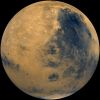
vom_mg01s306.jpgMars: according to Viking 2 Orbiter66 visite
|
|

vom_mg04s341.jpgMars: according to Viking 2 Orbiter66 visite
|
|
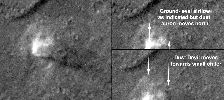
vo1_755A10_and_755A11.gifDust Devil in Syria Planum (GIF-Movie)66 visiteCaption NASA:"On 1 August 1978, the two cameras of the Viking 1 Orbiter's Imaging System acquired overlapping pictures of a Region in between Syria and Sinai Planum that showed a light-toned columnar feature casting a shadow toward the South-East (lower right). The two images, 755A10 and 755A11, were obtained just 15" apart from each other.
During that time, the bright feature and its shadow changed. The feature was a Dust Devil, and the Viking cameras caught it in motion.
Nearly three decades later, the MGS-MOC acquired an image on 22 March 2005 of the area, with the ephemeral Dust Devil long, long gone. During the 15" interval between the two Viking 1 images, the Dust Devil moved toward the North-East (upper right) at a rate of about 18 mt (about 59 feet) per second. Sunlight illuminates all of the images from the upper left; North is up".MareKromium
|
|
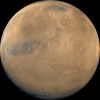
vo1_mg12n190.jpgMars: according to Viking 1 Orbiter65 visite
|
|

vo1_mf31s343.jpgMars: according to Viking 1 Orbiter64 visite
|
|
|
|
|
| 45 immagini su 4 pagina(e) |
 |
4 |
|








