| Piú viste - Mars through the Viking Orbiters |
![vo1_738a27[1]-PCF-LXTT.jpg](albums/userpics/10060/small_vo1_738a27%5B1%5D-PCF-LXTT.jpg "Nome del file=vo1_738a27[1]-PCF-LXTT.jpg
Dimensione del file=284KiB
Dimensioni=1823x2000
Aggiunta il=Giu 12, 2011")
vo1_738a27[1]-PCF-LXTT.jpgFrame Viking Orbiter 1 n. 738a27 (Natural Colors; credits for the additional process. and color.: Dr Paolo C. Fienga - Lunexit Team)608 visitenessun commentoMareKromium
|
|
![vo2_065b74[1]-PCF-LXTT.jpg](albums/userpics/10060/small_vo2_065b74%5B1%5D-PCF-LXTT.jpg "Nome del file=vo2_065b74[1]-PCF-LXTT.jpg
Dimensione del file=378KiB
Dimensioni=2200x2029
Aggiunta il=Giu 15, 2011")
vo2_065b74[1]-PCF-LXTT.jpgFrame Viking Orbiter 2 n. 065b74 (Natural Colors; credits for the additional process. and color.: Dr Paolo C. Fienga - Lunexit Team)342 visitenessun commentoMareKromium
|
|
![vo1_225a13[1]-PCF-LXTT.jpg](albums/userpics/10060/small_vo1_225a13%5B1%5D-PCF-LXTT.jpg "Nome del file=vo1_225a13[1]-PCF-LXTT.jpg
Dimensione del file=223KiB
Dimensioni=1770x1579
Aggiunta il=Giu 18, 2011")
vo1_225a13[1]-PCF-LXTT.jpgFrame Viking Orbiter 1 n. 225a13 (Natural Colors; credits for the additional process. and color.: Dr Paolo C. Fienga - Lunexit Team)261 visitenessun commentoMareKromium
|
|
![vo1_057a45[1]-PCF-LXTT.jpg](albums/userpics/10060/small_vo1_057a45%5B1%5D-PCF-LXTT.jpg "Nome del file=vo1_057a45[1]-PCF-LXTT.jpg
Dimensione del file=91KiB
Dimensioni=1065x987
Aggiunta il=Giu 10, 2011")
vo1_057a45[1]-PCF-LXTT.jpgFrame Viking Orbiter 1 n. 057a45 (Enhanced Natural Colors; credits for the additional process. and color.: Dr Paolo C. Fienga - Lunexit Team)238 visitenessun commentoMareKromium
|
|
![vo1_083a37[1]-PCF-LXTT.jpg](albums/userpics/10060/small_vo1_083a37%5B1%5D-PCF-LXTT.jpg "Nome del file=vo1_083a37[1]-PCF-LXTT.jpg
Dimensione del file=115KiB
Dimensioni=993x1061
Aggiunta il=Giu 10, 2011")
vo1_083a37[1]-PCF-LXTT.jpgFrame Viking Orbiter 1 n. 083a37 (Natural Colors; credits for the additional process. and color.: Dr Paolo C. Fienga - Lunexit Team)237 visitenessun commentoMareKromium
|
|
![vo2_428b61[1]-PCF-LXTT.jpg](albums/userpics/10060/small_vo2_428b61%5B1%5D-PCF-LXTT.jpg "Nome del file=vo2_428b61[1]-PCF-LXTT.jpg
Dimensione del file=54KiB
Dimensioni=1294x814
Aggiunta il=Giu 22, 2011")
vo2_428b61[1]-PCF-LXTT.jpgFrame Viking Orbiter 2 n. 428b61 (Absolute Natural Colors; credits for the additional process. and color.: Dr Paolo C. Fienga - Lunexit Team)233 visitenessun commentoMareKromium
|
|

vo2_428b60-PCF-LXTT.jpgFrame Viking Orbiter 2 n. 428b60 (Natural Colors; credits for the additional process. and color.: Dr Paolo C. Fienga - Lunexit Team)227 visitenessun commentoMareKromium
|
|

Volcanoes-Olympus_Mons.jpgImage n. 641A52 - Olympus (Enhanced Absolute Natural Colors; credits for the additional process. and color.: Dr Paolo C. Fienga - Lunexit Team) 224 visiteThis image shows the Volcano Olympus Mons. With a diameter of more than 600 Km (approx. the size of Arizona) and a height of nearly 25 Km above the surrounding Plains, Olympus it is the tallest volcano known to exist in the Solar System. When clouds are present, it is sometimes even visible above the clouds.
The relative ages of the Surface in various parts of Mars can be estimated from the number of Impact Craters present in a given area, with young regions having fewer craters than old regions. Only two Craters are visible here, indicating that Olympus Mons is young, probably the youngest Volcanic Feature on Mars. By some estimates, the most recent large volcanic eruption at Olympus Mons occurred only 25 million years ago. The oldest activity at Olympus Mons could be much older than this and would have been buried by younger Lava Flows.
The Caldera of Olympus Mons is the depression near the top center of the image. The Caldera is about 65 × 80 Km across (approx. the size of Rhode Island) and occurs near the maximum elevation of the Volcano. It formed when the Magma within the Volcano either erupted out of Vents located on the side, or temporarily drained deeper into the Planet. In either case, the removal of this Magma allowed part of the overlying Surface to collapse, producing a topographic depression that is termed as "Caldera". The overlapping series of structures in the Olympus Mons Caldera demonstrates that this Magma withdrawal occurred a number of different times.
Similar Calderas are seen on other Volcanos, both on Mars and on Earth.MareKromium
|
|
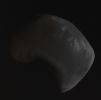
vo2_413b83-PCF-LXTT.jpgFrame Viking Orbiter 2 n. 413b83 (Natural Colors; credits for the additional process. and color.: Dr Paolo C. Fienga - Lunexit Team)223 visitenessun commentoMareKromium
|
|
![vo2_248b57[1]-PCF-LXTT.jpg](albums/userpics/10060/small_vo2_248b57%5B1%5D-PCF-LXTT.jpg "Nome del file=vo2_248b57[1]-PCF-LXTT.jpg
Dimensione del file=54KiB
Dimensioni=1130x931
Aggiunta il=Giu 20, 2011")
vo2_248b57[1]-PCF-LXTT.jpgFrame Viking Orbiter 2 n. 248b57 (Natural Colors; credits for the additional process. and color.: Dr Paolo C. Fienga - Lunexit Team)219 visitenessun commentoMareKromium
|
|

vo1_00437-01.jpgMosaic P-18114 - Noctis Labyrinthus at Dawn (Absolute Natural Colors; credits for the additional process. and color.: Dr Paolo C. Fienga - Lunexit Team)216 visiteThis image shows Early Morning Fog in the Noctis Labyrinthus Region of Mars, at the Westernmost End of the Valles Marineris Canyon System. This Fog, which is probably composed of Water Ice, is confined primarily to the low-lying Troughs, but occasionally extends over the adjacent Plateau. The Region shown here is about 300 Km across.MareKromium
|
|

vo1_057a45.jpgFrame Viking Orbiter 1 n. 057a45 (Natural Colors; credits for the additional process. and color.: Dr Paolo C. Fienga - Lunexit Team)208 visitenessun commentoMareKromium
|
|
| 45 immagini su 4 pagina(e) |
1 |
 |
|








