| Piú viste - Imagination |
The_Night_Before.jpgThe Night Before (by Roberto Tremolada)71 visitenessun commentoMareKromium
|
|

Mars Full Panorama.jpgSummer afternoon on Mars70 visite
|
|
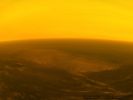
Huygens-Down-10.jpgHuygens' Descent to Titan: the Shoreline - 20 Km from the Surface (credits: R. Pascal)70 visitenessun commentoMareKromium
|
|

Enceladus-IMG003036.jpgThe Fountains of Enceladus (by Karl Kofoed)69 visiteCaption NASA:"This artist's painting of the South Polar Region of Saturn's tiny moon Enceladus shows massive jets of water ice being blasted into space. The moon's lack of atmosphere and low gravity prevents the jets from fanning out quickly as they might on a more massive world. These plumes feed the extensive E-Ring of Saturn". MareKromium
|
|
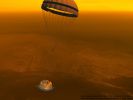
Huygens-Down-07.jpgHuygens' Descent to Titan: 30 Km from the Surface (credits: R. Pascal)69 visiteHuygens at an altitude of about 30 Km above the surface of Titan. MareKromium
|
|

Orbital_Insertion.jpgOrbital Insertion (by Roberto Tremolada)69 visitenessun commentoMareKromium
|
|

Chasma Boreale-00.JPGChasma Boreale (1)68 visiteBoth Martian Polar Caps show ragged outlines, with sinuous valleys and spiral-shaped troughs giving the Caps' edges a sawtooth outline. Scientists think the spirals develop as solar heating melts and evaporates the ice more strongly on the Equator-ward and West-facing sides of any slight depression. In time, these deepen into valleys and canyons.
The largest trough in the Northern Polar Cap is a huge canyon named Chasma Boreale. It runs into the ice cap for 570 Km (about 350 miles), making a broad valley that ends at a point called Tenuis Cavus, shown in this THEMIS image taken at visible wavelengths.
|
|

Chasma Boreale-01.JPGChasma Boreale (2)68 visiteTapering from a width of 120 Km (75 miles) at its mouth, Chasma Boreale is only about 35 Km (22 miles) wide here. The cliffs on the Northern (top) and Eastern (right) sides of the image rise about 1400 meters (4600 feet) above the base. On the inside walls of this gigantic amphitheater are stacked layers of ice, while on its floor lie a dark sheet of what is likely frozen sand and a horde of sand dunes marching down-canyon under the winds' direction.
Chasma Boreale is so dramatic a feature that it forms part of a proposed martian "Polar Park." Yet setting aside future tourist revenues, the canyon is rewarding scientists today with glimpses into the history of the martian climate.
|
|

Huygens-Down-01.jpgHuygens' Descent to Titan: 110 Km from the Surface (credits: R. Pascal)68 visiteThe haze of Titan's Atmosphere preferently scatters blue and UltraViolet light: this is the reason why the Outer Atmosphere of Titan appears blue in some Cassini images. In reality, the effect of a blue outer atmosphere on Titan may be less prominent than on this rendered image.
This was the altitude were the main parachute was jettisoned and first surface structures came into view for Huygens' cameras.MareKromium
|
|
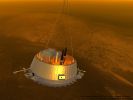
Huygens-Down-09.jpgHuygens' Descent to Titan: 20 Km from the Surface (credits: R. Pascal)68 visiteA closeup view of Huygens at an altitude of about 20 Km. MareKromium
|
|

Exoplanet.jpgExoplanet OGLE-2003-BLG-235L/MOA-2003-BLG-53L67 visiteNASA's Hubble Space Telescope has for the first time identified the parent star of a distant planet (system name OGLE-2003-BLG-235L/MOA-2003-BLG-53L) discovered in 2003 through ground-based gravitational microlensing. Gravitational microlensing occurs when a foreground star amplifies the light of a background star that momentarily aligns with it. Follow-up observations by HST in 2005 separated the light of the slightly offset foreground star from the background star. This allowed the host star to be identified as a red dwarf star located 19.000 LY away. The HST observations allow for the planet's mass and the orbit from its parent red star to be determined.
In this artist's concept, the rings and moon around the gas giant are hypothetical, but plausible, given the nature of the family of gas giant planets in our Solar System.
|
|
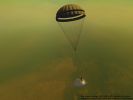
Huygens-Down-04.jpgHuygens' Descent to Titan: 85 Km from the Surface (credits: R. Pascal)67 visiteAltitude: about 85 Km and still nearly two hours of descent are separating Huygens from the Surface of Titan.MareKromium
|
|
| 93 immagini su 8 pagina(e) |
 |
|
|
|
|
7 |
|








