| Piú viste - Imagination |

Exo-Planet_STEEL.pngSteel: exo-planet LTT9779 b115 visitenessun commentoMareKromium
|
|

Gandal.jpgEternal Vigilance... (by Giorgio Picciau - Uforobots.net & c4dteam 2010)114 visite"...Eternal Vigilance is the Price of Liberty..."
Thomas JeffersonMareKromium
|
|

Eccentricity_zero.pngEccentricity Zero (Almost Circular Orbit)110 visiteFor those who want to learn something...MareKromium
|
|
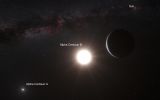
Alpha_Centauri_A_e_B.jpgThe Alpha Centauri Star-System (Artistic Impression)109 visiteNice, but unrealistic (but that's ok: it is only Imagination...)MareKromium
|
|

Titan-PIA16634-Fantasy.jpgOn the Surface of Titan...108 visiteCaption NASA:"This artist's concept envisions what Hydrocarbon Ice forming on a liquid Hydrocarbon Sea of Saturn's moon Titan might look like. A new model from scientists on NASA's Cassini mission suggests that clumps of Methane-and-Ethane-rich ice -- shown here as the lighter-colored clusters -- could float under some conditions".MareKromium
|
|

Titan-Malaska.jpgTitan's Fly-Over (by Mike Malaska)106 visiteQuesta "Visione" di Titano, da circa 150 Km di altitudine, per quanto è bella e suggestiva, tanto è - purtroppo e concettualmente - sbagliata. A nostro parere.
Perchè? Da quale punto di vista?
Dal "solito": quello dell'illuminazione.
Questa "veduta", infatti, può essere ragionevolissima per la Terra (chessò, pensiamo al Mojave Desert, oppure alla Monument Valley); può essere ragionevole per Marte (e qui diremmo che si può pensare ed immaginare la Regione Equatoriale della Vallis Marineris Canyon System), ma per Titano, ad oltre un miliardo di Km dal Sole...
Peccato. Bel Lavoro Mike, ma hai cercato di "gratificare" troppo la NASA (solo "loro", infatti, ci propongono Titano con illuminazione simil-Terrestre) e, come sempre accade in questi casi, il risultato finale è tanto bello, quanto irrealistico.
Try again!MareKromium
|
|
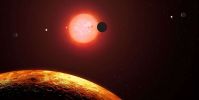
AAPnV17.jpgGW Orionis106 visiteSic itur ad astra.
Publio Virgilio MaroneMareKromium
|
|

Visitor.jpgVisitors from beyond...101 visitenessun commentoMareKromium
|
|

The_Teapot.jpgDo you see?!?100 visiteSure, you can see the 2D rectangle of colours, but can you see deeper? Counting colour patches in the featured image, you might estimate that the most information that this 2D digital image can hold is about 60 (horizontal) x 50(vertical) x 256 (possible colours) = 768,000 bits. However, the yet-unproven Holographic Principle states that, counter-intuitively, the information in a 2D panel can include all of the information in a 3D room that can be enclosed by the panel. The principle derives from the idea that the Planck length, the length scale where quantum mechanics begins to dominate classical gravity, is one side of an area that can hold only about one bit of information. The limit was first postulated by physicist Gerard 't Hooft in 1993. It can arise from generalizations from seemingly distant speculation that the information held by a black hole is determined not by its enclosed volume but by the surface area of its event horizon. The term "holographic" arises from a hologram analogy where three-dimension images are created by projecting light through a flat screen. Beware, some people staring at the featured image may not think it encodes just 768,000 bits - nor even 2563,000 bit permutations - rather they might claim it encodes a three-dimensional teapot. MareKromium
|
|

Tempe_Terra-DE-PCF-LXTT-IPF.jpgThe Last Days of Mars: Tempe Terra Region (Credits: Don Edwards and Paolo C. Fienga)96 visiteDear Friends of Lunar Explorer Italia and the Italian Planetary Foundation,
starting from January, 13th, 2014, we have decided to submit to your careful attention and consideration, 5 (five) "Martian Fantasies" which, in our opinion, may give you an idea about how Mars could have looked like near the end of its "Life" (as we know it, of course). We imagined the existence of some residual Wet-Lands (for instance, a few Lakes with some small River nearby), and a little Vegetation, located just in their immediate proximities.
And then ... a boundless Desert. In other words, only a few "Oasis of Life", made of residual Waters and a minimal Local Vegetation, and both completely surrounded by the yellow and orange Sands of a Desert which, in a (we believe, relatively) short amount of time, would have covered the entire Planet, and turned it into what we can see today.
This "Computer-made Reconstruction" shows you a portion of Tempe Terra, in a time that, as you can see, was VERY close to the complete desertification of the entire Region.
Note: for a better understanding of what we have been trying to show you here, please consider that in the locations where the color of the Residual Waters tends towards the green and a very light blue, it means that said Residual Waters are already very shallow; on the other hand, the darker the color of the Residual Waters gets, then the greater is their actual depth.
Please, some feedback on your side will be deeply appreciated and, therefore, do not hesitate to write to us and let us know what you think of these "Fantasies" which we have decided to entitle "The Last Days of Mars".
Thanks and enjoy!
Dr Paolo C. Fienga (PhD) - E-mail: alphacentauri@intercom.itMareKromium
|
|

Tharsis_Region-PCF-LXTT-IPF-1.jpgThe Last Days of Mars: Tharsis Region (Credits: Don Edwards and Paolo C. Fienga)94 visiteDear Friends of Lunar Explorer Italia and the Italian Planetary Foundation,
starting from January, 13th, 2014, we have decided to submit to your careful attention and consideration, 5 (five) "Martian Fantasies" which, in our opinion, may give you an idea about how Mars could have looked like near the end of its "Life" (as we know it, of course). We imagined the existence of some residual Wet-Lands (for instance, a few Lakes with some small River nearby), and a little Vegetation, located just in their immediate proximities.
And then ... a boundless Desert. In other words, only a few "Oasis of Life", made of residual Waters and a minimal Local Vegetation, and both completely surrounded by the yellow and orange Sands of a Desert which, in a (we believe, relatively) short amount of time, would have covered the entire Planet, and turned it into what we can see today.
This "Computer-made Reconstruction" shows you a portion of the Tharsis Region, and - precisely - an area located to the South of the huge Shield-Volcano known as Olympus Mons.
Note: for a better understanding of what we have been trying to show you here, please consider that in the locations where the color of the Residual Waters tends towards the green and a very light blue, it means that said Residual Waters are already very shallow; on the other hand, the darker the color of the Residual Waters gets, then the greater is their actual depth.
Please, some feedback on your side will be deeply appreciated and, therefore, do not hesitate to write to us and let us know what you think of these "Fantasies" which we have decided to entitle "The Last Days of Mars".
Thanks and enjoy!
Dr Paolo C. Fienga (PhD) - E-mail: alphacentauri@intercom.itMareKromium
|
|

XX-Energy.jpgPlay again!93 visiteSolito "Gioco Ottico". Quello che si vede è fermo e "noi" ci illudiamo di vederlo in moto, o vice-versa? Enjoy!...MareKromium
|
|
| 93 immagini su 8 pagina(e) |
 |
|
4 | |
|
|
|








